



الصفحة 1
الصفحة 1

International Trade and Multinational Activity : Heterogeneity of Firms, Incentives for Foreign Direct Investment, and International Business Cycle Dynamics
During the last 25 year, the neoclassical Heckscher-Ohlin trade theory has been extended to the ‘new’ trade theory by including imperfect competition and fixed costs into the analysis of trade relations. Furthermore, these micro-oriented trade models are increasingly used to analyze macro-oriented questions. Chapter 2 of this study investigates the dynamic welfare effects of exposure to trade in a new trade model, which is extended by firm heterogeneity.

International Impacts on Social Policy : Short Histories in Global Perspective
This book consists of 39 short essays that exemplify how interactions between inter- and trans-national interdependencies and domestic factors have shaped the dynamics of social policy in various parts of the world at different points in time. Each chapter highlights a specific type of interdependence which has been identified to provide us with a nuanced understanding of specific social policy developments at discrete points in history. The volume is divided into four parts that are concerned with a particular type of cross-border interrelation. The four parts examine the impact on social policy of trade relations and economic crises, violence, international organisations and cross-border communication and migration.

Global history with Chinese characteristics : Autocratic States along the Silk Road in the decline of the Spanish and Qing Empires 1680-1796
This book examines perceptions and dialogues between China and Europe by analysing strategic geopolitical sites which fostered commerce, consumption and socioeconomic networks between China and Europe through a particular case study: Macau, connecting with South China, and Marseille in Mediterranean Europe from 1680 to 1800
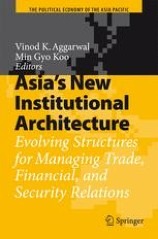
Asias New Institutional Architecture : Evolving Structures for Managing Trade, Financial, and Security Relations
This book investigates the origins and evolution of Asia’s new institutional architecture in trade, finance, and security from both a theoretical and empirical perspective. The traditional institutional equilibrium in Asia has come under heavy strain in the "post triple shocks period" - the post-Cold War, the post-financial crisis of 1997-98, and the post-9-11 attacks. The new dynamics of rivalry and cooperation among states at both the intraregional and transregional levels is now shaping a new institutional architecture. Political and business leaders from Northeast and Southeast Asia interact with each other more frequently. South Asia’s participation in the rest of Asia in recent years is truly impressive. As we show, the future institutional trajectory of Asia is still open, but we believe that the book provides a timely examination of key shifts in the region. In doing so, our hope is to provide policymakers and analysts with an institutional road map for the future.
