



الصفحة 1
الصفحة 1

Nuclear Condensed Matter Physics with Synchrotron : Basic Principles, Methodology and Applications
This book provides a comprehensive introduction to the growing field of nuclear condensed matter physics with synchrotron radiation, a technique which finds numerous applications in fields such as magnetism, physics of surfaces and interfaces, lattice dynamics and more. Due to the enormous brilliance of modern synchrotron radiation sources, the method is particularly suited for the investigation of low-dimensional structures such as thin films and nanoparticles. The use of isotopic probe layers, for example, allows one to determine magnetic and vibrational properties with very high spatial resolution; focusing techniques and x-ray interference effects lead to a very high sensitivity for smallest amounts of material. The book is written on an introductory level with many examples employed to illustrate the special experimental possibilities.

NonlinearWaves and Solitons on Contours and Closed Surfaces
The present volume is an introduction to nonlinear waves and soliton theory in the special environment of compact spaces such a closed curves and surfaces and other domain contours. It assumes familiarity with basic soliton theory and nonlinear dynamical systems.

Nanotechnology for Microfluidics
The book focuses on microfluidics with applications in nanotechnology. The first part summarizes the recent advances and achievements in the field of microfluidic technology, with emphasize on the the influence of nanotechnology. The second part introduces various applications of microfluidics in nanotechnology, such as drug delivery, tissue engineering and biomedical diagnosis.

Nanoinformatics
Brings out the state of the art on how informatics-based tools are used and expected to be used in nanomaterials research. There has been great progress in the area in which “big-data” generated by experiments or computations are fully utilized to accelerate discovery of new materials, key factors, and design rules. Data-intensive approaches play indispensable roles in advanced materials characterization. "Materials informatics" is the central paradigm in the new trend. "Nanoinformatics" is its essential subset, which focuses on nanostructures of materials such as surfaces, interfaces, dopants, and point defects, playing a critical role in determining materials properties. There have been significant advances in experimental and computational techniques to characterize individual atoms in nanostructures and to gain quantitative information. The collaboration of researchers in materials science and information science is growing actively and is creating a new trend in materials science and engineering.

Nano- and Micromaterials
The future focus of nanotechnology will be on realizing new functions over greater scales. This book describes the creation of nano- and microscale structures and functions by controlling temperature, light, pressure, or carrier injections. It covers novel nano-integration technologies such as quantum-well devices possilbe by utilizing, for example, the self-organization of surface nanostructures and optically or pressure-induced phase transitions, micro machines using microstereolithography, as well as new techniques of laser spectroscopy and new computational methods for estimating atomic and electronic structures and their functions on the nano- and microscales.

Multiscale Dissipative Mechanisms and Hierarchical Surfaces : Friction, Superhydrophobicity, and Biomimetics
Multiscale Dissipative Mechanisms and Hierarchical Surfaces covers the rapidly developing topics of hierarchical surfaces, roughness-induced superhydrophobicity and biomimetic surfaces. The research in these topics has been progressing rapidly in the recent years due to the advances in the nanosciences and surfaces science and due to potential applications in nanotechnology. The first in its field, this monograph provides a comprehensive review of these subject and presents the background introduction as well as recent and new results in the area.

Multi-body Dynamic Modeling of Multi-legged Robots
This book describes the development of an integrated approach for generating the path and gait of realistic hexapod robotic systems. It discusses in detail locomation with straight-ahead, crab and turning motion capabilities in varying terrains, like sloping surfaces, staircases, and various user-defined rough terrains. It also presents computer simulations and validation using Virtual Prototyping (VP) tools and real-world experiments.

Morphological Models of Random Structures
This book covers methods of Mathematical Morphology to model and simulate random sets and functions (scalar and multivariate). The introduced models concern many physical situations in heterogeneous media, where a probabilistic approach is required, like fracture statistics of materials, scaling up of permeability in porous media, electron microscopy images (including multispectral images), rough surfaces, multi-component composites, biological tissues, textures for image coding and synthesis. The common feature of these random structures is their domain of definition in n dimensions, requiring more general models than standard Stochastic Processes.The main topics of the book cover an introduction to the theory of random sets, random space tessellations, Boolean random sets and functions, space-time random sets and functions (Dead Leaves, Sequential Alternate models, Reaction-Diffusion), prediction of effective properties of random media, and probabilistic fracture theories.

Mediterranean Land-surface Processes Assessed from Space
1. 1 Space View and Ground Observations 1 1. 2 Mediterranean Climatic Environment 2 1. 3 Processes at Surfaces 10 1. 3. 1 Deforestation and Land-use Changes 10 1. 3. 2 Water Related Problems 16 1. 3. 3 Fire, Grazing, and Land Degradation 19 1. 3. 4 Drought, Floods, Frost, and Desertification 21 1. 3. 5 Coupling Between Surface and Atmosphere: The Role of the Atmospheric Boundary Layer 25 1. 4 Role and Capabilities of Measurements Made From Space 30 1. 4. 1 Research Programmes 30 1. 4. 2 Expected Information 32 1. 4. 3 Research Strategy 33 1. 4. 4 Observation of Changes in Heterogeneous Landscapes: Spatial and Temporal Scales 35 1. 4. 5 Land-surface Change Indicators Observable from Space 36 Spectral Characteristics of Vegetation and Soils (36); Responses of Remote Sensing Signals to Changes of Land-surface Properties (40) 1. 5 About this Book 48 Chapter 2 Processing and Archiving of Satellite and Ancillary Data 51 2. 1 Introduction 51 2. 2 The Remote Sensing Data Base 55 2. 2. 1 Satellite Instruments 55 The NOAA Observing System (55); Meteosat (57); Nimbus-7 (59); Landsat (59); SPOT (61); DMSP (62); ERS-1 and ERS-2 (62); TRMM (63); Terra (64); Envisat (65); Aqua (66) 2. 2. 2 Aircraft Instruments 66 The Use of Aircraft for Land-surface Process Studies (66); AVIRIS (67); TMS (68); AIRSAR (68); DIAL (69) 2. 3 Reception, Acquisition and Availability of Satellite Data 70 2. 3.

Medical Applications of Colloids
This volume collects chapters dealing with significant topics in colloids and surfaces relevant to medical applications. The book will be of interest to scientists and practitioners in areas as diverse as medical diagnostics, drug formulations, X-ray photoelectron spectroscopy of biomaterials, and particle transport in human airways.

Mathematics of Surfaces XII ; 12th IMA International Conference, Sheffield, UK, September 4-6, 2007, Proceedings
This book constitutes the refereed proceedings of the 12th IMA International Conference on the Mathematics of Surfaces, held in Sheffield, UK in September 2007. The papers cover a range of ideas from underlying theoretical tools to industrial uses of surfaces.
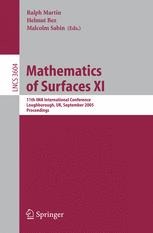
Mathematics of Surfaces XI ; 11th IMA International Conference, Loughborough, UK, September 5-7, 2005, Proceedings
Constitutes the refereed proceedings of the 11th IMA International Conference on the Mathematics of Surfaces, held in Loughborough, UK in September 2005. Among the topics addressed are Voronoi diagrams, linear systems, curvatures on meshes, approximate parameterization, condition numbers, pythagorean hodographs, and more.

Ionic Soft Matter : Modern Trends in Theory and Applications; Proceedings of the NATO Advanced Research Workshop on Ionic Soft Matter: Modern Trends in Theory and Application Lviv, Ukraine, 14-17 April, 2004
Consists of reviews of the experimental, theoretical and simulation studies on ionic criticality, polyelectrolytes, proton transport in fuel cell membranes, and the design of DNA arrays. This book deals with discussions of the fundamental and applied problems of important phenomena such as ion association, ion adsorption, ion solvation.

Introduction to Soliton Theory : Applications to Mechanics
This monograph provides the application of soliton theory to solve certain problems selected from the fields of mechanics. The present monograph is not a simple translation of its predecessor appeared in Publishing House of the Romanian Academy in 2002. Improvements outline the way in which the soliton theory is applied to solve some engineering problems. The book addresses concrete resolution methods of certain problems such as the motion of thin elastic rod, vibrations of initial deformed thin elastic rod, the coupled pendulum oscillations, dynamics of left ventricle, transient flow of blood in arteries, the subharmonic waves generation in a piezoelectric plate with Cantor-like structure, and some problems related to Tzitzeica surfaces. This comprehensive study enables the readers to make connections between the soliton physical phenomenon and some partical, engineering problems.

Intersections de deux quadriques et pinceaux de courbes de genre 1 = Intersections of two quadrics and pencils of curves of genus 1
This research monograph focuses on the arithmetic, over number fields, of surfaces fibred into curves of genus 1 over the projective line, and of intersections of two quadrics in projective space. The first half contains a complete account of the technique initiated by Swinnerton-Dyer in 1993 for studying rational points on pencils of curves of genus 1, while incorporating and generalising most of its subsequent refinements. The second half, which builds upon the first, is devoted to quartic del Pezzo surfaces and higher-dimensional intersections of two quadrics.

Interior Surfaces and Materials : Aesthetics, Technology, Implementation
Provides detailed and specific information on the use of appropriate materials in interior design. The book leads off with an overview of the range of available products for interior design, including large-format photographs of each material and interiors that use them. This is followed by detailed discussions of relevant aspects and production methods of the individual material groups, including selected examples. The processing of the materials is illustrated by production photographs from the construction site and numerous detail drawings. In the accompanying texts, expert planners who specialize in the various materials share their practical knowledge of how to use them.

Interior Spaces : Space, Light, Materials
Space, light and material: from the meditative ambiance of a chapel or synagogue to the colourful, organic forms of fashion boutiques, the design of an interior space - composed of lighting, the surfaces, textures and colours of materials, finishing and features - creates atmosphere and lends specific character. The growing willingness on the part of designers in recent years to experiment with colours, materials and spatial concepts is demonstrated in the range and diversity of international examples presented in this, the third volume in the series "In Detail". All plans and drawings of interiors and furnishings have been carefully researched and drawn by the staff of DETAIL.

Interface oral health science 2014 : Innovative research on biosis-abiosis intelligent interface
The Tohoku University Graduate School of Dentistry first introduced the concept of “Interface Oral Health Science”, designed to establish and maintain healthy oral cavities, which are home to a number of mixed systems. Included in those systems are: (1) host tissues such as teeth, mucosa, muscle and bone, (2) parasites and microorganisms cohabiting the surfaces of the oral cavity, and (3) biomaterials that are used for the rehabilitation of oral functions. In addition, (4) these systems are subject to severe and complex mechanical forces. Therefore, it is critical to promote dental studies that integrate a wide range of interdisciplinary research as medicine, agriculture, material science, engineering, and pharmacology.

Integral Foam Molding of Light Metals : Technology, Foam Physics and Foam Simulation
This book shows in three parts the technology, the fundamentals and the simulation models for the Integral Foam Molding of Light Metals Part I: “Technology” shows for the first time that foaming of metals is possible by applying molding techniques very similar to polymer integral foam molding. Part II: “Physics” is devoted to the physics of foaming with special emphasis on the very short time scale which is characteristic for integral foam molding. Part III: “Numerical Simulation” presents a new lattice Boltzmann approach for the treatment of free surfaces is developed and applied on foam evolution problems. For the first time, the numerical simulation of foam evolution starting from nucleation until decay is accessible.

Innovative Superhard Materials and Sustainable Coatings for Advanced Manufacturing ; Proceedings of the NATO Advanced Research Workshop on Innovative Superhard Materials and Sustainable Coating, Kiev, Ukraine,12 - 15 May 2004.
Modern industry imposes ever increasing requirements upon tools and tool materials as to the provision for performance under the conditions of high cutting speeds and dynamic loads as well as under intensive thermal and chemical interactions with workpiece materials. The industry demands a higher productivity in combination with the accuracy of geometry and dimensions of workpieces and quality of working surfaces of the machined pieces. These requirements are best met by the tool superhard materials (diamond and diamond-like cubic boron nitride). Ceramics based on silicon carbide, aluminum and boron oxides as well as on titanium, silicon and aluminum nitrides offer promise as tool materials. Tungsten-containing cemented carbides are still considered as suitable tool materials. Hi- hardness and high strength composites based on the above materials fit all the requirements imposed by machining jobs when manufacturing elements of machinery, in particular those operating under the extreme conditions of high temperatures and loads.
