



الصفحة 1
الصفحة 1

Ultimate Limit-State Design of Concrete Structures : A new approach
Structural concrete members often show great deviation in structural performance from that predicted by the current code of practice. In certain cases the predications considerably underestimate the capabilities of a structure or member, while in others the predictions are unsafe as they overestimate the member's ability to perform in a prescribed manner. Clearly, a rational and unified design methodology is still lacking for structural concrete. This book presents a simplified methodology based on calculations which are quick, easily programmable and no more complex than those required by the current codes.

Structural concrete : Theory and design
Covers the historical background of structural concrete; advantages and disadvantages; codes and practice; and design philosophy and concepts. It then launches into a discussion of the properties of reinforced concrete, and continues with chapters on flexural analysis and design; deflection and control of cracking; development length of reinforcing bars; designing with the strut-and-tie method; one-way slabs; axially loaded columns; and more.

Optimization aided design : Reinforced concrete
Presents innovative optimization aided design methods for concrete structures. Mathematical optimization is applied to practical problems of structural concrete at each level: from external, through internal structure identification to cross-section design. It is shown how to design resource-efficient structures following the flux of forces, how to optimally adapt reinforcement layouts to the internal force flow, and how to efficiently cope with demanding cross-sectional design tasks such as biaxial bending.

Fibre reinforced concrete : Improvements and innovations II : X rILEM-fib international symposium on fibre reinforced concrete (BEFIB) 2021
Highlights the latest advances, innovations, and applications in the field of fibre-reinforced concrete (FRC). It discusses a diverse range of topics concerning FRC: technological aspects, nanotechnologies related with FRC, mechanical properties, long-term properties, analytical and numerical models, structural design, codes and standards, quality control, case studies, Textile-Reinforced Concrete, Geopolymers.
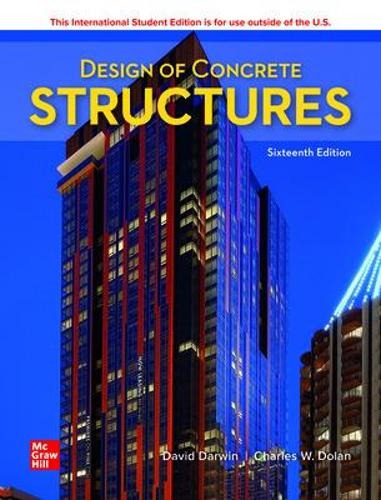
Design of Concrete Structures
Presents the basic mechanics of structural concrete and methods for the design of individual members subjected to bending, shear, torsion, and axial forces. It additionally addresses in detail applications of the various types of structural members and systems, including an extensive presentation of slabs, beams, columns, walls, footings, retaining walls, and the integration of building systems

Computational Structural Concrete : Theory and Applications
Concrete is by far the most used building material due to its advantages: it is shapeable, cost-effective and available everywhere. Combined with reinforcement it provides an immense bandwidth of properties and may be customized for a huge range of purposes. Thus, concrete is the building material of the 20th century. To be the building material of the 21th century its sustainability has to move into focus. Reinforced concrete structures have to be designed expending less material whereby their load carrying potential has to be fully utilized.
