



الصفحة 1
الصفحة 1

Human origins and environmental backgrounds
Human Origins and Environmental Backgrounds is a benchmark compendium of research that presents itself at a major paradigm shift in paleoanthropology. The editors offer a variety of theoretical approaches to puzzles on the place of the Hominidae, particularly Homo sapiens, among the Primates, including our unique bipedal positional behavior and social structure and the selective factors that might have been involved in our evolution in the broad context of Miocene and later environments. The contributors represent several generations of pioneering laboratory and field researchers from Japan, France and the United States, who have worked together over the past 40 years and who have trained future leaders in evolutionary anthropology and experimental primatology. This volume, compiled by the leading experts in the field, explores the interface between hominid origins and palaeoenvironments.

Geological atlas of Africa : With notes on stratigraphy, tectonics, economic geology, geohazards, geosites and geoscientific education of each country
Here is the new edition of the first attempt to summarize the geology of Africa by presenting it in an atlas and to synthesize the stratigraphy, tectonics, economic geology, geohazards and geosites of each country and territory of the continent. Furthermore, the digitized geological maps are correlated and harmonized according to the current stratigraphic timetable. The atlas aims to contribute to capacity building in African Earth Sciences and to aid the initiation of research and enable the achievement of economic opportunities by providing a database of basic geological background information.
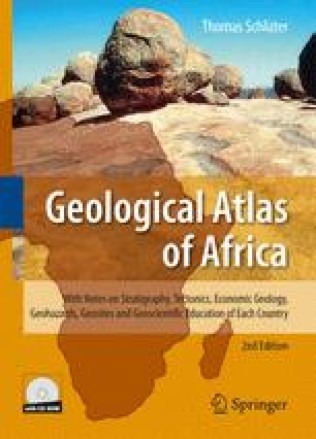
Geological atlas of Africa : With notes on stratigraphy, tectonics, economic geology, geohazards, geosites and geoscientific education of each country
T is atlas is intended primarily for anybody who is in-some background for the arrangement of how the terested in basic geology of Africa. Its originality lies atlas was done. T e second chapter is devoted to the in the fact that the regional geology of each African history of geological mapping in Africa, necessary nation or territory is reviewed country-wise by maps for a fuller appreciation of why this work in Africa is and text, a view normally not presented in textbooks worth doing. Chapter 3 provides an executive s- of regional geology. It is my belief, that there has long mary on the stratigraphy and tectonics of Africa as a been a need in universities and geological surveys, whole, i. e. in the context of no political boundaries.

Evolutionary Stasis and Change in the Dominican Republic Neogene
In practice, however, science is no less susceptible to fads, culture shifts, and pendulum swings than any other realm of human endeavor. This is an especially important feature of science to keep in mind in the present climate of shrinking government funding (at least in prop- tion to the demand) and the resulting susceptibility of individual scientists and entire disciplines to being influenced by the changing priorities of funding agencies (even if, as such agencies maintain, those priorities come ultimately “from the c- munity”). The present volume is in several important respects a testimonial to both the threats and opportunities that such scientific culture swings pose, both for the individual researcher and a wider field. When scientific research in the Dominican Republic Neogene began more than a century ago, paleontology was an essentially descriptive discipline, focused mainly on finding, describing, and documenting the taxa represented in the fossil record, and (especially in invertebrate paleontology) on using these taxa for bi- tratigraphic correlation.

Continental Scientific Drilling : A Decade of Progress, and Challenges for the Future
Scientific drilling is an indispensable tool of modern Earth science - search, as it provides the only means of obtaining direct information on processes operating at depth. Drilling allows for the determination of - situ properties of solid materials and fluids and permits testing of hypot- ses and models derived from surface observations. In addition, drill holes may be used as a natural laboratory for experiments and as observatories for long-term monitoring of on-going active processes. Earth drilling, therefore, plays a critical role in scientific research directed towards - proved understanding of the workings of our planet and has a key role in solving urgent socio-economic problems. As a rule, drilling projects are an integral component of major geosci- tific research programs, comprising comprehensive pre-site investigations, accompanying laboratory studies, the drilling phase itself, and consecutive measurements and tests in the drill hole. Such drilling programs are costly and thus only realizable to a limited extent. International cost sharing, the optimal utilization of all available resources, the incorporation of inter- tional leading experts, and the application of the existing know-how, as well as the selection of an optimal drilling location (“World Geological Site”), are thus essential elements of an international scientific drilling p- gram.

Continental Evolution : The Geology of Morocco : Structure, Stratigraphy, and Tectonics of the Africa-Atlantic-Mediterranean Triple Junction
Morocco is one of the most fascinating lands in the world from the point of view of its geological structure and evolution. Our knowledge on the geology of the country has been greatly improved during the last decades, based on numerous seismic profiles and boreholes, seismological analysis of focal mechanisms, seismic tomography, gravimetric/geodetic modelling and, on the other hand, based on a big National Program of Geological Mapping including modern geochemical analyses (trace elements) and reliable isotopic datings (39Ar-40Ar, U-Pb zircon, Sm-Nd, etc). Moreover, a number of academic studies have been performed in relation with the increasing number of Moroccan universities.
Carbonate Reservoir Characterization : An Integrated Approach
One principal need in petroleum recovery from carbonate reservoirs is the description of the three-dimensional distribution of petrophysical properties in order to improve performance predictions by means of fluid-flow computer simulations. The book focuses on a rock based approach for the integration of geological, petrophysical, and geostatistical methods to construct a reservoir model suitable to input into flow simulation programs. This second edition includes a new chapter on model construction and new examples of limestone, dolostone, and touching-vug reservoir models as well as improved chapters on basic petrophysical properties, rock-fabric/petrophysical relationships, calibration of wireline logs, and sequence stratigraphy.
Applied Stratigraphy
This book aims to incorporate major aspects and essential elements underpinning the modern applications and perspectives of stratigraphy. It focuses on traditional and innovative techniques and how these can be utilized in reconstructing the geological history of sedimentary basins and in solving manifold geological problems and phenomena. Each chapter summarizes contributions by leading researchers in the field. It is hoped that this book will provide the reader with key insights into all these aspects and applications.
Antarctica : Contributions to Global Earth Sciences
Sixty articles arranged in eight thematic sections refer to most recent geological and geophysical results of Antarctic research. The Precambrian of the East Antarctic shield and its geological history is considered as well as sub-ice topography, geophysics and stratigraphy, sedimentology and geophysics of the surrounding Southern Ocean. Particular emphasis is given to the connection of the Antarctic and the surrounding continents when forming part of Gondwana.
