



الصفحة 1
الصفحة 1

Modeling Uncertainty : An Examination of Stochastic Theory, Methods, and Applications
Modeling Uncertainty: An Examination of Stochastic Theory, Methods, and Applications, is a volume undertaken by the friends and colleagues of Sid Yakowitz in his honor. Fifty internationally known scholars have collectively contributed 30 papers on modeling uncertainty to this volume. Each of these papers was carefully reviewed and in the majority of cases the original submission was revised before being accepted for publication in the book. The papers cover a great variety of topics in probability, statistics, economics, stochastic optimization, control theory, regression analysis, simulation, stochastic programming, Markov decision process, application in the HIV context, and others. There are papers with a theoretical emphasis and others that focus on applications. A number of papers survey the work in a particular area and in a few papers the authors present their personal view of a topic. It is a book with a considerable number of expository articles, which are accessible to a nonexpert - a graduate student in mathematics, statistics, engineering, and economics departments, or just anyone with some mathematical background who is interested in a preliminary exposition of a particular topic. Many of the papers present the state of the art of a specific area or represent original contributions which advance the present state of knowledge. In sum.

Interdisciplinary public health reasoning and epidemic modelling : The case of black death
This is a book about interdisciplinary public health reasoning and epidemic m- th elling, in general, and the study of the infamous 14 century AD Black Death d- aster, in particular. We focus on the intellectual context in which epidemic mod- ling takes place, in a way that accounts for the present-day interdisciplinary and multicultural trends in scientific inquiry. Like most scientific fields, public health research defines itself based on knowledge, which raises serious epistemic and cognitive issues.

Financial mathematics, derivatives and structured products
Introduces readers to the financial markets, derivatives, structured products and how the products are modelled and implemented by practitioners. In addition, it equips readers with the necessary knowledge of financial markets needed in order to work as product structurers, traders, sales or risk managers. As the book seeks to unify the derivatives modelling and the financial engineering practice in the market, it will be of interest to financial practitioners and academic researchers alike. Further, it takes a different route from the existing financial mathematics books, and will appeal to students and practitioners with or without a scientific background. The book can also be used as a textbook for the following courses: Financial Mathematics (undergraduate level) Stochastic Modelling in Finance (postgraduate level) Financial Markets and Derivatives (undergraduate level) Structured Products and Solutions (undergraduate/postgraduate level)
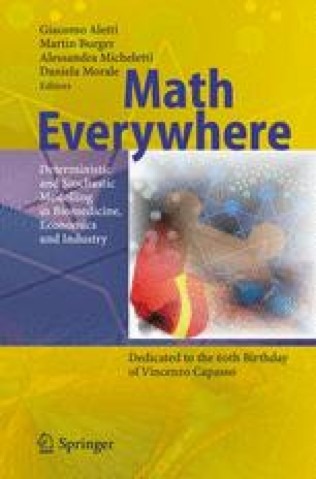
Math Everywhere : Deterministic and Stochastic Modelling in Biomedicine, Economics and Industry
These proceedings are reporting on the conference ''Math Everywhere", a successful event celebrating a leading scientist, promoting ideas he pursued and sharing the open atmosphere he is known for. The areas of the contributions are the following , Deterministic and Stochastic Systems. Mathematical Problems in Biology, Medicine and Ecology, Mathematical Problems in Industry and Economics.
An Introduction to Queueing Theory: and Matrix-Analytic Methods
The present textbook contains the recordsof a two–semester course on que- ing theory, including an introduction to matrix–analytic methods. This book provides a mathematical introduction to the theory of queuing theory and matrix-analytic methods … . The style of the text … is concise and rigorous. The proofs are presented for study. Each chapter concludes with a set of exercises inviting readers to prove supplementary results and review particular aspects of the theory. The book under review attempts to give an introduction to the theory of queues without losing contact with its applicability. … For instructors who prefer the topics covered, this book is a nice candidate as they do not need to choose the topics but only need to elaborate on them. Nevertheless, it would be a good reference book for an introductory course in queuing theory, stochastic modelling, or applied probability
