



الصفحة 1
الصفحة 1

Open Quantum Systems II : The Markovian Approach
These books present in a self-contained way the mathematical theories involved in the modeling of such phenomena. They describe physically relevant models, develop their mathematical analysis and derive their physical implications. Volume II is dedicated to the Markovian formalism of classical and quantum open systems. A complete exposition of noise theory, Markov processes and stochastic differential equations, both in the classical and the quantum context, is provided. These mathematical tools are put into perspective with physical motivations and applications.
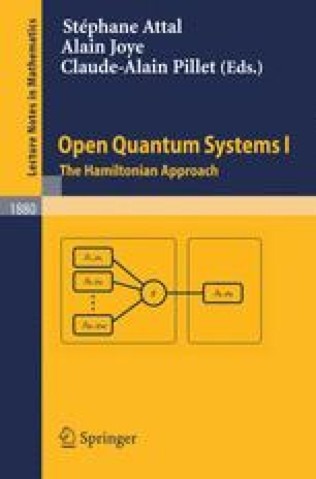
Open Quantum Systems I : The Hamiltonian Approach
These books present in a self-contained way the mathematical theories involved in the modeling of such phenomena. They describe physically relevant models, develop their mathematical analysis and derive their physical implications. This Volume, I the Hamiltonian description of quantum open systems is discussed. This includes an introduction to quantum statistical mechanics and its operator algebraic formulation, modular theory, spectral analysis and their applications to quantum dynamical systems.

Noise-Induced Transitions : Theory and Applications in Physics, Chemistry, and Biology
This classic text, an often-requested reprint, develops and explains the foundations of noise-induced processes. At its core is a self-contained, textbook-style presentation of the elements of probability theory, of the theory of Markovian diffusion processes and of the theory of stochastic differential equations, on which the modeling of fluctuating natural and artificial environments is based. Following an introduction to the mathematical tools, the occurrence and the properties of noise-induced transitions are then analyzed for rapidly fluctuating environments describable by the white-noise idealization. Subsequently, more realistic and general types of colored noises are considered. Appropriate practical methods for dealing with these situations are developed. The latter part of the book contains applications and experimental studies illustrating the many facets of noise-induced transitions. The following applications are considered in Noise-Induced Transitions: population dynamics, electrical circuits, chemical and photochemical reactions, non-linear optics, and hydrodynamical systems.
Noise-Induced Phenomena in Slow-Fast Dynamical Systems : A Sample-Paths Approach
Stochastic differential equations play an increasingly important role in modeling the dynamics of a large variety of systems in the natural sciences, and in technological applications. This book presents a new constructive approach to the quantitative description of solutions to systems of stochastic differential equations evolving on well-separated timescales. The method, which combines techniques from stochastic analysis and singular perturbation theory, allows the domains of concentration for typical sample paths to be determined, and provides precise estimates on the transition probabilities between these domains. In addition to the detailed presentation of the set-up and mathematical results, applications to problems in physics, biology, and climatology are discussed. The emphasis lies on noise-induced phenomena such as stochastic resonance, hysteresis, excitability, and the reduction of bifurcation delay.

Modeling with Itô Stochastic Differential Equations
This modeling procedure is thoroughly explained and illustrated for randomly varying systems in population biology, chemistry, physics, engineering, and finance. Introductory chapters present the fundamental concepts of random variables, stochastic processes, stochastic integration, and stochastic differential equations. These concepts are explained in a Hilbert space setting which unifies and simplifies the presentation. Computer programs, given throughout the text, are useful in solving representative stochastic problems. Analytical and computational exercises are provided in each chapter that complement the material in the text.
mODa 8 - Advances in Model-Oriented Design and Analysis ; Proceedings of the 8th International Workshop in Model-Oriented Design and Analysis held in Almagro, Spain, June 4–8, 2007
The volume contains the proceedings of the 8th Workshop on Model-Oriented Design and Analysis. This book offers leading and pioneering work on optimal experimental designs, both from a mathematical/statistical point of view and with regard to real applications. Scientists from all over the world, from Eastern and Western Europe, the USA, Latin-America, Asia and Africa, have contributed to this volume. Primary topics are designs for nonlinear models and applications to experimental medicine.

Introduction to Stochastic Integration
The theory of stochastic integration, also called the Ito calculus, has a large spectrum of applications in virtually every scientific area involving random functions, but it can be a very difficult subject for people without much mathematical background. The Ito calculus was originally motivated by the construction of Markov diffusion processes from infinitesimal generators. Previously, the construction of such processes required several steps, whereas Ito constructed these diffusion processes directly in a single step as the solutions of stochastic integral equations associated with the infinitesimal generators. Moreover, the properties of these diffusion processes can be derived from the stochastic integral equations and the Ito formula. This introductory textbook on stochastic integration provides a concise introduction to the Ito calculus
Forward-backward stochastic differential equations and their applications
This volume is a survey/monograph on the recently developed theory of forward-backward stochastic differential equations (FBSDEs). Basic techniques such as the method of optimal control, the "Four Step Scheme", and the method of continuation are presented in full. Related topics such as backward stochastic PDEs and many applications of FBSDEs are also discussed in detail. The volume is suitable for readers with basic knowledge of stochastic differential equations, and some exposure to the stochastic control theory and PDEs. It can be used for researchers and/or senior graduate students in the areas of probability, control theory, mathematical finance, and other related fields.

Data science in theory and practice : Techniques for big data analytics and complex data sets
Delivers a comprehensive treatment of the mathematical and statistical models useful for analyzing data sets arising in various disciplines, like banking, finance, health care, bioinformatics, security, education, and social services. Written in five parts, the book examines some of the most commonly used and fundamental mathematical and statistical concepts that form the basis of data science. The authors go on to analyze various data transformation techniques useful for extracting information from raw data, long memory behavior, and predictive modeling. Readers will also learn from topics like: Analyses of foundational theoretical subjects, including the history of data science, matrix algebra and random vectors, and multivariate analysis A comprehensive examination of time series forecasting, including the different components of time series and transformations to achieve stationarity Introductions to both the R and Python programming languages, including basic data types and sample manipulations for both languages An exploration of algorithms, including how to write one and how to perform an asymptotic analysis A comprehensive discussion of several techniques for analyzing and predicting complex data sets

Computing Characterizations of Drugs for Ion Channels and Receptors Using Markov Models
Flow of ions through voltage gated channels can be represented theoretically using stochastic differential equations where the gating mechanism is represented by a Markov model. The flow through a channel can be manipulated using various drugs, and the effect of a given drug can be reflected by changing the Markov model. These lecture notes provide an accessible introduction to the mathematical methods needed to deal with these models. They emphasize the use of numerical methods and provide sufficient details for the reader to implement the models and thereby study the effect of various drugs. Examples in the text include stochastic calcium release from internal storage systems in cells, as well as stochastic models of the transmembrane potential. Well known Markov models are studied and a systematic approach to including the effect of mutations is presented.
Malliavin Calculus for Lévy Processes with Applications to Finance
While the original works on Malliavin calculus aimed to study the smoothness of densities of solutions to stochastic differential equations, this book has another goal. It portrays the most important and innovative applications in stochastic control and finance, such as hedging in complete and incomplete markets, optimisation in the presence of asymmetric information and also pricing and sensitivity analysis. In a self-contained fashion, both the Malliavin calculus with respect to Brownian motion and general Lévy type of noise are treated. Besides, forward integration is included and indeed extended to general Lévy processes. The forward integration is a recent development within anticipative stochastic calculus that, together with the Malliavin calculus, provides new methods for the study of insider trading problems.

Calcolo stocastico per la finanza = Stochastic Calculation for Finance
Offers an introduction to the mathematical, probabilistic and numerical methods that are the basis of the models for the valuation of derivative instruments, such as options and futures, dealt with in modern financial markets. The book is aimed at readers with scientific training, wishing to develop skills in the field of stochastic calculus applied to finance.
A Benchmark Approach to Quantitative Finance
The general framework is used to provide an understanding of the nature of stochastic volatility. The book is intended for a wide audience that includes quantitative analysts, postgraduate students and practitioners in finance, economics and insurance. It aims to be a self-contained, accessible but mathematically rigorous introduction to quantitative finance for readers that have a reasonable mathematical or quantitative background. Finally, the book should stimulate interest in the benchmark approach by describing some of its power and wide applicability.
