



الصفحة 1
الصفحة 1

Motivational Aspects of Prejudice and Racism
Motivational Aspects of Prejudice and Racism examines the cognitive processes as well as the motivational forces that create and sustain social hierarchies based on racial categories. A panel of top scholars analyzes the subtle and explicit manifestations of bias within and across racial groups, while refuting the idea that race has lost its power as a social concept. Chapter authors review the evolution of the psychological understanding of racism and its effects, pinpoint emerging trends in racism research, and illuminate the experience of prejudice from minority group members’ perspectives. Well-known psychosocial phenomena as the cross-race identification effect, social identity, and majority culture members' conflicting attitudes regarding race, are explored, with the underlying ideologies that nurture them. The volume concludes with a realistic assessment of the future, and possible elimination, of racism. Readers are challenged to re-think self and social identities and self-concepts—particularly relevant ideas as America grows more diverse, and potentially more divided.

Globalization and culture at work : Exploring their combined glocality
Behaviour at work can no longer be stereotyped as global or local – modern or traditional – with very little in-between. Instead work behaviour is a complex interplay between Global and Local values. It takes place in a Glocality. Thus individual achievement co-exists with group aspirations, pay diversity takes place in a social context, teamwork reflects cultural narrative, and labour mobility is bound by community bias. Globalization and Culture at Work: Exploring their Combined Glocality breaks new ground by exploring such glocalities, and the implications they create for managing human potential better. The volume is essential reading for researchers, managers, culturalists and consultants of work behaviour alike.

Employability revisited : Strengths- and life-phase-oriented human resource management
One of the most pressing issues in current and future human resource management is the inclusion of strengths and life stages within human resource structures. This book examines in a multi-perspective, innovative and participatory way the conditioning factors for persistent stereotyping processes in the context of age and work. Levers for change as well as the circular model for optimizing or implementing life-phase oriented human resource management are presented. It also offers practical assistance for corporate leaders and human resources managers for the implementation of a strength-oriented human resources management.

Approche pratique de la couverture des pertes de substance cutanée de la main et des doigts = Practical Approach to Covering Skin Losses from the Hand and Fingers
This book is neither a summary nor an encyclopedia devoted to the treatment of loss of skin substance in the hand. There are currently excellent books that can serve as a reference, at any time, for the treatment of any skin defect, of the hand ... or elsewhere. We wanted a completely different perspective on trauma management open by hand, while respecting the spirit of the “Practical Approach” collection directed by Christian Fontaine: a simple presentation diagram, relatively stereotypical, a rich and varied iconography, tips and tricks, in short, an anthology of technical details and answers to the most common questions about hand flap surgery.
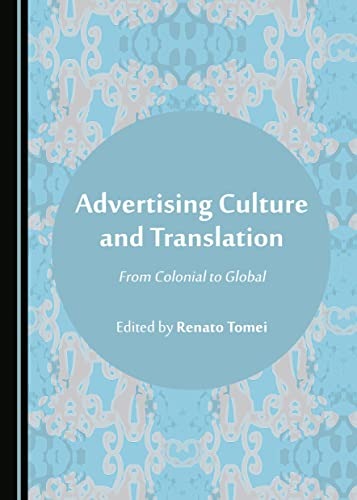
Advertising culture and translation : From colonial to global
A first comprehensive study combining and integrating advertising, culture and translation within the framework of colonial, Commonwealth, and postcolonial studies, and globalization. It addresses a number of controversial issues evident in two relatively young disciplines, as a result of decades of research and teaching in university courses. A cross-cultural approach to translational issues and the translatability of advertising cohesively is adopted here, exploring the dynamics of the conflict between the 'centre' and the 'periphery'. It introduces the concept of advertising English as lingua franca (AELF), marking new trends in the domain of varieties of English around the world (VEAW). The data examined here show the ambivalent polarity conditioning advertising and translation: both have been mutually exclusive, and both have been subject to bans, censorship and ideological control, racism, propaganda, and stereotyping. In their fundamental principles and concepts of theories and applications, however, neither discipline cannot exist outside a free market and total freedom of expression and trust
