



الصفحة 1
الصفحة 1

Modern Mathematical Statistics with Applications
This book tries to strike a balance between mathematical foundations and statistical practice. The book provides a clear and current exposition of statistical concepts and methodology, including many examples and exercises based on real data gleaned from publicly available sources. The main focus of the book is on presenting and illustrating methods of inferential statistics used by investigators in a wide variety of disciplines, from actuarial science all the way to zoology. It begins with a chapter on descriptive statistics that immediately exposes the reader to the analysis of real data. The next six chapters develop the probability material that facilitates the transition from simply describing data to drawing formal conclusions based on inferential methodology. Point estimation, the use of statistical intervals, and hypothesis testing are the topics of the first three inferential chapters. The remainder of the book explores the use of these methods in a variety of more complex settings.

Modélisation et statistique spatiales = Spatial modeling and statistics
Spatial statistics are undergoing significant development due to their use in many fields: earth sciences, environment and climatology, epidemiology, econometrics, image analysis, etc. This book presents the main spatial models used as well as their statistics for the three types of data: geostatistics (observation on a continuous domain), data on a discrete network, point data. The objective is to present in a concise but mathematically complete way the most classical models (second order and variogram; software model and Gibbs-Markov field; point processes) as well as their simulation by MCMC algorithm. Then comes the presentation of statistical tools useful for their study.

How Data Quality Affects our Understanding of the Earnings Distribution
This book demonstrates how data quality issues affect all surveys and proposes methods that can be utilised to deal with the observable components of survey error in a statistically sound manner. This book begins by profiling the post-Apartheid period in South Africa's history when the sampling frame and survey methodology for household surveys was undergoing periodic changes due to the changing geopolitical landscape in the country. This book profiles how different components of error had disproportionate magnitudes in different survey years, including coverage error, sampling error, nonresponse error, measurement error, processing error and adjustment error.

Heavy-Tailed Time Series
This book aims to present a comprehensive, self-contained, and concise overview of extreme value theory for time series, incorporating the latest research trends alongside classical methodology.Additionally, the book incorporates complete proofs and exercises with solutions as well as substantive reference lists and appendices, featuring a novel commentary on the theory of vague convergence.

Forecasting and Assessing Risk of Individual Electricity Peaks
The overarching aim of this open access book is to present self-contained theory and algorithms for investigation and prediction of electric demand peaks. A cross-section of popular demand forecasting algorithms from statistics, machine learning and mathematics is presented, followed by extreme value theory techniques with examples.

Fading Foundations : Probability and the Regress Problem
This book addresses the age-old problem of infinite regresses in epistemology. How can we ever come to know something if knowing requires having good reasons, and reasons can only be good if they are backed by good reasons in turn? The problem has puzzled philosophers ever since antiquity, giving rise to what is often called Agrippa's Trilemma. The current volume approaches the old problem in a provocative and thoroughly contemporary way. Taking seriously the idea that good reasons are typically probabilistic in character, it develops and defends a new solution that challenges venerable philosophical intuitions and explains why they were mistakenly held. Key to the new solution is the phenomenon of fading foundations, according to which distant reasons are less important than those that are nearby.

Differential Undercounts in the U.S. Census : Who is Missed?
This book describes the differences in US census coverage, also referred to as “differential undercount”, by showing which groups have the highest net undercounts and which groups have the greatest undercount differentials, and discusses why such undercounts occur. In addition to focusing on measuring census coverage for several demographic characteristics, including age, gender, race, Hispanic origin status, and tenure, it also considers several of the main hard-to-count populations, such as immigrants, the homeless, the LBGT community, children in foster care, and the disabled. However, given the dearth of accurate undercount data for these groups, they are covered less comprehensively than those demographic groups for which there is reliable undercount data from the Census Bureau. This book is of interest to demographers, statisticians, survey methodologists, and all those interested in census coverage.

Design of Observational Studies
This book introduction to statistical inference in observational studies and a detailed discussion of the principles that guide the design of observational studies. An observational study is an empiric investigation of effects caused by treatments when randomized experimentation is unethical or infeasible. Observational studies are common in most fields that study the effects of treatments on people, including medicine, economics, epidemiology, education, psychology, political science and sociology. The quality and strength of evidence provided by an observational study is determined largely by its design. Design of Observational Studies is organized into five parts. Chapters 2, 3, and 5 of Part I cover concisely many of the ideas discussed in Rosenbaum’s Observational Studies. Part II discusses the practical aspects of using propensity scores and other tools to create a matched comparison that balances many covariates, and includes an updated chapter on matching in R. In Part III, the concept of design sensitivity is used to appraise the relative ability of competing designs to distinguish treatment effects from biases due to unmeasured covariates. Part IV discusses evidence factors and the computerized construction of more than one comparison group. Part V discusses planning the analysis of an observational study, with particular reference to Sir Ronald Fisher’s striking advice for observational studies: "make your theories elaborate."
Linear and Generalized Linear Mixed Models and Their Applications
This book covers two major classes of mixed effects models—linear mixed models and generalized linear mixed models—and it presents an up-to-date account of theory and methods in analysis of these models as well as their applications in various fields. It offers a systematic approach to inference about non-Gaussian linear mixed models. Furthermore, it discusses the latest developments and methods in the field, incorporating relevant updates since publication of the first edition. These include advances in high-dimensional linear mixed models in genome-wide association studies (GWAS), advances in inference about generalized linear mixed models with crossed random effects, new methods in mixed model prediction, mixed model selection, and mixed model diagnostics.
Le raisonnement bayésien : Modélisation et inférence = Bayesian reasoning : Modeling and inference
Describes in detail the practice of the Bayesian statistical approach using many examples chosen for their educational interest. The first part gives the general principles of statistical modeling making it possible to supervise but also to come to the aid of the imagination of the apprentice modeler. By examining examples of increasing difficulty, the reader forges the keys to building their own model. The second part presents the most useful calculation algorithms for estimating the unknowns of the model. Each inference method is presented and illustrated by numerous application cases.
Bayesian core : A practical approach to computational Bayesian statistics
This Bayesian modeling book provides an operational methodology for conducting Bayesian inference, rather than focusing on its theoretical justifications. Special attention is paid to the derivation of prior distributions in each case and specific reference solutions are given for each of the models.
Applied Multivariate Statistical Analysis
This book presents the tools and concepts of multivariate data analysis in a way that is understandable for non-mathematicians and practitioners who face statistical data analysis.

An Introduction to Kolmogorov Complexity and Its Applications
Written by two experts in the field, this book is ideal for advanced undergraduate students, graduate students, and researchers in all fields of science. It is self-contained: it contains the basic requirements from mathematics, probability theory, statistics, information theory, and computer science. Included are history, theory, new developments, a wide range of applications, numerous (new) problem sets, comments, source references, and hints to solutions of problems. This is the only comprehensive treatment of the central ideas of Kolmogorov complexity and their applications.
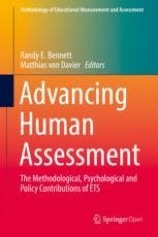
Advancing Human Assessment : The Methodological, Psychological and Policy Contributions of ETS
Describes the extensive contributions made toward the advancement of human assessment by scientists from one of the world’s leading research institutions, Educational Testing Service. The book’s four major sections detail research and development in measurement and statistics, education policy analysis and evaluation, scientific psychology, and validity. Many of the developments presented have become de-facto standards in educational and psychological measurement, including in item response theory (IRT), linking and equating, differential item functioning (DIF), and educational surveys like the National Assessment of Educational Progress (NAEP), the Programme of international Student Assessment (PISA), the Progress of International Reading Literacy Study (PIRLS) and the Trends in Mathematics and Science Study (TIMSS). In addition to its comprehensive coverage of contributions to the theory and methodology of educational and psychological measurement and statistics,
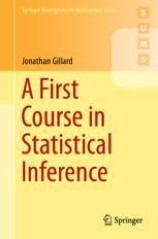
A First Course in Statistical Inference
Offers a modern and accessible introduction to Statistical Inference, the science of inferring key information from data. Aimed at beginning undergraduate students in mathematics, it presents the concepts underpinning frequentist statistical theory. Written in a conversational and informal style, this concise text concentrates on ideas and concepts, with key theorems stated and proved. Detailed worked examples are included and each chapter ends with a set of exercises, with full solutions given at the back of the book. Examples using R are provided throughout the book, with a brief guide to the software included. Topics covered in the book include: sampling distributions, properties of estimators, confidence intervals, hypothesis testing, ANOVA, and fitting a straight line to paired data.
