



الصفحة 1
الصفحة 1

Introduction to Engineering Statistics and Six Sigma : Statistical Quality Control and Design of Experiments and Systems
Introduction to Engineering Statistics and Six Sigma contains precise descriptions of all of the many related methods and details case studies showing how they have been applied in engineering and business to achieve millions of dollars of savings. Specifically, the methods introduced include many kinds of design of experiments (DOE) and statistical process control (SPC) charting approaches, failure mode and effects analysis (FMEA), formal optimization, genetic algorithms, gauge reproducibility and repeatability (R&R), linear regression, neural nets, simulation, quality function deployment (QFD) and Taguchi methods. A major goal of the book is to help the reader to determine exactly which methods to apply in which situation and to predict how and when the methods might not be effective.

Industrial competitiveness : Cost reduction
The objectives of industrial management are: - Implementation of the policy adopted by the owners or the board of directors - Optimum return on investment - Efficient utilization of Men, Machine and Money. In other words, industry must make profit. Manufacturing represents only one aspect of the activities of industrial management. Present-day manufacturing methodology does not consider making profit as their primary objective. The manufacturing process requires the knowledge of many disciplines, such as design, process planning, costing, marketing, sales, customer relations, costing, purchasing, bookkeeping, inventory control, material handling, shipping, and so on.

Frontiers in Statistical Quality Control 8
The proportion of nonconforming meters in a lot has traditionally defined lot quality for utility meter sampling inspection purposes. However, lot quality is usually measured on the basis of two criteria for such products: the proportion of nonc- forming packages in the lot and the lot mean quantity.
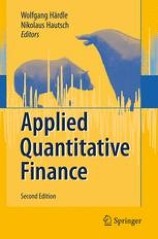
Applied Quantitative Finance
Applied Quantitative Finance (2nd edition) provides a comprehensive and state-of-the-art treatment of cutting-edge topics and methods. It provides solutions to and presents theoretical developments in many practical problems such as risk management, pricing of credit derivatives, quantification of volatility and copula modelling. The synthesis of theory and practice supported by computational tools is reflected in the selection of topics as well as in a finely tuned balance of scientific contributions on practical implementation and theoretical concepts. This linkage between theory and practice offers theoreticians insights into considerations of applicability and, vice versa, provides practitioners comfortable access to new techniques in quantitative finance.
