



الصفحة 1
الصفحة 1

Handbook on Quality and Standardisation in E-Learning
The handbook provides a cross-national perspective on these issues and draws a clear picture of the situation in quality development and standardisation. It covers topics of a rather foundational nature in quality and standardisation research as well as descriptions of quality approaches, instruments, standards, experiences and best practices. The Handbook is directed to learners, professionals, researchers and policy makers – people creating the next generation of learning.

Designers' guide to EN 1994-2 Eurocode 4 : Design of steel and composite structures ; Part 2 : General rules and rules for bridges
It is an authoritative guide to the technical background and practical aspects of this European code of practice that will supersede corresponding national codes in the countries that are members of the European Standardisation Organisation - CEN (Comite Europeen de Normalisation). This book provides guidance on the interpretation and use of EN 1994-2 and presents worked examples. It deals with the issues that are encountered in typical steel and concrete composite bridge designs, and explains the relationships between EN 1994-1-1, EN 1994-2 and the other Eurocodes.

Managing Innovation and Standards : A Case in the European Heating Industry
This book provides an in-depth study of the management of standards and regulation in sustainable and radical innovation development. It considers the case of micro Combined Heat and Power (mCHP) technology. The developers of this radical innovation in the European heating sector encountered major conflicts when attempting to create or adapt standards when bringing the technology to market. Utilising rich research data and interviews with key actors, the author uses this case to derive a grounded theory on the management of standards and regulation during an innovation process. The results also have important implications for innovators, which are reflected in clear advice for practice.
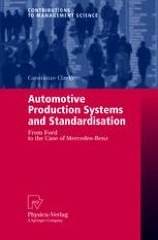
Automotive production systems and standardisation : From Ford to the case of Mercedes-Benz
The introduction of the Mercedes-Benz Production System (MPS) is exemplary of a trend within the automotive industry: the creation and introduction of company-specific standardised production systems. This book contributes to the debate about production systems by examining the social and economic implications of the role of standardisation in production systems. In this context it addresses three core issues: First, the driving forces behind the changing forms and functions of standardisation and the role of institutions therein. Second, the impact of standardisation on the evolution of automotive production systems. Third, based on the author's own empirical research conducted over a three year period at the Mercedes-Benz plant Stuttgart-Untertürkheim/Germany, the book examines the influence of standardisation on the work of actors on the shop floor in terms of organisational learning processes and the regulation of work.
