



الصفحة 1
الصفحة 1

Integration of Information for Environmental Security : Environmental Security - Information Security - Disaster Forecast and Prevention - Water Resources Management
Currently the necessary information exists in a multitude of forms and formats geographically and physically scattered over different countries, institutes and organisations, and are subject to widely different data policies and management schemes. Moreover, there is no complete and updated overview of the existing information, e.g. in the form of a metadata catalogue. As a result, integration of this information in case of emergencies has proven to be extremely difficult, if not impossible. Although in some cases, interesting and impressive "demonstrations" have been shown of the possibilities of the integration of information, for a number of reasons these have reached the "operational" stage.

Geographic information metadata for spatial data infrastructures : Resources, interoperability and information retrieval
Metadata play a fundamental role in both DLs and SDIs. Commonly defined as "structured data about data" or "data which describe attributes of a resource" or, more simply, "information about data", it is an essential requirement for locating and evaluating available data. Therefore, this book focuses on the study of different metadata aspects, which contribute to a more efficient use of DLs and SDIs. The three main issues addressed are: the management of nested collections of resources, the interoperability between metadata schemas, and the integration of information retrieval techniques to the discovery services of geographic data catalogs (contributing in this way to avoid metadata content heterogeneity).

Flood Risk Management : Hazards, Vulnerability and Mitigation Measures
Floods are of increasing public concern world-wide due to increasing damages and unacceptably high numbers of injuries. Previous approaches of flood protection led to limited success especially during recent extreme events. Therefore, an integrated flood risk management is required which takes into consideration both the hydrometeorogical and the societal processes. Moreover, real effects of risk mitigation measures have to be critically assessed. The book draws a comprehensive picture of all these aspects and their interrelations. It furthermore provides a lot of detail on earth observation, flood hazard modelling, climate change, flood forecasting, modelling vulnerability, mitigation measures and the various dimensions of management strategies. In addition to local and regional results of science, engineering and social science investigations on modelling and management, transboundary co-operation of large river catchments are of interest.

Digital Soil Mapping with Limited Data
This book focuses on digital soil mapping methodologies and applications for areas where data are limited, and has the following sections (i) introductory papers, (ii) dealing with limited spatial data infrastructures, (iii) methodology development, and (iv) examples of digital soil mapping in various parts of the globe (including USA, Brazil, UK, France, Czech Republic, Honduras, Kenya, Australia). The final chapter summarises priorities for digital soil mapping.
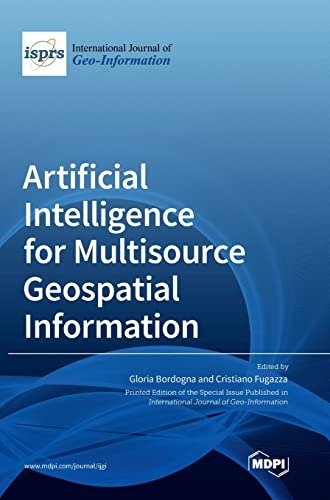
Artificial intelligence for multisource geospatial information
Collects 10 original research contributions published in the Special Issue entitled “Artificial Intelligence for Multisource Geospatial Information” of the ISPRS International Journal of Geo-Information. The focus is on different methods of Geospatial Artificial Intelligence (GeoAI) based on deep learning using different network architectures, clustering, soft computing, and semantic approaches. They are proposed to deal with a variety of Geospatial Big Data (GBD), such as georeferenced texts and photos in social networks, remote sensing images, cartographic maps, multidimensional geo databases, metadata in spatial data infrastructures, and for different tasks, such as for multisource georeferenced text integration and geodata flexible querying, for social sensing by applying sentiment analysis, clustering and geo analysis, for segmentation of roads, clouds and snow, and for detection of small targets and people on the streets.

Advances in Geoinformatics : VIII Brazilian Symposium on Geoinformatics, GEOINFO 2006, Campos do Jordão (SP), Brazil, November 19-22, 2006
The GeoInfo series of scientific conferences is an annual forum for exploring research, development and innovative applications in geographic information science and related areas. This book provides a privileged view of what is currently happening in the field of geoinformatics, and a preview of what could be the hotter developments and research topics a few years from now. Additionally, it includes recent research results on spatial databases, spatial ontologies, computational geometry and visualization for geographic information systems, geostatistics and spatial statistics, spatial analysis, interoperability, and innovative applications of geotechnologies.

Advances in 3D Geo Information Systems
The individual papers represent a valuable collection of information on the current state-of-the-art research in the field of 3D geoinformation. It covers a range of these challenges, collected under the themes of Applications, Acquisition, Modelling, Analysis and Visualisation. The main strength of the collection concerns the data modelling and DBMS implementation issues with 3D GIS.
