



الصفحة 1
الصفحة 1

Ubiquitous Intelligence and Computing ; 3rd International Conference, UIC 2006, Wuhan, China, September 3-6, 2006, Proceedings
This book is the refereed proceedings of the Third International Conference on Ubiquitous Intelligence and Computing, UIC 2006, held in Wuhan, China. The book presents 117 revised full papers together with a keynote paper were carefully reviewed and selected from 382 submissions.

The Disappearing Computer : Interaction Design, System Infrastructures and Applications for Smart Environments
Elaborates how it will be replaced by a new generation of technologies, moving computing off the desktop and ultimately integrating it with real world objects and everyday environments. Computing becomes thus an inseparable part of our everyday activities while simultaneously disappearing into the background. It becomes a ubiquitous utility taking on a role similar to electricity – an enabling but invisible and pervasive medium revealing its functionality on request in an unobtrusive way and supporting people’s everyday activities. This book provides a unique combination of concepts, methods and prototypes of ubiquitous and pervasive computing reflecting the current interest in smart environments and ambient intelligence.

Real-time Linked Dataspaces : Enabling Data Ecosystems for Intelligent Systems
Explores the dataspace paradigm as a best-effort approach to data management within data ecosystems. It establishes the theoretical foundations and principles of real-time linked dataspaces as a data platform for intelligent systems.
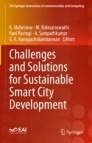
Challenges and Solutions for Sustainable Smart City Development
Discusses advances in smart and sustainable development of smart environments. The authors discuss the challenges faced in developing sustainable smart applications and provide potential solutions. The solutions are aimed at improving reliability and security with the goal of affordability, safety, and durability. Topics include health care applications, sustainable smart transportation systems, intelligent sustainable wearable electronics, and sustainable smart building and alert systems. Authors are from both industry and academia and present research from around the world. Addresses problems and solutions for sustainable development of smart cities; Includes applications such as healthcare, transportation, wearables, security, and more ; Relevant for scientist and researchers working on real time smart city development.

Ambient intelligence : A novel paradigm
Ambient Intelligence (AmI) is an integrating technology for supporting a pervasive and transparent infrastructure for implementing smart environments. Such technology is used to enable environments for detecting events and behaviors of people and for responding in a contextually relevant fashion. AmI proposes a multi-disciplinary approach for enhancing human machine interaction. The authors start with a description of the iDorm as an example of a smart environment conforming to the AmI paradigm, and introduces computer vision as an important component of the system. Other computer vision examples describe visual monitoring for the elderly, classic and novel surveillance techniques using clusters of cameras installed in indoor and outdoor application domains, and the monitoring of public spaces. Face and speech recognition systems are also covered as well as enhanced LEGO blocks for novel educational purposes. The book closes with a provocative chapter on how a cybernetic system can be designed as the backbone of a human machine interaction.
