



الصفحة 1
الصفحة 1

Modern Differential Geometry in Gauge Theories : Maxwell Fields ; Vol. I
Differential geometry, in the classical sense, is developed through the theory of smooth manifolds. Modern differential geometry from the author’s perspective is used in this work to describe physical theories of a geometric character without using any notion of calculus (smoothness). Instead, an axiomatic treatment of differential geometry is presented via sheaf theory (geometry) and sheaf cohomology (analysis). Using vector sheaves, in place of bundles, based on arbitrary topological spaces, this unique approach in general furthers new perspectives and calculations that generate unexpected potential applications .Volume 1, the focus is on Maxwell fields. All the basic concepts of this mathematical approach are formulated and used thereafter to describe elementary particles, electromagnetism, and geometric prequantization. Maxwell fields are fully examined and classified in the language of sheaf theory and sheaf cohomology.

Mixed Hodge Structures
The text of this book has its origins more than twenty- ve years ago. In the seminar of the Dutch Singularity Theory project in 1982 and 1983, the second-named author gave a series of lectures on Mixed Hodge Structures and Singularities, accompanied by a set of hand-written notes. The publication of these notes was prevented by a revolution in the subject due to Morihiko Saito: the introduction of the theory of Mixed Hodge Modules around 1985. Understanding this theory was at the same time of great importance and very hard, due to the fact that it uni es many di erent theories which are quite complicated themselves: algebraic D-modules and perverse sheaves. The present book intends to provide a comprehensive text about Mixed Hodge Theory with a view towards Mixed Hodge Modules.

Geometry of Principal Sheaves
The book provides a detailed introduction to the theory of connections on principal sheaves in the framework of Abstract Differential Geometry (ADG). This is a new approach to differential geometry based on sheaf theoretic methods, without use of ordinary calculus. This point of view complies with the demand of contemporary physics to cope with non-smooth models of physical phenomena and spaces with singularities. Starting with a brief survey of the required sheaf theory and cohomology, the exposition then moves on to differential triads (the abstraction of smooth manifolds) and Lie sheaves of groups (the abstraction of Lie groups). Having laid the groundwork, the main part of the book is devoted to the theory of connections on principal sheaves, incorporating connections on vector

Fourier Transforms of Invariant Functions on Finite Reductive Lie Algebras
In this book the author studies Fourier transforms using Deligne-Lusztig induction and the Lie algebra version of Lusztig’s character sheaves theory. He conjectures a commutation formula between Deligne-Lusztig induction and Fourier transforms that he proves in many cases. As an application the computation of the values of the trigonometric sums (on reductive Lie algebras) is shown to reduce to the computation of the generalized Green functions and to the computation of some fourth roots of unity.

D-Modules, Perverse Sheaves, and Representation Theory
D-modules continues to be an active area of stimulating research in such mathematical areas as algebra, analysis, differential equations, and representation theory. Key to D-modules, Perverse Sheaves, and Representation Theory is the authors' essential algebraic-analytic approach to the theory, which connects D-modules to representation theory and other areas of mathematics. Significant concepts and topics that have emerged over the last few decades are presented, including a treatment of the theory of holonomic D-modules, perverse sheaves, the all-important Riemann-Hilbert correspondence, Hodge modules, and the solution to the Kazhdan-Lusztig conjecture using D-module theory.
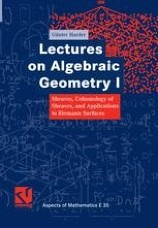
Lectures on Algebraic Geometry I : Sheaves, Cohomology of Sheaves, and Applications to Riemann Surfaces
This book and the following second volume is an introduction into modern algebraic geometry. In the first volume the methods of homological algebra, theory of sheaves, and sheaf cohomology are developed. These methods are indispensable for modern algebraic geometry, but they are also fundamental for other branches of mathematics and of great interest in their own.In the last chapter of volume I these concepts are applied to the theory of compact Riemann surfaces. In this chapter the author makes clear how influential the ideas of Abel, Riemann and Jacobi were and that many of the modern methods have been anticipated by them.
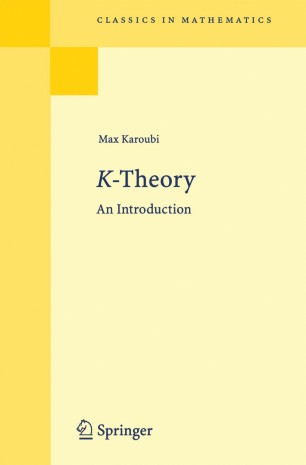
K-Theory : An Introduction
From the Preface: K-theory was introduced by A. Grothendieck in his formulation of the Riemann- Roch theorem. For each projective algebraic variety, Grothendieck constructed a group from the category of coherent algebraic sheaves, and showed that it had many nice properties. Atiyah and Hirzebruch considered a topological analog defined for any compact space X, a group K{X) constructed from the category of vector bundles on X. It is this ''topological K-theory" that this book will study. Topological K-theory has become an important tool in topology. Using K- theory, Adams and Atiyah were able to give a simple proof that the only spheres which can be provided with H-space structures are S1, S3 and S7. Moreover, it is possible to derive a substantial part of stable homotopy theory from K-theory.

Categories and Sheaves
This book covers categories, homological algebra and sheaves in a systematic and exhaustive manner starting from scratch, and continues with full proofs to an exposition of the most recent results in the literature, and sometimes beyond.The authors present the general theory of categories and functors, emphasising inductive and projective limits, tensor categories, representable functors, ind-objects and localization. Then they study homological algebra including additive, abelian, triangulated categories and also unbounded derived categories using transfinite induction and accessible objects. Finally, sheaf theory as well as twisted sheaves and stacks appear in the framework of Grothendieck topologies.

Algebraic Geometry : An Introduction
The book starts with easily-formulated problems with non-trivial solutions – for example, Bézout’s theorem and the problem of rational curves – and uses these problems to introduce the fundamental tools of modern algebraic geometry: dimension; singularities; sheaves; varieties; and cohomology. The treatment uses as little commutative algebra as possible by quoting without proof (or proving only in special cases) theorems whose proof is not necessary in practice, the priority being to develop an understanding of the phenomena rather than a mastery of the technique. A range of exercises is provided for each topic discussed, and a selection of problems and exam papers are collected in an appendix to provide material for further study.

Algebraic Cycles, Sheaves, Shtukas, and Moduli : Impanga Lecture Notes
The articles in this volume are devoted to: - moduli of coherent sheaves. - principal bundles and sheaves and their moduli. - new insights into Geometric Invariant Theory. - stacks of shtukas and their compactifications. - algebraic cycles vs. commutative algebra. - Thom polynomials of singularities. - zero schemes of sections of vector bundles.
