



الصفحة 1
الصفحة 1

Guide to web development with Java : Understanding website creation
This comprehensive Guide to Web Development with Java introduces the readers to the three-tiered, Model-View-Controller architecture by using Spring JPA, JSPs, and Spring MVC controllers. These three technologies use Java, so that a student with a background in programming will be able to master them with ease, with the end result of being able to create web applications that use MVC, validate user input,and save data to a database.

Foundations of Java for ABAP Programmers
The only beginning book of its kind, this book will teach you SAP/ABAP developers the skills you need for Java 5 programming. The book emphasizes the fundamentals of core Java SE 5 and Java EE 5, to get you up to speed with these technologies. You'll learn about the most important enterprise Java API found in the new Java EE 5 platform, which you can immediately use and integrate. Furthermore, the book elaborates on connecting to a database, SAP Java Connector, servlets, Java Server Pages, Enterprise JavaBeans, and Java Messaging.
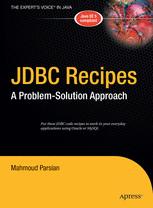
JDBC Recipes : A Problem-Solution Approach
JDBC Recipes provides easy-to-implement, usable solutions to problems in relational databases that use JDBC. You will be able to integrate these solutions into your web-based applications, such as Java servlets, JavaServer Pages, and Java server-side frameworks. This handy book allows you to cut and paste the solutions without any code changes. This book focuses on topics that have been ignored in most other JDBC books, such as database and result set metadata. It will help you develop database solutions, like adapters, connectors, and frameworks using Java/JDBC. The insightful solutions will enable you to handle all data types, including large binary objects. A unique feature of the book is that it presents JDBC solutions (result sets) in XML.
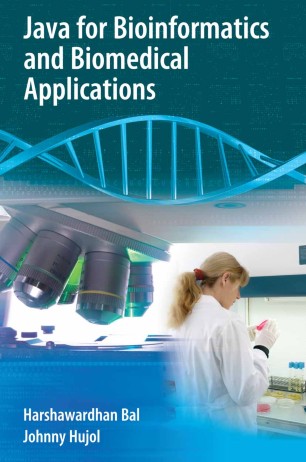
Java for Bioinformatics and Biomedical Applications
Illustrates how individual bioinformatics applications (such as BLAST and Genscan) can be stitched together into a pipeline so that users can direct the output of one tool (for example, gene predictions using Genscan) to perform further analysis (say, homology searching using BLAST).
