



الصفحة 1
الصفحة 1

Programming for Computations - Python : A Gentle Introduction to Numerical Simulations with Python
This book presents computer programming as a key method for solving mathematical problems. There are two versions of the book, one for MATLAB and one for Python. The book was inspired by the Springer book TCSE 6: A Primer on Scientific Programming with Python (by Langtangen), but the style is more accessible and concise, in keeping with the needs of engineering students. The book outlines the shortest possible path from no previous experience with programming to a set of skills that allows the students to write simple programs for solving common mathematical problems with numerical methods in engineering and science courses. The emphasis is on generic algorithms, clean design of programs, use of functions, and automatic tests for verification.

Programming for Computations - MATLAB/Octave : A Gentle Introduction to Numerical Simulations with MATLAB/Octave
This book presents computer programming as a key method for solving mathematical problems. There are two versions of the book, one for MATLAB and one for Python. The book was inspired by the Springer book TCSE 6: A Primer on Scientific Programming with Python (by Langtangen), but the style is more accessible and concise, in keeping with the needs of engineering students. The book outlines the shortest possible path from no previous experience with programming to a set of skills that allows the students to write simple programs for solving common mathematical problems with numerical methods in engineering and science courses. The emphasis is on generic algorithms, clean design of programs, use of functions, and automatic tests for verification.
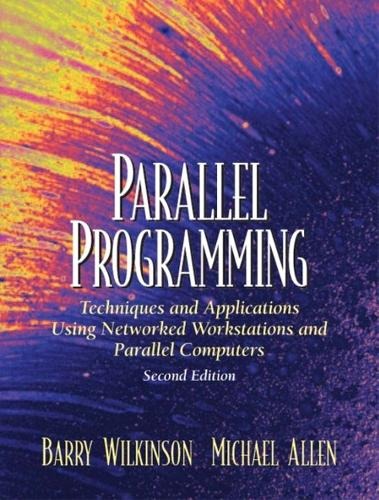
Parallel programming : Technigues and applications using networked workstations and parallel computers
Covers the techniques of parallel programming in a practical manner that enables students to write and evaluate their parallel programs. Supported by the National Science Foundation and exhaustively class-tested, it is the first text of its kind that does not require access to a special multiprocessor system, concentrating instead only on parallel programs that can be executed on networked workstations using freely available parallel software tools. The Second Edition has been revised to incorporate a greater focus on cluster programming as this type of programming has become more widespread with the availability of low-cost computers.

Parallel programming : for multicore and cluster systems ; 3rd ed.
Covers the new development in processor architecture and parallel hardware. It provides detailed descriptions of parallel programming techniques that are necessary for developing efficient programs for multicore processors as well as for parallel cluster systems and supercomputers. The book is structured in three main parts, covering all areas of parallel computing: the architecture of parallel systems, parallel programming models and environments, and the implementation of efficient application algorithms. The emphasis lies on parallel programming techniques needed for different architectures. In particular, this third edition includes an extended update of the chapter on computer architecture and performance analysis taking new developments such as the aspect of energy consumption into consideration.

Introduction to the Tools of Scientific Computing
The book provides an introduction to common programming tools and methods in numerical mathematics and scientific computing. Unlike widely used standard approaches, it does not focus on any particular language but aims to explain the key underlying concepts. In general, new concepts are first introduced in the particularly user-friendly Python language and then transferred and expanded in various scientific programming environments from C / C ++, Julia and MATLAB to Maple. This includes different approaches to distributed computing.

Introduction to Scientific Programming with Python
This book offers an initial introduction to programming for scientific and computational applications using the Python programming language. The presentation style is compact and example-based, making it suitable for students and researchers with little or no prior experience in programming.

Cours doptique : Simulations et exercices résolus avec Maple, Matlab, Mathematica, Mathcad = Optics course: Simulations and exercises solved with Maple, Matlab, Mathematica, Mathcad
Intended for students at the L and M levels of the university as well as for engineers wishing to study certain subjects in greater depth. It covers all the themes of a traditional optics course, from geometric optics to holography, interference, diffraction, coherence and the use of the Fourier transform for spectroscopy. The presentation is developed from mathematical models deriving from typical situations and fundamental examples which are presented in the form of computer programs ready to be implemented. These programs are also available on the CD accompanying the book, for each of the following scientific programming environments: Matlab, Maple, Mathematica and Mathcad. Thus, the reader will be able to modify the parameters of the examples proposed to adapt them to new situations.
