



الصفحة 1
الصفحة 1

Multimodal Texts in Disciplinary Education : A Comprehensive Framework
This book provides an introduction to multimodality and the role of multimodal texts in today’s education. Presenting a comprehensive framework for analysing and working with multimodal texts in disciplinary education, it serves as a tool for researchers and teachers alike. The second part of the book focuses on sample analyses of a variety of educational texts for different age groups and from different disciplines, including games and online resources. The authors also comment on the specific challenges of each text, and how teachers can discuss such texts with their students to enhance both their understanding of the content and their multimodal literacy.

Modeling Theory in Science Education
The book focuses as much on course content as on instruction and learning methodology, and presents practical aspects that have repeatedly demonstrated their value in fostering meaningful and equitable learning of physics and other science courses at the secondary school and college levels.The author shows how a scientific theory that is the object of a given science course can be organized around a limited set of basic models. Special tools are introduced, including modeling schemata, for students to meaningfully construct models and required conceptions, and for teachers to efficiently plan instruction and assess and regulate student learning and teaching practice. A scientific model is conceived to represent a particular pattern in the structure or behavior of physical realities and to explore and reify the pattern in specific ways. The author further shows how to engage students in modeling activities through structured learning cycles.

Metaphor and Analogy in Science Education
This book brings together powerful ideas and new developments from internationally recognised scholars and classroom practitioners to provide theoretical and practical knowledge to inform progress in science education. This is achieved through a series of related chapters reporting research on analogy and metaphor in science education. Throughout the book, contributors not only highlight successful applications of analogies and metaphors, but also foreshadow exciting developments for research and practice. Themes include metaphor and analogy: best practice, as reasoning; for learning; applications in teacher development; in science education research; philosophical and theoretical foundations. Accordingly, the book is likely to appeal to a wide audience of science educators –classroom practitioners, student teachers, teacher educators and researchers.

Internationalisation and Globalisation in Mathematics and Science Education
This book aims to: Develop theoretical frameworks of the phenomena of internationalisation and globalisation and identify related ethical, moral, political and economic issues facing mathematics and science educators. Provide a venue for the publication of results of international comparisons on cultural differences and similarities rather than merely on achievement and outcomes. Provide a forum for critical discussion of the various models and forms of international projects and collaborations. Provide a representation of the different voices and interests from around the world rather than consensus on issues.

Interdisciplinary Mathematics Education : The State of the Art and Beyond
This book is the first major publication on the topic of “Interdisciplinary Mathematics Education” It offers extensive theoretical insights, empirical research, and practitioner accounts of interdisciplinary mathematics work in STEM and beyond (e.g. in music and the arts).

Instructional Scaffolding in STEM Education : Strategies and Efficacy Evidence
This book uses meta-analysis to synthesize research on scaffolding and scaffolding-related interventions in STEM (science, technology, engineering, and mathematics) education. Specifically, the volume examines the extent to which study quality, assessment type, and scaffolding characteristics (strategy, intended outcome, fading schedule, scaffolding intervention, and paired intervention) influence cognitive student outcomes. It includes detailed descriptions of the theoretical foundations of scaffolding, scaffolding strategies that have been proposed to meet different intended learning outcomes in STEM, and associated efficacy information. Furthermore, the book describes assessment strategies and study designs which can be used to evaluate the influence of scaffolding, and suggests new fields in which scaffolding strategies that have proven efficacious may be used.

Informatics Education - The Bridge between Using and Understanding Computers ; International Conference on Informatics in Secondary Schools - Evolution and Perspectives, ISSEP 2006, Vilnius, Lithuania, November 7-11, 2006, Proceedings
Although the school system is subject to specific national regulations, didactical issues warrant discussion on an international level. This applies specifically to informatics didactics. In contrast to most other scientific disciplines, informatics undergoes substantial technical and scientific changes and shifts of paradigms even at the basic level taught in secondary school. Moreover, informatics education is under more stringent observation from parents, potential employers, and policy makers than other disciplines. It is considered to be a modern discipline. Hence, being well-educated in informatics seemingly ensures good job perspectives. Further, policy makers pay attention to informatics education, hoping that a young population well-educated in this modern technology will contribute to the future wealth of the nation.

Informatics education - supporting computational thinking ; 3rd International Conference on informatics in secondary schools : Evolution and perspectives, ISSEP 2008 Torun Poland, July 1-4, 2008 Proceedings
Informatics Education – Supporting Computational Thinking contains papers presented at the Third International Conference on Informatics in Secondary Schools – Evolution and Perspective, ISSEP 2008, held in July 2008 in Torun, Poland. As with the proceedings of the two previous ISSEP conferences (2005 in Klag- furt, Austria, and 2006 in Vilnius, Lithuania), the papers presented in this volume address issues of informatics education transcending national boundaries and, the- fore, transcending differences in the various national legislation and organization of the educational system. Observing these issues, one might notice a trend. The p- ceedings of the First ISSEP were termed From Computer Literacy to Informatics F- damentals [1]. There, broad room was given to general education in ICT.

Il solito Albert e la piccola Dolly : La scienza dei bambini e dei ragazzi = The usual Albert and little Dolly : The science of children and young people
After hundreds of years, science has come out of the ivory tower and entered society. Today science is not done with laboratory research alone but by involving different social actors. There are scientists, but also politicians, administrators, entrepreneurs and ordinary people, young and old. Their fears, real or perceived, can put a stop to its development. Their trust and their hopes nourish it and create a climate of expectations that are not always met. In the great narrative of science, the first actors, the scientists, are from time to time destroyers and benefactors, saints or monsters, fathers of the Golem with feet of clay or of Frankestein who turns and destroys. Not infrequently then there are many Sisyphus who continually restart their business - and it is not excluded that in the eyes of some they share with Penelope the habit of undoing at night what they do during the day.

From computer literacy to informatics fundamentals ; International conference on informatics in secondary schools : Evolution and perspectives, ISSEP 2005, Klagenfurt, Austria, March 30-April 1, 2005, Proceedings
Duetothepenetrationofinformationtechnologyintosocietyatlargeandinto schools in particular, the relationship between informatics and education leading togeneralcomputerliteracyortotheuseofIT-basedapproachesinconventional subjects, e-learning in school, is an evident focus of many contributions. According to the broad scope of the conference its proceedings are split into two volumes. This volume, From Computer Literacy to Informatics Fundam- tals, covers papers reporting on national strategies of informatics instruction and their evolution in accordance with the penetration of information proce- ing equipment in our daily life. In one way or another, these strategies strive to accommodate the needs of basic skills in information and communication te- nology (ICT) with educational principles that can be conveyed by informatics instruction in a traditional sense. Hence, the papers on national strategies are complementedintwoways: ?rstly, bycontributionsthatstrivetoidentifyfun- mental issues, informatics can contribute to the general education process of the youth; and, secondly, by papers presenting approaches on how to link or even to combine instruction about such informatics fundamentals with the need to introduce pupils to the productive use of ICT.

Feyerabend’s Epistemological Anarchism : How Science Works and its Importance for Science Education
argues that the traditional image of Feyerabend is erroneous and that, contrary to common belief, he was a great admirer of science. It shows how Feyerabend presented a vision of science that represented how science really works. Besides giving a theoretical framework based on Feyerabend´s philosophy of science, offers criteria that can help readers to evaluate and understand research reported in important international science education journals, with respect to Feyerabend’s epistemological anarchism. includes an evaluation of general chemistry and physics textbooks.

Education and Climate Change : The Role of Universities
This book draws on a multidimensional model of educational change, the book reviews the field of climate change education and identifies some of the areas in which past efforts have fallen short in supporting effective pedagogical change at scale.

Dinaric Perspectives on TIMSS 2019 : Teaching and Learning Mathematics and Science in South-Eastern Europe
This book brings together national experts from across the Dinaric region to rigorously review IEA’s Trends in International Mathematics and Science Study (TIMSS) 2019 grade four data to develop a multidimensional and culturally sensitive perspective on their TIMSS 2019 primary-level results. The Dinaric region, named after the Dinaric Alps, is located in South-eastern Europe, and stretches through Croatia, Bosnia and Herzegovina, Serbia, Montenegro, Kosovo[1], Albania, and North Macedonia. IEA’s TIMSS has been an invaluable resource for monitoring international trends in mathematics and science achievement at grades four and eight since 1995. The TIMSS 2019 administration of the test to grade four students, provided a unique opportunity for analysis within shared regional settings and enabled the construction of this first report based on international study results from the region, prepared by the National Research Coordinators in collaboration with IEA.

Curriculum Reform in the European Schools : Towards a 21st Century Vision
Examines the modern role of the European School system within the European Union, at a time when the global economy demands a new vision for contemporary education. The European schools are currently in a state of crisis: their 60-year-old tradition of bilingual and multilingual education is being strained by rapid EU expansion and the removal of English speaking teachers as a result of Brexit. Their tried and tested model of mathematics and science education has rapidly been overtaken by new developments in pedagogy and assessment research, while recruitment and retention of students and teachers has become increasingly fraught as European member states review what they are, and what they are not, prepared to fund. The authors draw on original and empirical research to assess the European Schools’ place in a new Europe where the entire post-war European Project is potentially at risk. This well-researched volume will be of interest to practitioners working in European schools as well as students and scholars of EU politics and international education.

Critical Questions in STEM Education
This volume is divided into three sections: the first one describes the nature of the component disciplines of STEM. The next section presents work from leaders representing all STEM disciplines and deals with aspects such as K-12 and post-secondary education. The last section draws conclusions regarding the natures of the disciplines, challenges and advantages of STEM education in terms of theoretical and practical implications. The two final chapters compile arguments from the research chapters, describing themes in research results, and making recommendations for best STEM education practice, and examining areas for future research in STEM education.

Creative Model Construction in Scientists and Students : The Role of Imagery, Analogy, and Mental Simulation
How do scientists use analogies and other processes to break away from old theories and generate new ones? This book documents such methods through the analysis of video tapes of scientifically trained experts thinking aloud while working on unfamiliar problems. Some aspects of creative scientific thinking are difficult to explain, such as the power of analogies, the use of physical intuition, and the enigmatic ability to learn from thought experiments. The book examines the hypothesis that these processes are based on imagistic mental simulation as an underlying mechanism. This allows the analysis of insight ("Aha!") episodes of creative theory formation.

Contributions from Science Education Research
In August 2005, over 500 international researchers from the field of science education met at the 5th European Science Education Research Association conference in Barcelona, Spain. Two of the main topics at this conference were: the decrease in the number of students interested in school science and concern about the worldwide outcomes of studies on students’ scientific literacy. At the conference, over 400 papers were presented, covering a wide range of topics relevant to science education research, such as evidence-based practice, teachers’ professional development, the role of ICT and multimedia, formal and informal learning environments, and argumentation and modelling in science education. This volume includes edited versions of 37 outstanding papers presented during the conference, including the lectures of the keynote speakers. They have been selected for their quality, variety and interest, and present a good overview of the field of science education research.

Contemporary Qualitative Research : Exemplars for Science and Mathematics Educators
This volume offers a unique set of research exemplars for science, mathematics and technology educators. The volume explores the important challenge of how to translate leading-edge methodologies into practical research strategies and techniques. The book is divided into three major sections, The Golden Age of Research, Meeting the Research Crises and A New Era of Research, with chapters exploring a variety of methodologies and representational forms and texts. These include historical, narrative, literary, phenomenological, autobiographical, virtual and performance texts, among others. Qualitative Research in Postmodern Times is an exciting and accessible book that will be essential reading for science, mathematics and technology educators interested in new forms of educational research. Beginning researchers will find it practically helpful in planning and conducting their research studies, while experienced researchers will welcome new theoretical insights into postmodern methodologies.

Conceptualizing Environmental Citizenship for 21st Century Education
This book is about the development of a common understanding of environmental citizenship. It conceptualizes and frames environmental citizenship taking an educational perspective. Organized in four complementary parts, the book first explains the political, economic and societal dimensions of the concept.
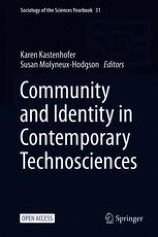
Community and Identity in Contemporary Technosciences
This book provides new thinking on scientific identity formation. It thoroughly interrogates the concepts of community and identity, including both historical and contemporaneous analyses of several scientific fields.
