



الصفحة 1
الصفحة 1
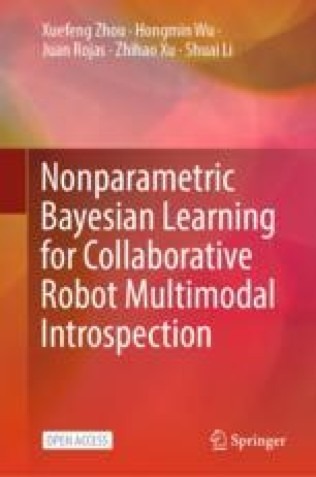
Nonparametric Bayesian Learning for Collaborative Robot Multimodal Introspection
This book focuses on robot introspection, which has a direct impact on physical human–robot interaction and long-term autonomy, and which can benefit from autonomous anomaly monitoring and diagnosis, as well as anomaly recovery strategies.

Informatics in Control, Automation and Robotics I
The present book includes a set of selected papers from the first “International Conference on Informatics in Control Automation and Robotics” (ICINCO 2004), held in Setúbal, Portugal, from 25 to 28 August 2004. The conference was organized in three simultaneous tracks: “Intelligent Control Systems and Optimization”, “Robotics and Automation” and “Systems Modeling, Signal Processing and Control”. The book is based on the same structure.

Field and service robotics : Results of the 6th international conference
This book presents the results of the sixth edition of Field and Service Robotics, FSR07, held in Chamonix, France, on 9th - 12th July 2007. The conference provided a forum for researchers, professionals and robot manufacturers to exchange up-to-date technical knowledge and experience. This book offers a collection of a broad range of topics including: Underwater Robots and Systems, Autonomous Navigation for Unmanned Aerial Vehicles, Simultaneous Localization and Mapping, Climbing Robotics, Sensor Fusion.

Experimental Robotics : The 10th International Symposium on Experimental Robotics
The goal of ISER is to provide a forum for research in robotics that focuses on novelty of theoretical contributions validated by experimental results. The meetings are conceived to bring together, in a small group setting, researchers from around the world who are in the forefront of experimental robotics research.
Evolutionary Swarm Robotics : Evolving Self-Organising Behaviours in Groups of Autonomous Robots
In this book the use of ER techniques for the design of self-organising group behaviours, for both simulated and real robots is introduced. This research has a twofold value. From an engineering perspective, an automatic methodology for synthesising complex behaviours in a robotic system is described.

Embedded Robotics : Mobile Robot Design and Applications with Embedded Systems
The EyeBot controller and mobile robots have evolved over more than a decade. This book gives an in-depth introduction to embedded systems and autonomous mobile robots, using the EyeBot controller (EyeCon) and the EyeBot mobile robot family as application examples. This book combines teaching and research material and can be used for courses in Embedded Systems as well as in Robotics and Automation.

Digital transformation in semiconductor manufacturing ; Proceedings of the 1st and 2nd European advances in digital transformation Conference, EADTC 2018, Zittau, Germany and EADTC 2019, Milan, Italy
This book reports on cutting-edge electrical engineering and microelectronics solutions to foster and support digitalization in the semiconductor industry.

Control Theory of Multi-fingered Hands : A Modelling and Analytical-Mechanics Approach for Dexterity and Intelligence
Control Theory of Multi-fingered Hands presents a comprehensive insight into the intelligence and dexterity of robotic multi-fingered hands from both the physical and control-theoretic viewpoints.
Control of Nonlinear Dynamical Systems : Methods and Applications
This book is devoted to new methods of control for complex dynamical systems and deals with nonlinear control systems having several degrees of freedom, subjected to unknown disturbances, and containing uncertain parameters. Various constraints are imposed on control inputs and state variables or their combinations. The book contains an introduction to the theory of optimal control and the theory of stability of motion, and also a description of some known methods based on these theories.
Cognitive Supervision for Robot-Assisted Minimally Invasive Laser Surgery
This thesis lays the groundwork for the automatic supervision of the laser incision process, which aims to complement surgeons’ perception of the state of tissues and enhance their control over laser incisions. The research problem is formulated as the estimation of variables that are representative of the state of tissues during laser cutting. Prior research in this area leveraged numerical computation methods that bear a high computational cost and are not straightforward to use in a surgical setting. This book proposes a novel solution to this problem, using models inspired by the ability of experienced surgeons to perform precise and clean laser cutting. It shows that these new models, which were extracted from experimental data using statistical learning techniques, are straightforward to use in a surgical setup, allowing greater precision in laser-based surgical procedures.

Autonomy oriented computing : From problem solving to complex systems modeling
Autonomy Oriented Computing explores the important theoretical and practical issues in AOC, by analyzing methodologies and presenting experimental case studies. The book serves as a comprehensive reference source for researchers, scientists, engineers, and professionals in all fields concerned with this promising new development in computer science. It can also be used as a main or supplementary text in graduate and undergraduate programs across a broad range of computer-related disciplines, including Robotics and Automation, Amorphous Computing, Image Processing and Computer Vision, Programming Paradigms, Computational Biology, and many others. The first part of the book, Fundamentals, describes the basic concepts and characteristics of an AOC system, and then it enumerates the critical design and engineering issues faced in AOC system development. The second part of the book, AOC in Depth, provides a detailed analysis of methodologies and case studies to evaluate the use of AOC in problem solving and complex system modeling. The final chapter reviews the essential features of the AOC paradigm and outlines a number of possibilities for future research and development.
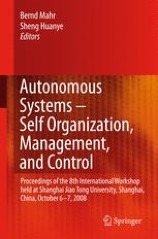
Autonomous Systems - Self-Organization, Management, and Contro ; Proceedings of the 8th International Workshop held at Shanghai Jiao Tong University, Shanghai, China, October 6–7, 2008
The International Workshop on "Autonomous Systems - Self-Organization, Management, and Control " is the eighth in a successful series of workshops that were established by Shanghai Jiao Tong University and Technische Universitat Berlin. The goal of these workshops is to bring together researchers from both universities in order to present research results to an international community.
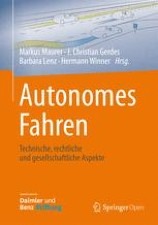
Autonomes fahren : Technische, rechtliche und gesellschaftliche aspekte = Autonomous driving : Technical, legal and social aspects
This book provides answers to a wide range of these and other questions. Experts from Germany and the USA describe central topics related to the automation of vehicles on public roads from an engineering and social science perspective. They show which "decisions" are required of an autonomous vehicle or which "ethics" must be programmed. The authors discuss expectations and concerns that characterize the individual and societal acceptance of autonomous driving. An increased safety potential through autonomous vehicles is compared to the challenges and solution approaches that play a role in securing the safety concept. In addition, they explain what possibilities for change and opportunities arise for our mobility and the reorganization of traffic, not least for freight traffic. The book thus offers an up-to-date, comprehensive and scientifically sound examination of the topic of "autonomous driving".
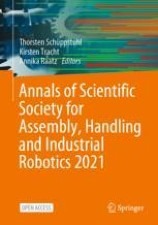
Annals of scientific society for assembly, handling and industrial robotics 2021
This proceedings presents a good overview of the current research landscape of assembly, handling and industrial robotics. The objective of MHI Colloquium is the successful networking at both academic and management level. Thereby, the colloquium focuses an academic exchange at a high level in order to distribute the obtained research results, to determine synergy effects and trends, to connect the actors in person and in conclusion, to strengthen the research field as well as the MHI community. In addition, there is the possibility to become acquatined with the organizing institute. Primary audience is formed by members of the scientific society for assembly, handling and industrial robotics (WGMHI).

Annals of scientific society for assembly, handling and industrial robotics
This proceedings presents a good overview of the current research landscape of industrial robots. The objective of MHI Colloquium is the successful networking at both academic and management level. Thereby, the colloquium focuses an academic exchange at a high level in order to distribute the obtained research results, to determine synergy effects and trends, to connect the actors in person and in conclusion, to strengthen the research field as well as the MHI community. In addition, there is the possibility to become acquatined with the organizing institute. Primary audience is formed by members of the scientific society for assembly, handling and industrial robotics (WGMHI).
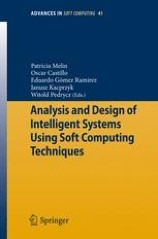
Analysis and Design of Intelligent Systems Using Soft Computing Techniques
This book comprises a selection of papers from IFSA 2007 on new methods for analysis and design of hybrid intelligent systems using soft computing techniques. Soft Computing (SC) consists of several computing paradigms, including fuzzy logic, neural networks, and genetic algorithms, which can be used to produce powerful hybrid intelligent systems for solving problems in pattern recognition, time series prediction, intelligent control, robotics and automation. Hybrid intelligent systems that combine several SC techniques are needed due to the complexity and high dimensionality of real-world problems. Hybrid intelligent systems can have different architectures, which have an impact on the efficiency and accuracy of these systems, for this reason it is very important to optimize architecture design. The architectures can combine, in different ways, neural networks, fuzzy logic and genetic algorithms, to achieve the ultimate goal of pattern recognition, time series prediction, intelligent control, or other application areas.
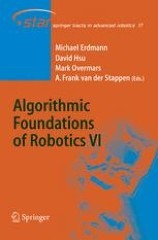
Algorithmic Foundations of Robotics VI
Robot algorithms are abstractions of computational processes that control or reason about motion and perception in the physical world. Because actions in the physical world are subject to physical laws and geometric constraints, the design and analysis of robot algorithms raises a unique combination of questions in control theory, computational and differential geometry, and computer science. Algorithms serve as a unifying theme in the multi-disciplinary field of robotics. This volume consists of selected contributions to the sixth Workshop on the Algorithmic Foundations of Robotics. This is a highly competitive meeting of experts in the field of algorithmic issues related to robotics and automation.

Algorithmic Foundation of Robotics VII : Selected Contributions of the 7th International Workshop on the Algorithmic Foundations of Robotics
This book contains the proceedings from the 2006 Workshop on the Algorithmic Foundations of Robotics. The 32 papers in this book span a wide variety of topics: from fundamental motion planning algorithms to applications in medicine and biology, but they have in common a foundation in the algorithmic problems of robotic systems.

AI based Robot Safe Learning and Control
This book mainly focuses on the safe control of robot manipulators. The control schemes are mainly developed based on dynamic neural network, which is an important theoretical branch of deep reinforcement learning.
