



الصفحة 1
الصفحة 1

Mirror Geometry of Lie Algebras, Lie Groups and Homogeneous Spaces
As K. Nomizu has justly noted [K. Nomizu, 56], Differential Geometry ever will be initiating newer and newer aspects of the theory of Lie groups. This monograph is devoted to just some such aspects of Lie groups and Lie algebras. New differential geometric problems came into being in connection with so called subsymmetric spaces, subsymmetries, and mirrors introduced in our works dating back to 1957 [L.V. Sabinin, 58a,59a,59b]. In addition, the exploration of mirrors and systems of mirrors is of interest in the case of symmetric spaces. Geometrically, the most rich in content there appeared to be the homogeneous Riemannian spaces with systems of mirrors generated by commuting subsymmetries, in particular, so called tri-symmetric spaces introduced in [L.V. Sabinin, 61b]. As to the concrete geometric problem which needs be solved and which is solved in this monograph, we indicate, for example, the problem of the classification of all tri-symmetric spaces with simple compact groups of motions. Passing from groups and subgroups connected with mirrors and subsymmetries to the corresponding Lie algebras and subalgebras leads to an important new concept of the involutive sum of Lie algebras [L.V. Sabinin, 65]. This concept is directly concerned with unitary symmetry of elementary par- cles (see [L.V. Sabinin, 95,85] and Appendix 1). The first examples of involutive (even iso-involutive) sums appeared in the - ploration of homogeneous Riemannian spaces with and axial symmetry. The consideration of spaces with mirrors [L.V. Sabinin, 59b] again led to iso-involutive sums.

Metric Structures for Riemannian and Non-Riemannian Spaces
The first stages of the new developments were presented in Gromov's course in Paris, which turned into the famous "Green Book" by Lafontaine and Pansu (1979). The present English translation of that work has been enriched and expanded with new material to reflect recent progress. Additionally, four appendices—by Gromov on Levy's inequality, by Pansu on "quasiconvex" domains, by Katz on systoles of Riemannian manifolds, and by Semmes overviewing analysis on metric spaces with measures—as well as an extensive bibliography and index round out this unique and beautiful book.
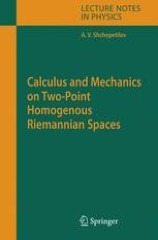
Calculus and mechanics on two-point homogenous riemannian spaces
The present monograph gives a short and concise introduction to classical and quantum mechanics on two-point homogenous Riemannian spaces, with empahsis on spaces with constant curvature. Chapter 1-4 provide the basic notations from differential geometry for studying two-body dynamics in these spaces. Chapter 5 deals with the problem of finding explicitly invariant expressions for the two-body quantum Hamiltonian. Chapter 6 addresses one-body problems in a central potential. Chapter 7 studies the classical counterpart of the quantum system of chapter 5. Chapter 8 investigates some applications in the quantum realm, namely for the coulomb and oscillator potentials.
