



الصفحة 1
الصفحة 1

Metric Structures for Riemannian and Non-Riemannian Spaces
The first stages of the new developments were presented in Gromov's course in Paris, which turned into the famous "Green Book" by Lafontaine and Pansu (1979). The present English translation of that work has been enriched and expanded with new material to reflect recent progress. Additionally, four appendices—by Gromov on Levy's inequality, by Pansu on "quasiconvex" domains, by Katz on systoles of Riemannian manifolds, and by Semmes overviewing analysis on metric spaces with measures—as well as an extensive bibliography and index round out this unique and beautiful book.

Information Geometry : Near Randomness and Near Independence
This volume will be useful to practising scientists and students working in the application of statistical models to real materials or to processes with perturbations of a Poisson process, a uniform process, or a state of independence for a bivariate process. We use information geometry to provide a common differential geometric framework for a wide range of illustrative applications including amino acid sequence spacings in protein chains, cryptology studies, clustering of communications and galaxies, cosmological voids, coupled spatial statistics in stochastic fibre networks and stochastic porous media, quantum chaology. Introduction sections are provided to mathematical statistics, differential geometry and the information geometry of spaces of probability density functions.

Generalized Curvatures
The central object of this book is the measure of geometric quantities describing N a subset of the Euclidean space (E ,), endowed with its standard scalar product. Let us state precisely what we mean by a geometric quantity. Consider a subset N S of points of the N-dimensional Euclidean space E , endowed with its standard N scalar product. LetG be the group of rigid motions of E . We say that a 0 quantity Q(S) associated toS is geometric with respect toG if the corresponding 0 quantity Q[g(S)] associated to g(S) equals Q(S), for all g?G . For instance, the 0 diameter ofS and the area of the convex hull ofS are quantities geometric with respect toG . But the distance from the origin O to the closest point ofS is not, 0 since it is not invariant under translations ofS. It is important to point out that the property of being geometric depends on the chosen group. For instance, ifG is the 1 N group of projective transformations of E , then the property ofS being a circle is geometric forG but not forG , while the property of being a conic or a straight 0 1 line is geometric for bothG andG . This point of view may be generalized to any 0 1 subsetS of any vector space E endowed with a groupG acting on it.

General Relativity
this book is a short and concise exposition of the central ideas of general relativity. Although the original audience was made up of mathematics students, the focus is on the chain of reasoning that leads to the relativistic theory from the analysis of distance and time measurements in the presence of gravity, rather than on the underlying mathematical structure. The geometric ideas - which are central to the understanding of the nature of gravity - are introduced in parallel with the development of the theory, the emphasis being on laying bare how one is led to pseudo-Riemannian geometry through a natural process of reconciliation of special relativity with the equivalence principle.

Einstein Manifolds
"[...] an efficient reference book for many fundamental techniques of Riemannian geometry. [...] despite its length, the reader will have no difficulty in getting the feel of its contents and discovering excellent examples of all interaction of geometry with partial differential equations, topology, and Lie groups. Above all, the book provides a clear insight into the scope and diversity of problems posed by its title."

Differential Geometry of Curves and Surfaces : A Concise Guide
The study of curves and surfaces forms an important part of classical differential geometry. Differential Geometry of Curves and Surfaces: A Concise Guide presents traditional material in this field along with important ideas of Riemannian geometry.Standard theoretical material is combined with more difficult theorems and complex problems, while maintaining a clear distinction between the two levels.

Complex Nonlinearity : Chaos, Phase Transitions, Topology Change and Path Integrals
The book starts with a textbook-like expose on nonlinear dynamics, attractors and chaos, both temporal and spatio-temporal, including modern techniques of chaos–control. Chapter 2 turns to the edge of chaos, in the form of phase transitions (equilibrium and non-equilibrium, oscillatory, fractal and noise-induced), as well as the related field of synergetics. While the natural stage for linear dynamics comprises of flat, Euclidean geometry (with the corresponding calculation tools from linear algebra and analysis), the natural stage for nonlinear dynamics is curved, Riemannian geometry (with the corresponding tools from nonlinear, tensor algebra and analysis). The extreme nonlinearity – chaos – corresponds to the topology change of this curved geometrical stage, usually called configuration manifold. Chapter 3 elaborates on geometry and topology change in relation with complex nonlinearity and chaos. Chapter 4 develops general nonlinear dynamics, continuous and discrete, deterministic and stochastic, in the unique form of path integrals and their action-amplitude formalism.
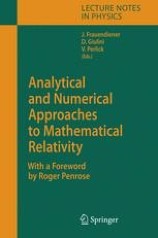
Analytical and Numerical Approaches to Mathematical Relativity
This book contains a representative collection of surveys by experts in mathematical relativity writing about the current status of, and problems in, their fields. There are four contributions for each of the following mathematical areas: differential geometry and differential topology, analytical methods and differential equations, and numerical methods. This book addresses graduate students and specialist researchers alike.
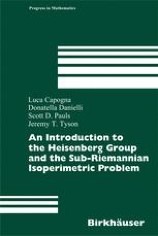
An Introduction to the Heisenberg Group and the Sub-Riemannian Isoperimetric Problem
This book provides an introduction to the basics of sub-Riemannian differential geometry and geometric analysis in the Heisenberg group, focusing primarily on the current state of knowledge regarding Pierre Pansu's celebrated 1982 conjecture regarding the sub-Riemannian isoperimetric profile.
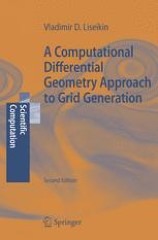
A Computational Differential Geometry Approach to Grid Generation
This monograph gives a detailed treatment of applications of geometric methods to advanced grid technology. It focuses on and describes a comprehensive approach based on the numerical solution of inverted Beltramian and diffusion equations with respect to monitor metrics for generating both structured and unstructured grids in domains and on surfaces.
