



الصفحة 1
الصفحة 1

Representation learning for natural language processing
Provides an overview of the recent advances in representation learning theory, algorithms, and applications for natural language processing (NLP), ranging from word embeddings to pre-trained language models. It is divided into four parts. Part I presents the representation learning techniques for multiple language entries, including words, sentences and documents, as well as pre-training techniques. Part II then introduces the related representation techniques to NLP, including graphs, cross-modal entries, and robustness. Part III then introduces the representation techniques for the knowledge that are closely related to NLP, including entity-based world knowledge, sememe-based linguistic knowledge, legal domain knowledge and biomedical domain knowledge. Lastly, Part IV discusses the remaining challenges and future research directions..

Representation Learning for Natural Language Processing
This book provides an overview of the recent advances in representation learning theory, algorithms and applications for natural language processing (NLP). It is divided into three parts.

Representation Learning : Propositionalization and Embeddings
This monograph addresses advances in representation learning, a cutting-edge research area of machine learning. Representation learning refers to modern data transformation techniques that convert data of different modalities and complexity, including texts, graphs, and relations, into compact tabular representations, which effectively capture their semantic properties and relations. The monograph focuses on (i) propositionalization approaches, established in relational learning and inductive logic programming, and (ii) embedding approaches, which have gained popularity with recent advances in deep learning. The authors establish a unifying perspective on representation learning techniques developed in these various areas of modern data science, enabling the reader to understand the common underlying principles and to gain insight using selected examples and sample Python code. The monograph should be of interest to a wide audience, ranging from data scientists, machine learning researchers and students to developers, software engineers and industrial researchers interested in hands-on AI solutions.

Deep learning architecture and application
As one of the fastest-growing topics in machine learning, deep learning algorithms have achieved unprecedented success in recent years. Novel paradigms (such as contrastive learning and few-shot learning) in deep learning and rising neural network architectures (e.g., transformer and masked autoencoder) are dramatically changing the field of data-driven algorithms. More importantly, deep learning models are redefining the next generation of industrial applications spanning image recognition, speech processing, language translation, healthcare, and other sciences. For example, recent advances in deep representation learning are allowing us to learn about protein 3D structures, which sheds new light on fundamental medicine and biology along with potentially bringing in billions of dollars (e.g., in the pharmaceutical market).
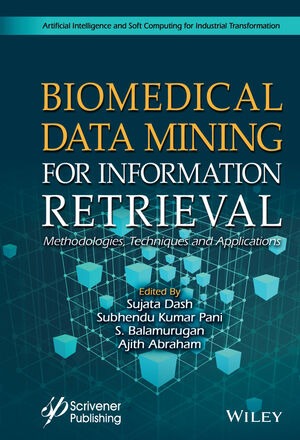
Biomedical data mining for information retrieval : Methodologies, techniques, and applications
Discusses data mining, biomedical image processing, information retrieval with broad coverage of basic scientific applications. covers the topic of mining biomedical text, images and visual features towards information retrieval. Biomedical and health informatics is an emerging field of research at the intersection of information science, computer science, and healthcare and brings tremendous opportunities and challenges due to easily available and abundant biomedical data for further analysis. The aim of healthcare informatics is to ensure the high-quality, efficient healthcare, better treatment and quality of life by analyzing biomedical and healthcare data including patient’s data, electronic health records (EHRs) and lifestyle. Previously, it was a common requirement to have a domain expert to develop a model for biomedical or healthcare; however, recent advancements in representation learning algorithms allows us to automatically to develop the model. Biomedical image mining, a novel research area, due to the vast amount of available biomedical images, increasingly generates and stores digitally.
