



الصفحة 1
الصفحة 1

On The Interpretation of Treaties : The Modern International Law as Expressed in the 1969 Vienna Convention on the Law of Treaties
This book investigates the contents and structure of this system. By importing knowledge from linguistics, and pragmatics in particular, a model is established giving representation to the concept of a rule of interpretation. Drawing on this model, the book then proceeds to reconstruct the contents of the various rules of interpretation. To facilitate reference, the conclusions suggest a list of 44 rules, all of which can be invoked by appliers citing VCLT Articles 31-33.

OMDoc : An Open Markup Format for Mathematical Documents [version 1.2]
Computers arechanging the way wethink. Of course,nearly all desk-workers have access to computers and use them to email their colleagues, search the Web for information and prepare documents. But I’m not referring to that. I mean that people have begun to think about what they do in compu- tional terms and to exploit the power of computers to do things that would previously have been unimaginable. This observation is especially true of mathematicians.

Object Recognition, Attention, and Action
This book provides an excellent introduction to the issues that are involved, with chapters that address the ways in which humans and machines attend to, recognize, and act toward objects in the visual environment.

Numerical Methods for Controlled Stochastic Delay Systems
The Markov chain approximation methods are widely used for the numerical solution of nonlinear stochastic control problems in continuous time. This book extends the methods to stochastic systems with delays. Because such problems are infinite-dimensional, many new issues arise in getting good numerical approximations and in the convergence proofs. Useful forms of numerical algorithms and system approximations are developed in this work, and the convergence proofs are given. All of the usual cost functions are treated as well as singular and impulsive controls. A major concern is on representations and approximations that use minimal memory.

Notes on Coxeter Transformations and the McKay Correspondence
One of the beautiful results in the representation theory of the finite groups is McKay's theorem on a correspondence between representations of the binary polyhedral group of SU(2) and vertices of an extended simply-laced Dynkin diagram. The Coxeter transformation is the main tool in the proof of the McKay correspondence, and is closely interrelated with the Cartan matrix and Poincaré series. The Coxeter functors constructed by Bernstein, Gelfand and Ponomarev plays a distinguished role in the representation theory of quivers.

Noetherian Semigroup Algebras
This work presents a comprehensive treatment of the main results and methods of the theory of Noetherian semigroup algebras. These general results are then applied and illustrated in the context of important classes of algebras that arise in a variety of areas and have been recently intensively studied. Several concrete constructions are described in full detail, in particular intriguing classes of quadratic algebras and algebras related to group rings of polycyclic-by-finite groups. These give new classes of Noetherian algebras of small Gelfand-Kirillov dimension. The focus is on the interplay between their combinatorics and the algebraic structure.
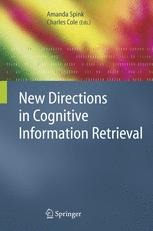
New Directions in Cognitive Information Retrieval
New Directions in Cognitive Information Retrieval presents an exciting new direction for research into cognitive oriented information retrieval (IR) research, a direction based on an analysis of the user’s problem situation and cognitive behavior when using the IR system. This contrasts with the current dominant IR research paradigm which concentrates on improving IR system matching performance. The chapters describe the leading edge concepts and models of cognitive IR that explore the nexus between human cognition, information and the social conditions that drive humans to seek information using IR systems. Chapter topics include: Polyrepresentation, cognitive overlap and the boomerang effect, Multitasking while conducting the search, Knowledge Diagram Visualizations of the topic space to facilitate user assimilation of information, Task, relevance, selection state, knowledge need and knowledge behavior, search training built into the search, children’s collaboration for school projects, and other cognitive perspectives on IR concepts and issues.

Multiplicative Invariant Theory
Multiplicative invariant theory, as a research area in its own right within the wider spectrum of invariant theory, is of relatively recent vintage. The present text offers a coherent account of the basic results achieved thus far.. Multiplicative invariant theory is intimately tied to integral representations of finite groups. Therefore, the field has a predominantly discrete, algebraic flavor. Geometry, specifically the theory of algebraic groups, enters through Weyl groups and their root lattices as well as via character lattices of algebraic tori.

Multiple Abstraction Hierachies for Mobile Robot Operation in Large Environments
This book focuses on the efficient performance of mobile robots through the use of multi-hierarchical symbolic representations of the environment. A mobile robot intended to perform deliberative actions must possess some symbolic representation of its workspace, but such representations of real environments usually become so large that should be conveniently arranged in order to facilitate and, in some cases, make possible their use. This book addresses all these issues considering symbolic multi-hierarchical structures. Such structures, based on the concept of abstraction, allow a robot to speed up its operation in large environments. Practical solutions tested on real robots (for instance, a robotic wheelchair for elder people) are provided.

Multimodal Texts in Disciplinary Education : A Comprehensive Framework
This book provides an introduction to multimodality and the role of multimodal texts in today’s education. Presenting a comprehensive framework for analysing and working with multimodal texts in disciplinary education, it serves as a tool for researchers and teachers alike. The second part of the book focuses on sample analyses of a variety of educational texts for different age groups and from different disciplines, including games and online resources. The authors also comment on the specific challenges of each text, and how teachers can discuss such texts with their students to enhance both their understanding of the content and their multimodal literacy.

Multimedia Content Representation, Classification and Security ; International Workshop, MRCS 2006, Istanbul, Turkey, September 11-13, 2006, Proceedings
This book constitutes the refereed proceedings of the International Workshop on Multimedia Content Representation, Classification and Security, MRCS 2006, held in Istanbul, Turkey in September 2006. The 100 revised papers presented together with 4 invited lectures were carefully reviewed and selected from more than 190 submissions. The papers are organized in topical sections on biometric recognition, multimedia content security, steganography, watermarking, authentication, classification for biometric recognition, digital watermarking, content analysis and representation, 3D object retrieval and classification, representation, analysis and retrieval in cultural heritage, content representation, indexing and retrieval, content analysis and classification, feature extraction and classification, multimodal signal processing, 3D video and free viewpoint video, multimedia content transmission and classification, video and image processing, as well as video analysis and representation.

MSC Maximal Stress Cooperation
In 1996 my book ‘The Nature of Cultures’ appeared in Vi- na and New York. It describes cultures as systems which are controlled by MSC and decorum. While MSC is a neologism meaning ‘maximal stress cooperation’ decorum is a very old term. It is as old as Western culture itself, and is furthermore, the translation of the even older Greek word ‘prepon’. Decorum and prepon mean ‘to be suitable, to be fitting’. It is all about the fitting of cultural medial contents to elementary cultural behavioural types and behavioural phases. These behavioural units are subject to a type of ranking system in which that which is essential is sorted from that which less essential. - corum then means – the representations of the media must ‘fit’ the ranking of the cultural behaviour. It is MSC which assumes the top position in this ranking. In 1996 and the two previous years when I was working on my book ‘The Nature of Cultures’ less than 5 years had passed since the Iron Curtain had been lifted. Many believed at that time that with ending of the Cold War, which was more or less de facto peace anyway, that a new and better age of peace was dawning.

Modern construction envelopes
Using current examples by renowned architects, Watts presents the constructive and material-related details. It is based on a text, photos, and standardized detail drawings, as well as 3D representations of the components

Modelling in Mechanical Engineering and Mechatronics : Towards Autonomous Intelligent Software Models
Modelling in Mechanical Engineering and Mechatronics presents a model-centred approach focusing on distributed development and use of autonomous intelligent software models, particularly the efficiency of the models, and their interaction and integration into distributed autonomous intelligent systems. In order to systematise the available knowledge, a domain ontology is presented; a subset of which is used to create a modelling theory based on knowledge and experience in the areas of software engineering, mechanical engineering and mechatronics. This holistic view of modelling explains the purpose and the essence of modelling, as well as the benefits that are to be expected. It discusses the relations to other branches of engineering and science and as a result, it demonstrates strategies, methods and tools for unleashing the full power of modelling.
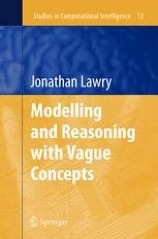
Modelling and Reasoning with Vague Concepts
This volume outlines a formal representation framework for modelling and reasoning with vague concepts in Artificial Intelligence. The new calculus has many applications, especially in automated reasoning, learning, data analysis and information fusion. This book gives a rigorous introduction to label semantics theory, illustrated with many examples, and suggests clear operational interpretations of the proposed measures. It also provides a detailed description of how the theory can be applied in data analysis and information fusion based on a range of benchmark problems.
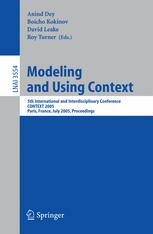
Modeling and Using Context ; 5th International and Interdisciplinary Conference, CONTEXT 2005, Paris, France, July 5-8, 2005, Proceedings
Context is of crucial importance for research and applications in many disciplines, as evidenced by many workshops, symposia, seminars, and conferences on specific aspects of context. The International and Interdisciplinary Conference on Modeling and Using Context (CONTEXT), the oldest conference series focusing on context, provides a unique interdisciplinary emphasis, bringing together participants from a wide range of disciplines, including artificial intelligence, cognitive science, computer science, linguistics, organizational science, philosophy, psychology, ubiquitous computing, and application areas such as medicine and law, to discuss and report on context-related research and projects. Previous CONTEXT conferences were held in Rio de Janeiro, Brazil (1997), Trento, Italy (1999, LNCS 1688), Dundee, UK (2001, LNCS 2116), and Palo Alto, USA (2003, LNCS 2680). CONTEXT 2005 was held in Paris, France during July 5–8, 2005. There was a strong response to the CONTEXT 2005 Call for Papers, with 120 submissions received. A careful review process assessed all submissions, with each paper first reviewed by the international Program Committee, and then reviewer discussions were initiated as needed to assure that the final decisions carefully considered all aspects of each paper. Reviews of submissions by the Program Chairs were supervised independently and anonymously, to assure fair consideration of all work. Out of the 120 submissions, 23 were selected as full papers for oral presentation, and 20 were selected as full papers for poster presentation. These outstanding papers are presented in this proceedings.
Modeling and Management of Fuzzy Semantic RDF Data
Presents the latest research findings in fuzzy RDF data modeling and management. Fuzziness widely exist in many data and knowledge intensive applications. With the increasing amount of metadata available, efficient and scalable management of massive semantic data with uncertainty is of crucial importance. This book goes to great depth concerning the fast-growing topic of technologies and approaches of modeling and managing fuzzy metadata with Resource Description Framework (RDF) format. Its major topics include representation of fuzzy RDF data, fuzzy RDF graph matching, query of fuzzy RDF data, and persistence of fuzzy RDF data in diverse databases. The objective of the book is to provide the state-of-the-art information to researchers, practitioners, and postgraduates students who work on the area of big data intelligence and at the same time serve as the uncertain data and knowledge engineering professional as a valuable real-world reference.

Model-Based Software and Data Integration ; 1st International Workshop, MBSDI 2008, Berlin, Germany, April 1-3, 2008. Proceedings
The First International Workshop on Model-Based Software and Data Integ- tion (MBSDI 2008), was ourfrst event of this kind in a forthcoming series of activities at TU Berlin, where a scientifc discussion and exchange forum was provided for both academic and industrial researchers. We aimed at researchers, engineersand practitionerswho focus onadvanced, model-basedsolutions inthe area of software and information integration and interoperability. As withevery beginning, the resonanceonour callsin today's overfoodingof workshops was somewhat unpredictable, and we did not really know how many paper submissions to expect. We were nicely surprised, considering the rather short lead time to organize the meeting and the very specialized and focused topic.

Model Driven Architecture and Ontology Development
Gaševic and his co-authors try to fill this gap by covering the subject of MDA application for ontology development on the Semantic Web. Part I of their book describes existing technologies, tools, and standards like XML, RDF, OWL, MDA, and UML. Part II presents the first detailed description of OMG’s new ODM (Ontology Definition Metamodel) initiative, a specification which is expected to be in the form of an OMG language like UML. Finally, Part III is dedicated to applications and practical aspects of developing ontologies using MDA-based languages.

Model Checking Software ; Vol. 3925 ; 13th International SPIN Workshop, Vienna, Austria, March 30 - April 1, 2006, Proceedings
he name “SPIN” refers both to a workshopon model checking and to a famous model checking tool. The SPIN workshop is an annual forum for practitioners and researchersinterested in state space-based techniques for the validation and analysis of software and hardware systems, including communication protocols. It focuses on techniques based on explicit representations of state spaces, as implemented in the SPIN model checker or other tools, and techniques based on a combination of explicit representations with other representations. The SPIN model checker has proven to be particularly suited for the analysis of concurrent asynchronous systems. The workshop aims to encourage interaction and exchange of ideas with all related areas in software engineering.
