



الصفحة 1
الصفحة 1
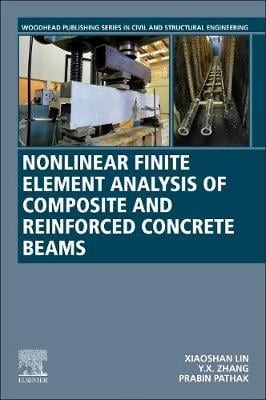
Nonlinear finite element analysis of composite and reinforced concrete beams
Nonlinear Finite Element Analysis of Composite and Reinforced Concrete Beams presents advanced methods and techniques for the analysis of composite and FRP reinforced concrete beams. The title introduces detailed numerical modeling methods and the modeling of the structural behavior of composite beams, including critical interfacial bond-slip behavior. It covers a new family of composite beam elements developed by the authors. Other sections cover nonlinear finite element analysis procedures and the numerical modeling techniques used in commercial finite element software that will be of particular interest to engineers and researchers executing numerical simulations.
Nonlinear Dynamics of Structures Under Extreme Transient Loads
Covers model building for different engineering structures and provides detailed presentations of extreme loading conditions. A number of illustrations are given quantifying; a plane crash or explosion induced impact loading, the effects of strong earthquake motion, and the impact and long-duration effects of strong stormy winds—along with a relevant framework for using modern computational tools. The book considers the levels of reserve in existing structures, and ways of reducing the negative impact of high-risk situations by employing sounder design procedures.

Non-destructive testing and evaluation of civil engineering structures
The non-destructive evaluation of civil engineering structures in reinforced concrete is becoming an increasingly important issue in this field of engineering. This book proposes innovative ways to deal with this problem, through the characterization of concrete durability indicators by the use of non-destructive techniques. It presents the description of the various non-destructive techniques and their combination for the evaluation of indicators. The processing of data issued from the combination of NDE methods is also illustrated through examples of data fusion methods.

New Materials in Civil Engineering
A valuable guide to the properties, selection criteria, products, applications, lifecycle and recyclability of advanced materials. It presents an A-to-Z approach to all types of materials, highlighting their key performance properties, principal characteristics and applications. Traditional materials covered include concrete, soil, steel, timber, fly ash, geosynthetic, fiber-reinforced concrete, smart materials, carbon fiber and reinforced polymers. In addition, the book covers nanotechnology and biotechnology in the development of new materials.

Metakaolin and Fly Ash as Mineral Admixtures for Concrete
Deals with modern theoretical concepts related to the impact of fly ash and metakaolin admixtures on structure formation processes of concrete. Results of the effect of fly ash, metakaolin and their composition on properties of self-compacting and self-leveling concrete are presented. Based on mathematical models, obtained using mathematical experiments planning methodology, the impact of the main factors and their combination on workability, strength and other properties that determine efficiency and durability of concrete are analyzed. Using calculated dependencies, a methodology for designing optimal compositions of concrete containing active mineral admixtures and superplasticizers is proposed. Features of industrial production of concrete for the proposed compositions are discussed. The book is intended for specialists working in the production of concrete and reinforced concrete products and elements. It can also be used by construction engineers to design compositions of cost-effective self-compacting and self-leveling concrete as well as to determine the rational direction of using technogenic raw materials like ash and metakaolin.

Mechanical Modelling and Computational Issues in Civil Engineering
In this edited book various novel approaches to problems of modern civil engineering are demonstrated. Experts associated within the Lagrange Laboratory present recent research results in civil engineering dealing both with modelling and computational aspects.

Measuring, Monitoring and Modeling Concrete Properties ; An International Symposium dedicated to Professor Surendra P. Shah, Northwestern University, USA
Of ECF16 Chairman Emmanuel E. Gdoutos The "16th European Conference of Fracture. The present volume is devoted to the symposium on "Measuring, Monitoring and Modeling Concrete Properties" (MMMCP). ECF16 focused in all aspects of structural integrity with the objective of improving the safety and performance of engineering str- tures, components, systems and their associated materials.

High performance concrete optimal composition design
Presents experimental and theoretical results allowing production of special high-strength rapid hardening concrete and fiber reinforced concrete. It describes a method for effective proportioning of high-strength fast-setting concrete and fiber reinforced concrete with high dynamic strength as well as selecting proper technological parameters, methodology for design of reinforced concrete structures using such concrete. Particular attention is paid to ensuring the early strengthening of concrete within 24 hours after casting and to constructing structures with limited energy resources at the site.

Fundamentals of durable reinforced concrete
The book presents a framework for specification through internationally adopted codes and standards and summarises the background to probabilistic approaches to durability design, providing a state-of-the-art review of mathematical modelling of deterioration mechanisms along with current directions in test methods for performance-based specifications.

Fundamentals of building construction : Materials and methods
Reference for thousands of professionals and students of architecture, engineering, and construction technology for over thirty years. The materials and methods described in this new seventh edition have been thoroughly updated to reflect the latest advancements in the industry. Carefully selected and logically arranged topics-ranging from basic building methods to the principles of structure and enclosure-help readers gain a working knowledge of the field in an enjoyable, easy-to-understand manner. All major construction systems, including light wood frame, mass timber, masonry, steel frame, light gauge steel, and reinforced concrete construction, are addressed. Now in its seventh edition, Fundamentals of building construction contains substantial revisions and updates.

Finite Elements in Structural Analysis : Theoretical Concepts and Modeling Procedures in Statics and Dynamics of Structures
Introduces the basic concepts of the finite element method in the static and dynamic analysis of beam, plate, shell and solid structures, discussing how the method works, the characteristics of a finite element approximation and how to avoid the pitfalls of finite element modeling. Presenting the finite element theory as simply as possible, the book allows readers to gain the knowledge required when applying powerful FEA software tools. Further, it describes modeling procedures, especially for reinforced concrete structures, as well as structural dynamics methods, with a particular focus on the seismic analysis of buildings, and explores the modeling of dynamic systems. Featuring numerous illustrative examples, the book allows readers to easily grasp the fundamentals of the finite element theory and to apply the finite element method proficiently.

Fibre reinforced concrete : Improvements and innovations II : X rILEM-fib international symposium on fibre reinforced concrete (BEFIB) 2021
Highlights the latest advances, innovations, and applications in the field of fibre-reinforced concrete (FRC). It discusses a diverse range of topics concerning FRC: technological aspects, nanotechnologies related with FRC, mechanical properties, long-term properties, analytical and numerical models, structural design, codes and standards, quality control, case studies, Textile-Reinforced Concrete, Geopolymers.

Fiber Concrete : In Construction
Helps the user to correctly use fiber-reinforced concrete as a building material in accordance with its properties in order to create a long-lasting building for the client at low cost. Fiber-reinforced concrete as an extension of concrete offers considerable advantages for building practice, which, based on the material properties, enable a very long service life.Fiber-reinforced concrete is particularly suitable for an aggressive environment such as salt exposure, since corrosion can be completely avoided. Particular attention is also paid to the shrinkage cracks that occur in the concrete and how they can be and how these can be avoided when using fibers.

Electrochemical processes and corrosion in reinforced concrete
Some reinforced concrete structures prematurely corrode as they age, with significant financial implications, but it is not immediately clear why some are more durable than others. This book looks at the various mechanisms for corrosion and how what seemed to be a relatively simple matter has become more complex the further it is understood due to the properties of concrete, steel and the way reinforced concrete structures are constructed. The significance of electrochemical processes is identified with recent research using new technology discussed.

Durability of reinforced concrete structures
Reinforced concrete structures corrode as they age, with significant financial implications, but it is not immediately clear why some are more durable than others. This book looks at the mechanisms for corrosion and how corrosion engineering can be used for these problems to be minimized in future projects. Several different examples of reinforced concrete structures with corrosion problems are described and the various life enhancement solutions considered and applied are discussed. The book includes a chapter on the effectiveness of corrosion monitoring techniques and questions why the reality is at odds with current theory and standards.

Design of structural elements : Concrete, steelwork, masonry and timber designs to Eurocodes
Topics include the philosophy of design, sustainable development, basic structural concepts, and material properties. After an overview of structural design, the book contains self-contained chapters with numerous diagrams and worked examples on design in reinforced concrete, structural steelwork and steel/concrete composites, masonry and timber based on EN 1990-1997. Elements considered cover reinforced concrete and composite floors, isolated foundation, cantilever retaining wall, load-bearing and panel walls, stud wall and connections.

Design of Reinforced Concrete Sections Under Bending and Axial Forces : Tables and Charts According to EUROCODE 2
Contains auxiliary calculation tools to facilitate the safety assessment of reinforced concrete sections. Essential parameters in the design to the ultimate limit state of resistance such as the percentage of reinforcement and the position of the neutral axis in concrete cross-sections, as well as the control of the maximum stresses in service limit states are provided by these tools.

Design of reinforced concrete residential building in Damascus
Our project consists of a reinforced residential building in the Damascus. It is made of thirteen stories including basement, and we have two water tanks on top of the stairwell. The basement consists two shelters.
Design of Reinforced Concrete Buildings for Seismic Performance : Practical Deterministic and Probabilistic Approaches
Presents an elegant, simple and theoretically coherent design framework. Required strength is determined on the basis of an estimated yield displacement and desired limits of system ductility and drift demands. A simple deterministic approach is presented along with its elaboration into a probabilistic treatment that allows for design to limit annual probabilities of failure. The design method allows the seismic force resisting system to be designed on the basis of elastic analysis results, while nonlinear analysis is used for performance verification. Detailing requirements of ACI 318 and Eurocode 8 are presented. Students will benefit from the coverage of seismology, structural dynamics, reinforced concrete, and capacity design approaches, which allows the book to be used as a foundation text in earthquake engineering.

Design of Hybrid Structures : Where Steel Profiles Meet Concrete
Focuses on design approaches for concrete structures reinforced in an unconventional way by steel profiles. It explains force transfer mechanisms of steel profiles and oncrete interfaces, and an analysis of the characteristics of hybrid structures, including slendercomponents. Several types of hybrid designs are addressed: walls and columns with several embedded steel profiles, connections strengthened by steel profiles between steel and composite or reinforced concrete components, including the specific case of shear keys connecting deep beams or flat slabs to columns. The transition zones in partly reinforced concrete and partly composite columns are also covered.
