



الصفحة 1
الصفحة 1

Modeling Uncertainty : An Examination of Stochastic Theory, Methods, and Applications
Modeling Uncertainty: An Examination of Stochastic Theory, Methods, and Applications, is a volume undertaken by the friends and colleagues of Sid Yakowitz in his honor. Fifty internationally known scholars have collectively contributed 30 papers on modeling uncertainty to this volume. Each of these papers was carefully reviewed and in the majority of cases the original submission was revised before being accepted for publication in the book. The papers cover a great variety of topics in probability, statistics, economics, stochastic optimization, control theory, regression analysis, simulation, stochastic programming, Markov decision process, application in the HIV context, and others. There are papers with a theoretical emphasis and others that focus on applications. A number of papers survey the work in a particular area and in a few papers the authors present their personal view of a topic. It is a book with a considerable number of expository articles, which are accessible to a nonexpert - a graduate student in mathematics, statistics, engineering, and economics departments, or just anyone with some mathematical background who is interested in a preliminary exposition of a particular topic. Many of the papers present the state of the art of a specific area or represent original contributions which advance the present state of knowledge. In sum.
Modeling Longitudinal Data
This book teaches the art and statistical science of modern longitudinal data analysis. The author emphasizes specifying, understanding, and interpreting longitudinal data models. He inspects the longitudinal data graphically, analyzes the time trend and covariates, models the covariance matrix, and then draws conclusions. The book has many figures and tables illustrating longitudinal data and numerous homework problems. The associated web site contains many longitudinal data sets, examples of computer code, and labs to re-enforce the material.
Mathematics of Uncertainty : Ideas, Methods, Application Problems
Mathematics of Uncertainty" provides the basic ideas and foundations of uncertainty, covering the fields of mathematics in which uncertainty, variability, imprecision and fuzziness of data are of importance. This introductory book describes the basic ideas of the mathematical fields of uncertainty from simple interpolation to wavelets, from error propagation to fuzzy sets and neural networks. The book presents the treatment of problems of interpolation and approximation, as well as observation fuzziness which can essentially influence the preciseness and reliability of statements on functional relationships.

Introductory Statistics with R
R is an Open Source implementation of the S language. It works on multiple computing platforms and can be freely downloaded. R is now in widespread use for teaching at many levels as well as for practical data analysis and methodological development. This book provides an elementary-level introduction to R, targeting both non-statistician scientists in various fields and students of statistics. The main mode of presentation is via code examples with liberal commenting of the code and the output, from the computational as well as the statistical viewpoint. A supplementary R package can be downloaded and contains the data sets.
Innovations in fuzzy clustering : Theory and applications
There is a great interest in clustering techniques due to the vast amount of data generated in every field including business, health, science, engineering, aerospace, management and so on. It is essential to extract useful information from the data. Clustering techniques are widely used in pattern recognition and related applications. The following contents are included: Introduction to Fuzzy Clustering / Fuzzy Clustering based Principal Component Analysis / Fuzzy Clustering based Regression Analysis Kernel based Fuzzy Clustering / Evaluation of Fuzzy Clustering / Self-Organized Fuzzy Clustering
Handbook of Multilevel Analysis
Multilevel analysis is the statistical analysis of hierarchically and non-hierarchically nested data. The simplest example is clustered data, such as a sample of students clustered within schools. Multilevel data are especially prevalent in the social and behavioral sciences and in the bio-medical sciences. The models used for this type of data are linear and nonlinear regression models that account for observed and unobserved heterogeneity at the various levels in the data. This book presents the state of the art in multilevel analysis, with an emphasis on more advanced topics. These topics are discussed conceptually, analyzed mathematically, and illustrated by empirical examples. The authors of the chapters are the leading experts in the field.

Finite Mixture and Markov Switching Models
The prominence of finite mixture modelling is greater than ever. Many important statistical topics like clustering data, outlier treatment, or dealing with unobserved heterogeneity involve finite mixture models in some way or other. The area of potential applications goes beyond simple data analysis and extends to regression analysis and to non-linear time series analysis using Markov switching models.It is the first time that the Bayesian perspective of finite mixture modelling is systematically presented in book form. It is argued that the Bayesian approach provides much insight in this context and is easily implemented in practice. Although the main focus is on Bayesian inference, the author reviews several frequentist techniques, especially selecting the number of components of a finite mixture model, and discusses some of their shortcomings compared to the Bayesian approach. The aim of this book is to impart the finite mixture and Markov switching approach to statistical modelling to a wide-ranging community. This includes not only statisticians, but also biologists, economists, engineers, financial agents, market researcher, medical researchers or any other frequent user of statistical models. This book should help newcomers to the field to understand how finite mixture and Markov switching models are formulated, what structures they imply on the data, what they could be used for, and how they are estimated.

Econometrics
This textbook teaches some of the basic econometric methods and the underlying assumptions behind them. It also includes a simple and concise treatment of more advanced topics in spatial correlation, panel data, limited dependent variables, regression diagnostics, specification testing and time series analysis. Some of the strengths of this book lie in presenting difficult material in a simple, yet rigorous manner. Each chapter has a set of theoretical exercises as well as an empirical illustration using a real economic application.
Dealing with Uncertainties : A Guide to Error Analysis
Dealing with Uncertainties proposes and explains a new approach for the analysis of uncertainties. Firstly, it is shown that uncertainties are the consequence of modern science rather than of measurements. Secondly, it stresses the importance of the deductive approach to uncertainties.

Correlated Data Analysis : Modeling, Analytics, and Applications
Presents some recent developments in correlated data analysis. It utilizes the class of dispersion models as marginal components in the formulation of joint models for correlated data. This enables the book to handle a broader range of data types than those analyzed by traditional generalized linear models.
Linear and Generalized Linear Mixed Models and Their Applications
This book covers two major classes of mixed effects models, linear mixed models and generalized linear mixed models, and it presents an up-to-date account of theory and methods in analysis of these models as well as their applications in various fields. The book offers a systematic approach to inference about non-Gaussian linear mixed models. Furthermore, it has included recently developed methods, such as mixed model diagnostics, mixed model selection, and jackknife method in the context of mixed models.
Linear and Generalized Linear Mixed Models and Their Applications
This book covers two major classes of mixed effects models—linear mixed models and generalized linear mixed models—and it presents an up-to-date account of theory and methods in analysis of these models as well as their applications in various fields. It offers a systematic approach to inference about non-Gaussian linear mixed models. Furthermore, it discusses the latest developments and methods in the field, incorporating relevant updates since publication of the first edition. These include advances in high-dimensional linear mixed models in genome-wide association studies (GWAS), advances in inference about generalized linear mixed models with crossed random effects, new methods in mixed model prediction, mixed model selection, and mixed model diagnostics.
Classical Methods of Statistics : With Applications in Fusion-Oriented Plasma Physics
Classical Methods of Statistics is a blend of theory and practical statistical methods written for graduate students and researchers interested in applications to plasma physics and its experimental aspects. It can also fruitfully be used by students majoring in probability theory and statistics. In the first part, the mathematical framework and some of the history of the subject are described. Many exercises help readers to understand the underlying concepts. In the second part, two case studies are presented exemplifying discriminant analysis and multivariate profile analysis. The introductions of these case studies outline contextual magnetic plasma fusion research. In the third part, an overview of statistical software is given and, in particular, SAS and S-PLUS are discussed. In the last chapter, several datasets with guided exercises, predominantly from the ASDEX Upgrade tokamak, are included and their physical background is concisely described. The book concludes with a list of essential keyword translations.
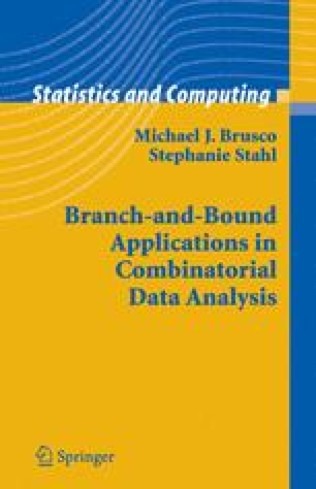
Branch-and-Bound Applications in Combinatorial Data Analysis
There are a variety of combinatorial optimization problems that are relevant to the examination of statistical data. Combinatorial problems arise in the clustering of a collection of objects, the seriation (sequencing or ordering) of objects, and the selection of variables for subsequent multivariate statistical analysis such as regression. The options for choosing a solution strategy in combinatorial data analysis can be overwhelming. Because some problems are too large or intractable for an optimal solution strategy, many researchers develop an over-reliance on heuristic methods to solve all combinatorial problems. However, with increasingly accessible computer power and ever-improving methodologies, optimal solution strategies have gained popularity for their ability to reduce unnecessary uncertainty. In this monograph, optimality is attained for nontrivially sized problems via the branch-and-bound paradigm.
Biostatistics and microbiology : A survival manual
This book presents a step-by-step manner that eliminates the greatest obstacle to the learner, which is applying the many processes that comprise a statistical method. The author counters the fear of statistical methods by describing early in the book a step-by-step procedure to perform a statistical method - a process that we will term "the six-step procedure." All of the testing will be performed adhering to six well-defined steps, which will greatly simplify the statistical process. Each step in the sequence must be completed before moving on to the next step.

Artificial intelligence techniques in hydrology and water resources management
The sustainable management of water cycles is crucial in the context of climate change and global warming. It involves managing global, regional, and local water cycles, as well as urban, agricultural, and industrial water cycles, to conserve water resources and their relationships with energy, food, microclimates, biodiversity, ecosystem functioning, and anthropogenic activities. Hydrological modeling is indispensable for achieving this goal, as it is essential for water resources management and the mitigation of natural disasters. In recent decades, the application of artificial intelligence (AI) techniques in hydrology and water resources management has led to notable advances. In the face of hydro-geo-meteorological uncertainty, AI approaches have proven to be powerful tools for accurately modeling complex, nonlinear hydrological processes and effectively utilizing various digital and imaging data sources, such as ground gauges, remote sensing tools, and in situ Internet of Things (IoT) devices.

A concise guide to market research : The process, data, and methods using IBM SPSS Statistics, 3rd
Offers an easily accessible and comprehensive guide to the entire market research process, from asking market research questions to collecting and analyzing data by means of quantitative methods. It is intended for all readers who wish to know more about the market research process, data management, and the most commonly used methods in market research. The book helps readers perform analyses, interpret the results, and make sound statistical decisions using IBM SPSS Statistics. Hypothesis tests, ANOVA, regression analysis, principal component analysis, factor analysis, and cluster analysis, as well as essential descriptive statistics, are covered in detail.
