



الصفحة 1
الصفحة 1

New Algorithms, Architectures and Applications for Reconfigurable Computing
New Algorithms, Architectures and Applications for Reconfigurable Computing consists of a collection of contributions from the authors of some of the best papers from the Field Programmable Logic conference (FPL’03) and the Design and Test Europe conference (DATE’03).

Introduction to Reconfigurable Computing : Architectures, Algorithms, and Applications
“Introduction to Reconfigurable Computing” provides a comprehensive study of the field Reconfigurable Computing. It provides an entry point to the novice willing to move in the research field reconfigurable computing, FPGA and system on programmable chip design. The book can also be used as teaching reference for a graduate course in computer engineering, or as reference to advance electrical and computer engineers. It provides a very strong theoretical and practical background to the field of reconfigurable computing, from the early Estrin’s machine to the very modern architecture like coarse-grained reconfigurable device and the embedded logic devices.

Fine- and Coarse-Grain Reconfigurable Computing
The FPGA technology is defined, which includes architecture, logic block structure, interconnect, and configuration methods and existing fine-grain reconfigurable architectures emerged from both academia and industry. Additionally, the implementation techniques and CAD tools developed to facilitate the implementation of a system in reconfigurable hardware by the industry and academia are provided.

Architecture of computing systems ; 34th International Conference, ARCS 2021, Virtual Event, June 7–8, 2021, Proceedings
This book constitutes the proceedings of the 34th International Conference on Architecture of Computing Systems, ARCS 2021, held virtually in July 2021. The 12 full papers in this volume were carefully reviewed and selected from 24 submissions. 2 workshop papers (VEFRE) are also included. ARCS has always been a conference attracting leading-edge research outcomes in Computer Architecture and Operating Systems, including a wide spectrum of topics ranging from fully integrated, self-powered embedded systems up to high-performance computing systems. It also provides a platform covering newly emerging and cross-cutting topics, such as autonomous and ubiquitous systems, reconfigurable computing and acceleration, neural networks and artificial intelligence. The selected papers cover a variety of topics from the ARCS core domains, including heterogeneous computing, memory optimizations, and organic computing.
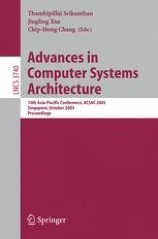
Advances in computer systems architecture ; Vol. 3740 ; 10th Asia-Pacific conference, ACSAC 2005, Singapore, October 24-26, 2005, Proceedings
The papers are organized in topical sections on energy efficient and power aware techniques, methodologies and architectures for application-specific systems, processor architectures and microarchitectures, high-reliability and fault-tolerant architectures, compiler and OS for emerging architectures, data value predictions, reconfigurable computing systems and polymorphic architectures, interconnect networks and network interfaces, parallel architectures and computation models, hardware-software partitioning, verification, and testing of complex architectures, architectures for secured computing, simulation and performance evaluation, architectures for emerging technologies and applications, and memory systems hierarchy and management
