



الصفحة 1
الصفحة 1

Metric Spaces
This volume provides a complete introduction to metric space theory for undergraduates. It covers the topology of metric spaces, continuity, connectedness, compactness and product spaces, and includes results such as the Tietze-Urysohn extension theorem, Picard's theorem on ordinary differential equations, and the set of discontinuities of the pointwise limit of a sequence of continuous functions.

Measure, Integration & Real Analysis
This book welcomes students into the fundamental theory of measure, integration, and real analysis. Focusing on an accessible approach, Axler lays the foundations for further study by promoting a deep understanding of key results.

Measure Theory and Probability Theory
The book can be used as a text for a two semester sequence of courses in measure theory and probability theory, with an option to include supplemental material on stochastic processes and special topics.Prerequisites are kept to the minimal level of an understanding of basic real analysis concepts such as limits, continuity, differentiability, Riemann integration, and convergence of sequences and series. A review of this material is included in the appendix. The book starts with an informal introduction that provides some heuristics into the abstract concepts of measure and integration theory, which are then rigorously developed. The first part of the book can be used for a standard real analysis course for both mathematics and statistics Ph.D. students as it provides full coverage of topics such as the construction of Lebesgue-Stieltjes measures on real line and Euclidean spaces, the basic convergence theorems, L^p spaces, signed measures, Radon-Nikodym theorem, Lebesgue's decomposition theorem and the fundamental theorem of Lebesgue integration on R, product spaces and product measures, and Fubini-Tonelli theorems. It also provides an elementary introduction to Banach and Hilbert spaces, convolutions, Fourier series and Fourier and Plancherel transforms.

Introduzione alla teoria della misura e all’analisi funzionale = Introduction to measurement theory and functional analysis
Presents a treatment of the theory of measure from an abstract point of view, with particular emphasis on some aspects of interest in probability. The typical arguments of the theory of integration are developed in a rather in-depth way, trying where possible to deduce classical results from the modern setting of the theory as well. The text has a modular structure, with interconnections between the parts: some chapters deal with theoretical aspects, others are dedicated to more applied topics. Alongside the numerous examples, a wide range of exercises is proposed.

Introduction to Stochastic Calculus for Finance : A New Didactic Approach
The justifcation is mainly pedagogical. These lecture notes start with an elementary approach to stochastic calculus due to Föllmer, who showed that one can develop Ito's calculus "pathwise" as an exercise in real analysis. The text opens to students interested in finance a quick (but by no means "dirty") road to the tools required for advanced finance in continuous time, including option pricing by martingale methods, term structure models in a HJM-framework and the Libor market model.

Functions de variable réelle : Théorie élémentaire = Real variable functions : Elementary theory
The Mathematics Elements of Nicolas BOURBAKI aim to provide a rigorous, systematic presentation without prerequisites of mathematics from their foundations. This Book is the fourth of the treaty; it is devoted to the basics of real analysis. It includes the chapters: Derivatives; Primitive and integral; Elementary functions; Differential equations ; Local study of functions; Generalized Taylorian developments. Euler-Maclaurin summation formula; The gamma function. It also contains historical notes.
Linear Functional Analysis
This introduction to the ideas and methods of linear functional analysis shows how familiar and useful concepts from finite-dimensional linear algebra can be extended or generalized to infinite-dimensional spaces. Aimed at advanced undergraduates in mathematics and physics, the book assumes a standard background of linear algebra, real analysis (including the theory of metric spaces), and Lebesgue integration, although an introductory chapter summarizes the requisite material. The initial chapters develop the theory of infinite-dimensional normed spaces, in particular Hilbert spaces, after which the emphasis shifts to studying operators between such spaces. Functional analysis has applications to a vast range of areas of mathematics; the final chapters discuss the particularly important areas of integral and differential equations.
Calculus of one variable
Aimed at first-year undergraduates in mathematics and the physical sciences, the only prerequisites are basic algebra, coordinate geometry and the beginnings of differentiation as covered in school. The transition from school to university mathematics is addressed by means of a systematic development of important classes of techniques, and through careful discussion of the basic definitions and some of the theorems of calculus, with proofs where appropriate, but stopping short of the rigour involved in Real Analysis.The influence of technology on the learning and teaching of mathematics is recognised through the use of the computer algebra and graphical package MAPLE to illustrate many of the ideas.
Basic Real Analysis
Basic Real Analysis and Advanced Real Analysis (available separately or together as a Set) systematically develop those concepts and tools in real analysis that are vital to every mathematician, whether pure or applied, aspiring or established. These works present a comprehensive treatment with a global view of the subject, emphasizing the connections between real analysis and other branches of mathematics.
Analysis II
As with the first, the second volume contains substantially more material than can be covered in a one-semester course. Such courses may omit many beautiful and well-grounded applications which connect broadly to many areas of mathematics. We of course hope that students will pursue this material independently; teachers may find it useful for undergraduate seminars. For an overview of the material presented, consult the table of contents and the chapter introductions. As before, we stress that doing the numerous exercises is indispensable for understanding the subject matter, and they also round out and amplify the main text. In writing this volume, we are indebted to the help of many.
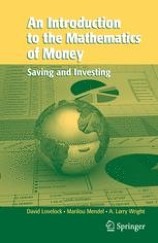
An Introduction to the Mathematics of Money : Saving and Investing
This is an undergraduate textbook on the basic aspects of personal savings and investing with a balanced mix of mathematical rigor and economic intuition. It uses routine financial calculations as the motivation and basis for tools of elementary real analysis rather than taking the latter as given. Proofs using induction, recurrence relations and proofs by contradiction are covered. Inequalities such as the Arithmetic-Geometric Mean Inequality and the Cauchy-Schwarz Inequality are used. Basic topics in probability and statistics are presented.

Advanced Real Analysis
Basic Real Analysis and Advanced Real Analysis (available separately or together as a Set) systematically develop those concepts and tools in real analysis that are vital to every mathematician, whether pure or applied, aspiring or established. These works present a comprehensive treatment with a global view of the subject, emphasizing the connections between real analysis and other branches of mathematics.

A Course in Calculus and Real Analysis
Provides a self-contained and rigorous introduction to calculus of functions of one variable. The presentation and sequencing of topics emphasizes the structural development of calculus. At the same time, due importance is given to computational techniques and applications. The authors have strived to make a distinction between the intrinsic definition of a geometric notion and its analytic characterization. It highlight the fact that calculus provides a firm foundation to several concepts and results that are generally encountered in high school and accepted on faith. For example, one can find here a proof of the classical result that the ratio of the circumference of a circle to its diameter is the same for all circles. Also, this book helps get a clear understanding of the concept of an angle and the definitions of the logarithmic, exponential and trigonometric functions together with a proof of the fact that these are not algebraic functions. A number of topics that may have been inadequately covered in calculus courses and glossed over in real analysis courses are treated here in considerable detail. As such, this book provides a unified exposition of calculus and real analysis.
