



الصفحة 1
الصفحة 1

New Computational Paradigms ; 1st Conference on Computability in Europe, CiE 2005, Amsterdam, The Netherlands, June 8-12, 2005, Proceedings
This book constitutes the refereed proceedings of the first International Conference on Computability in Europe, CiE 2005, held in Amsterdam, The Netherlands in June 2005. The 68 revised full papers presented were carefully reviewed and selected from 144 submissions. Among them are papers corresponding to two tutorials, six plenary talks and papers of six special sessions involving mathematical logic and computer science at the same time as offering the methodological foundations for models of computation. The papers address many aspects of computability in Europe with a special focus on new computational paradigms. These include first of all connections between computation and physical systems (e.g., quantum and analog computation, neural nets, molecular computation), but also cover new perspectives on models of computation arising from basic research in mathematical logic and theoretical computer science.

Information security and privacy ; 6th Australasian Conference, ACISP 2001, Sydney, Australia, July 11-13, 2001. Proceedings
A Few Thoughts on E-Commerce.- New CBC-MAC Forgery Attacks.- Cryptanalysis of a Public Key Cryptosystem Proposed at ACISP 2000.- Improved Cryptanalysis of the Self-Shrinking Generator.- Attacks Based on Small Factors in Various Group Structures.- On Classifying Conference Key Distribution Protocols.- Pseudorandomness of MISTY-Type Transformations and the Block Cipher KASUMI.- New Public-Key Cryptosystem Using Divisor Class Groups.- First Implementation of Cryptographic Protocols Based on Algebraic Number Fields.- Practical Key Recovery Schemes.- Non-deterministic Processors.- Personal Secure Booting.- Evaluation of Tamper-Resistant Software Deviating from Structured Programming Rules.- A Strategy for MLS Workflow.- Condition-Driven Integration of Security Services.- SKETHIC: Secure Kernel Extension against Trojan Horses with Informat ion-Carrying Codes.- Secure and Private Distribution of Online Video and Some Related Cryptographic Issues.- Private Information Retrieval Based on the Subgroup Membership Problem.

Information Security and Cryptology ; 3rd SKLOIS Conference, Inscrypt 2007, Xining, China, August 31 - September 5, 2007, Revised Selected Papers
This book constitutes the thoroughly refereed post-conference proceedings of the Third SKLOIS (State Key Laboratory of Information Security) Conference on Information Security and Cryptology, Inscrypt 2007 (formerly CISC), held in Xining, China, in August/September 2007.The 33 revised full papers and 10 revised short papers presented together with 2 invited papers were carefully reviewed and selected from 167 submissions. The papers are organized in topical sections on digital signature schemes, block cipher, key management, zero knowledge and secure computation protocols, secret sharing, stream cipher and pseudorandomness.

Information Geometry : Near Randomness and Near Independence
This volume will be useful to practising scientists and students working in the application of statistical models to real materials or to processes with perturbations of a Poisson process, a uniform process, or a state of independence for a bivariate process. We use information geometry to provide a common differential geometric framework for a wide range of illustrative applications including amino acid sequence spacings in protein chains, cryptology studies, clustering of communications and galaxies, cosmological voids, coupled spatial statistics in stochastic fibre networks and stochastic porous media, quantum chaology. Introduction sections are provided to mathematical statistics, differential geometry and the information geometry of spaces of probability density functions.

Design and analysis of randomized algorithms : Introduction to design paradigms
Randomness is a powerful phenomenon that can be harnessed to solve various problems in all areas of computer science. Randomized algorithms are often more efficient, simpler and, surprisingly, also more reliable than their deterministic counterparts. Computing tasks exist that require billions of years of computer work when solved using the fastest known deterministic algorithms, but they can be solved using randomized algorithms in a few minutes with negligible error probabilities. Introducing the fascinating world of randomness, this book systematically teaches the main algorithm design paradigms – foiling an adversary, abundance of witnesses, fingerprinting, amplification, and random sampling, etc. – while also providing a deep insight into the nature of success in randomization. Taking sufficient time to present motivations and to develop the reader's intuition, while being rigorous throughout, this text is a very effective and efficient introduction to this exciting field.

Computer science : Theory and applications ; 15th International computer science symposium in Russia, CSR 2020, Yekaterinburg, Russia, June 29 – July 3, 2020, Proceedings
This book constitutes the proceedings of the 15th International Computer Science Symposium in Russia, CSR 2020, held in Yekaterinburg, Russia, in June 2020. The 25 full papers and 6 invited papers were carefully reviewed and selected from 49 submissions. The papers cover a broad range of topics, such as: algorithms and data structures; computational complexity, including hardness of approximation and parameterized complexity; randomness in computing, approximation algorithms, fixed-parameter algorithms; combinatorial optimization, constraint satisfaction, operations research; computational geometry; string algorithms; formal languages and automata, including applications to computational linguistics; codes and cryptography; combinatorics in computer science; computational biology; applications of logic to computer science, proof complexity; database theory; distributed computing; fundamentals of machine learning, including learning theory, grammatical inference and neural computing; computational social choice; quantum computing and quantum cryptography; theoretical aspects of big data.

Computational Mechanics of Composite Materials : Sensitivity, Randomness and Multiscale Behaviour
The Engineering Materials and Processes series focuses on all forms of materials and the processes used to synthesise and formulate them as they relate to the various engineering disciplines. The series deals with a diverse range of materials: ceramics; metals (ferrous and non-ferrous); semiconductors; composites, polymers biomimetics etc. Each monograph in the series will be written by a specialist and will demonstrate how enhancements in materials and the processes associated with them can improve performance in the field of engineering in which they are used.
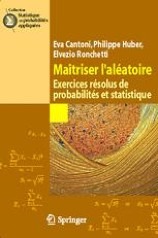
Maîtriser laléatoire : Exercices résolus de probabilités et statistique = Mastering Randomness : Solved Exercises in Probability and Statistics
Consists of 245 solved exercises that cover all the basic concepts of probability and statistics. The work is structured in nine chapters, each containing a brief introduction, bibliographic references to more specialized works, as well as a series of exercises and their detailed solutions. Ranked in increasing order of difficulty, these will allow the reader to appreciate the extent of his progress. This book can be used as a supplement to any theory manual on statistics and probability. Due to the great diversity of the examples offered, it will suit a diverse readership: students of economics, psychology, social sciences, mathematics, physics, chemistry, medicine or biology.

Chance : The life of games and the game of life
With its many easy-to-follow mathematical examples, this book takes the reader on an almost chronological trip through the fascinating and amazing laws of chance, omnipresent in the natural world and in our daily lives. Along the route many fascinating topics are discussed, such as: challenging probability paradoxes; "paranormal" coincidences; game odds; causes and effects; interpretation of opinion polls; winning chances as a game proceeds; the nature of randomness; entropy and randomness; randomness in life; algorithmic complexity and the undecidability of randomness; possibilities and limitations of learning the laws of a Universe immersed in chance events. This charming book will inform and entertain the scientist and non-scientist alike.
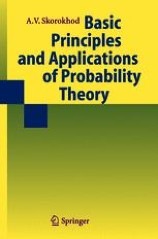
Basic principles and applications of probability theory
This introductory chapter discusses such notions as determinism, chaos and randomness, p- dictibility and unpredictibility, some initial approaches to formalizing r- domness and it surveys certain problems that can be solved by probability theory. This will perhaps give one an idea to what extent the theory can - swer questions arising in speci?c random occurrences and the character of the answers provided by the theory. 1. 1 The Nature of Randomness The phrase “by chance” has no single meaning in ordinary language. For instance, it may mean unpremeditated, nonobligatory, unexpected, and so on. Its opposite sense is simpler: “not by chance” signi?es obliged to or bound to (happen). In philosophy, necessity counteracts randomness. Necessity signi?es conforming to law – it can be expressed by an exact law. The basic laws of mechanics, physics and astronomy can be formulated in terms of precise quantitativerelationswhichmustholdwithironcladnecessity.
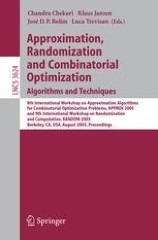
Approximation, randomization and combinatorial optimization. algorithms and techniques ; 8th international workshop on approximation algorithms for compinatorial optimization problems, APPROX 2005 and 9th international workshop on randomization and computation, RANDOM 2005, Berkeley, CA, USA, August 22-24, 2005, Proceedings
This volume contains the papers presented at the 8th International Workshopon Approximation Algorithms for Combinatorial Optimization Problems(APPROX 2005) and the 9th International Workshop on Randomization andComputation (RANDOM 2005), APPROX focuses on algorith-mic and complexity issues surrounding the development of efficient approximatesolutions to computationally hard problems, RANDOM isconcerned with applications of randomness to computational and combinatorialproblems, The volume contains 20 contributed papers selected by the APPROX Pro-gram
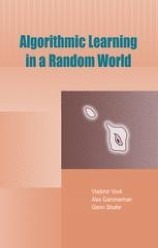
Algorithmic Learning in a Random World
This new monograph integrates mathematical theory and revealing experimental work. It demonstrates mathematically the validity of the reliability claimed by conformal predictors when they are applied to independent and identically distributed data, and it confirms experimentally that the accuracy is sufficient for many practical problems. Later chapters generalize these results to models called repetitive structures, which originate in the algorithmic theory of randomness and statistical physics. The approach is flexible enough to incorporate most existing methods of machine learning, including newer methods such as boosting and support vector machines and older methods such as nearest neighbors and the bootstrap.
A Modular Calculus for the Average Cost of Data Structuring
This volume, with forewords by Greg Bollella and Dana Scott, presents novel programs based on the new advances in this area, including the first randomness-preserving version of Heapsort. Programs are provided, along with derivations of their average-case time, to illustrate the radically different approach to average-case timing. The automated static timing tool applies the Modular Calculus to extract the average-case running time of programs directly from their MOQA code.
