



الصفحة 1
الصفحة 1

Microwave Radiometry of Vegetation Canopies
Research into microwave radiation from the Earth’s surface in the presence of vegetation canopies, as well as the development of algorithms for retrieval of soil and vegetation parameters from microwave radiometric measurements, have been actively conducted for the last 30 years by scientific groups worldwide. The capability of the microwave radiometric method to determine soil moisture and vegetation biometric indices was revealed 25 years ago by the author and his colleagues. Soil moisture and vegetation covers play a key role in the hydrological cycle and in water and energy transfer on the border of land surface and atmosphere through evaporation and transpiration. Accomplishment of large international projects shows that microwave radiometry of soil and vegetation has become an instrument of practical application and operational use. A systematic account of questions concerning the microwave radiometry of the Earth’s surface in the presence of vegetation canopies is the main objective of the book.

Microwave Dielectric Behaviour of Wet Soils
This book, aimed for agriculture and soil physicists and those working in the areas of remote sensing, deals with the physical and dielectric properties of soils, methods of soil, dielectric measurements using microwaves and remote sensing techniques. Some of the results on soil moisture measurements, theoretical models of soil moisture data and the recently used synthetic aperture radar techniques for the purpose of remote sensing and their interpretation of soil moistures are also discussed. The course contents are developed and updated with the help of the latest literature available which will help bridge the existing need of scientists in the area.

Earth science satellite remote sensing ; Vol.1 : Science and instruments
Satellite remote sensing for Earth science data has been rapidly expanding during the last decade. Volume 1 of this two volume monograph covers missions/sensors, such as Sea-viewing Wide Field-of-view Sensor (SeaWiFS), Tropical Rainfall Measuring Mission (TRMM), Total Ozone Mapping Spectrometer (TOMS), Atmospheric Infrared Sounder (AIRS), and Advanced Microwave Sounding Unit (AMSU). It also discusses the NPOESS and NPP missions. Emphasis was placed on the recently launched Moderate Resolution Imaging Spectroradiometer (MODIS) on board of both Terra and Aqua. Some key MODIS science team members were invited to contribute several chapters. The core of this monograph arose from the workshop for Earth Science Satellite Remote Sensing held at George Mason University (GMU) in October 2002. Both volumes are designed to give scientists and graduate students with limited remote sensing background a thorough introduction to current and future NASA, NOAA and other Earth science remote sensing missions.
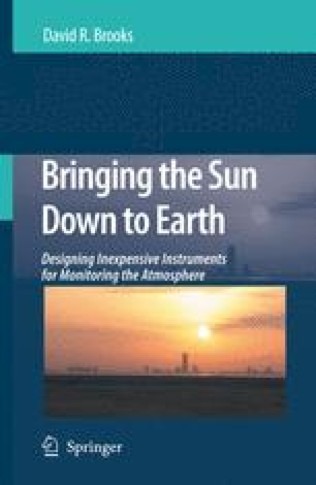
Bringing the sun down to earth : Designing inexpensive instruments for monitoring the atmosphere
The book describes in detail how to design, build, calibrate, and use inexpensive instruments for measuring solar radiation, ranging from total radiation from the entire sky to narrow spectral bands of radiation travelling along a path directly from the sun. Students and their teachers will learn a great deal about weather, the seasons, and the atmosphere, and they will develop a much better understanding of how to measure the physical world around them.
