



الصفحة 1
الصفحة 1

Nuclear Law : The Global Debate
This open access book traces the journey of nuclear law: its origins, how it has developed, where it is now, and where it is headed. As a discipline, this highly specialized body of law makes it possible for us to benefit from the life-saving applications of nuclear science and technology, including diagnosing cancer as well as avoiding and mitigating the effects of climate change. This book seeks to give readers a glimpse into the future of nuclear law, science and technology. It intends to provoke thought and discussion about how we can maximize the benefits and minimize the risks inherent in nuclear science and technology. This compilation of essays presents a global view in discipline as well as in geography.

Nuclear Fission and Cluster Radioactivity : An Energy-Density Functional Approach
It is the first application to nuclear physics from energy-density functional method, for which Professor Walter Kohn received the Nobel Prize in Chemistry. The book presents a comprehensive extension of the Bohr-Wheeler theory with the present knowledge of nuclear density distribution function.

Nuclear back-end and transmutation technology for waste disposal : Beyond the Fukushima accident
Covers essential aspects of transmutation technologies, highlighting especially the advances in Japan. The accident at the Fukushima Daiichi Nuclear Power Plant (NPP) has caused us to focus attention on a large amount of spent nuclear fuels stored in NPPs. In addition, public anxiety regarding the treatment and disposal of high-level radioactive wastes that require long-term control is growing. The Japanese policy on the back-end of the nuclear fuel cycle is still unpredictable in the aftermath of the accident. Therefore, research and development for enhancing the safety of various processes involved in nuclear energy production are being actively pursued worldwide.

Minerals as Advanced Materials I
This book represents a collection of papers presented at the 1st International workshop ‘Minerals as Advanced Materials I’ . The basic idea of the workshop was to identify minerals and mineral objects that have or potentially have unique physical, chemical and structural properties that are of interest from the viewpoint of applied mineralogy and material science.
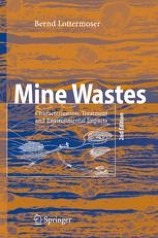
Mine Wastes : Characterization, Treatment and Environmental Impacts
Provides an overview of the accumulation of wastes at mine, including sulfidic mine wastes, mine water, tailings, cyanidation wastes of gold-silver ores, radioactive wastes of uranium ores, and wastes of phosphate and potash ores. This work presents crucial aspects of mine wastes as scientific issues.

Handbook of Bioterrorism and Disaster Medicine
This comprehensive volume, written by experts in the field, is the essential portable handbook on bioterrorism and disaster medicine. The volume covers all pertinent topics with meticulous organization and includes an abundance of invaluable web-based resources. Written as both a practical and clinical guide to various types of disasters, it includes planning and response procedures to help mitigate the impact of disasters on affected individuals and communities. Designed to be used in the field, all the essential aspects are included: public health, bioterror agents, chemical warfare, radioactive agents, manmade disasters, natural disasters, humanitarian disasters, infectious and tropical diseases, and basics of emergency medicine. Handbook of Bioterrorism and Disaster Medicine is the ideal tool for researchers, first responders, medical students, physicians, and other healthcare providers who work in the field.

Graves' disease And New Therapies
• Thyroid gland. • The hypothalamic pituitary thyroid axis. • Thyroid hormones. • Physiology. • Thyroid tests. • Blood tests. • TSH test. • T4 tests. • T3 test. • Thyroid antibodies test. • Imaging tests. • Ultrasound. • Thyroid scan. • Radioactive iodine uptake test. • Thyroid gland disorders. • Hyperthyroidism. • Hypothyroidism. • Anti-thyroid medication. • Radioactive iodine therapy. • Thyroid surgery. • Graves’ ophthalmopathy. • Treatment of GO.

GeomInt–Mechanical Integrity of Host Rocks
This book summarizes the results of the collaborative project “GeomInt: Geomechanical integrity of host and barrier rocks - experiment, modeling and analysis of discontinuities” within the Program: Geo Research for Sustainability (GEO: N) of the Federal Ministry of Education and Research (BMBF).

Geology and Ecosystems
This book includes an analysis of the relationship between the different geological, hydrochemical, hydrogeological and engineering-geological processes and the processes within surface ecosystems. The analysis of specific interactions between the lithosphere and biosphere provides an integrated concept of the role of the geological environment in the evolution of the biosphere. The practical significance of the book is reflected by the analysis of modern engineering activity associated with the mining of minerals, excessive groundwater withdrawal, disposal of industrial and domestic wastes (including radioactive wastes) and their impacts on all components of the environment. Geology and Ecosystems includes a scientific approach to the complex monitoring of the environment under different natural and anthropogenic conditions, including the monitoring of permafrost regions. An important part of the book is the analysis of the "water factor" impact on ecosystems and sustainable development. Influences of intensive groundwater extraction on river flow, vegetation and land subsidence are also considered.

Geological Storage of Highly Radioactive Waste : Current Concepts and Plans for Radioactive Waste Disposal
The book describes and assesses current concepts for long-term disposal of highly radioactive waste. Different types of rock are discussed and assessed with respect to practical difficulties in construction of a repository, and the efficiency in isolating radioactive waste. Safety matters are most important and are treated in the respective chapters and in a final, conclusive chapter. Cost issues and related quality matters are discussed for the case of constructing a virgin repository and repositories in the form of converted abandoned mines.
Forest Radioecology in Fukushima : Radiocesium Dynamics, Impact, and Future
This book provides holistic information on the radioactive contamination of forests. Topics are highly interdisciplinary, ranging from the dynamics of radioactive cesium in forest ecosystems to the radiation protection or the socio-economic aspects of radiation effects. It is designed to help people understand the radioactive contamination in forests and provide hints of how to cope with it and restore their livelihoods. The book is characterized by its well-balanced structure that allows the reader to understand the whole picture without going into too much scientific content. After explaining the basics of radioactive materials and radiation, the book illustrates the radioactive contamination of forests, it also describes the impacts on the forestry and life of local people and the measures taken by. Few books address the concerns about how to deal with radioactive contamination of forests and the future perspectives. In this book, people can learn all about the Fukushima nuclear accident of forests, forest products, and people with abundant reference materials.

Food Safety and Ways to Prevent Life-Threatening Pollutants
The fears regarding food safety started long time ago, and till this very moment of ours, the international organizations and INGOs pay lots of hard work to minimize and achieve reduction in the effects and the suffering caused to people around the world by contaminated foods each year. This research talks about the main patterns of food contaminants, and they are chemical, physical, biological, and last but not least the contamination caused by radioactive substances. It is also important to talk about the methods of precaution and protection against the diseases and illnesses produced by contaminated foods, as well about the role of INGOs which are dedicated and specialized in law and regulations enactment for bounding the incidence of food contamination in the world, for raising the public awareness towards food safety, and to keep up with the latest updates of events. This research also contains vast Information about Covid-19 and its spreading process via contaminated food.

Fenomeni Radioattivi : Dai nuclei alle stelle = Radioactive phenomena : From nuclei to stars
The topics covered constitute an introduction to radioactive phenomena in the strict sense with excursions, having as a starting point and guiding thread the decay b, in the field of elementary particle physics, in particular neutrinos, and astrophysics. Some topics are traditional (alpha decay, beta gamma), others concern frontier physics (so that the reader is offered particular itineraries from established physics to evolving physics).
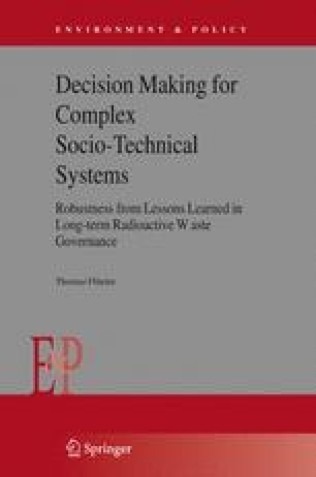
Decision Making for Complex Socio-Technical Systems : Robustness from Lessons Learned in Long-Term Radioactive Waste Governance
The long-term governance of radioactive waste continues to be a major complex and contentious socio-technical issue worldwide. Traditionally, it has been considered as mainly a challenge to scientists and engineers to develop technical "solutions" to specific problems. But increasingly these narrow solutions have been enlarged by wider societal considerations such as ethics, public involvement, control and retrievability – needs that have in the meanwhile been recognised by the nuclear community, at least in a general way. In this book, we analyse motives for a broad discourse as well as suggest prerequisites to launch it. The author attempts to give a novel, empirically based and technically sound treatment of fundamental issues in long-term management and governance. Written to be accessible to a wide selection of the interested public, the study proposes a combination of technical design issues, analysis methods and institutional backup in a dynamic procedure, and with involvement at all levels of political, commercial and social life.
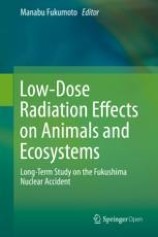
Low-Dose Radiation Effects on Animals and Ecosystems : Long-Term Study on the Fukushima Nuclear Accident
Brings together the works of radiation biologists and ecologists to provide reliable radioecology data and gives insight into future radioprotection. The book examines the environmental pollution and radiation exposure, and contains valuable data from abandoned livestock in the ex-evacuation zone and from wild animals including invertebrates and vertebrates, aqueous and terrestrial animals, and plants that are subjected to long-term exposure in the area still affected by radiation. It also analyzes dose evaluation, and offers new perspectives gained from the accident, as well as an overview for future studies to promote radioprotection of humans and the ecosystem.
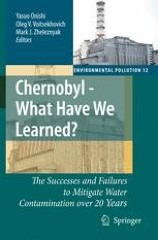
Chernobyl - What Have We Learned? : The Successes and Failures to Mitigate Water Contamination Over 20 Years
Twenty million people have been exposed to Chernobyl radionuclides through the Dnieper River aquatic pathways. This book presents a 20-year historical overview and comprehensive study results of the aquatic environment affected by the 1986 Chernobyl nuclear accident. During this time, many water quality management practices and countermeasures were enacted. The book presents in-depth analyses of these water remediation actions, using current science and mathematical modeling, and discusses why some were successful, but many others failed. The chapter entitled Where Do We Go From Here? incorporates a comprehensive discussion of the planned New Safe Confinement (NSC) structure to cover the Chernobyl plant. The book closes with a summary and conclusions drawn from these analyses, making it a valuable reference tool for the future. This book will be of interest to engineers, scientists, decision-makers, and those involved in radiation protection and radioecology, environmental protection and risk assessment, water remediation and mitigation measures, and radioactive waste disposal. In addition, the detailed, almost day-to-day, emergency responses to the Chernobyl accident described in this book will also be useful to people developing emergency and long-term responses to accidental or intentional (by terrorists) releases of radionuclides, toxic chemicals and biological agents.
Agricultural Implications of the Fukushima Nuclear Accident : The First Three Years
Consists of various topics, including radioactivity inspection of food products; decontamination trials for rice and livestock production; the state of contamination in wild animals and birds, trees, mushrooms, and timber; the dynamics of radioactivity distribution in mountain and paddy fields; damage incurred by the forestry and fishery industries; and the change in consumers’ minds. The last chapter introduces a real-time radioisotope imaging system, the forefront technique to visualize actual movement of cesium in soil and in plants. This is the only book to provide systematic data about the actual change of radioactivity, and thus is of great value for all researchers who wish to understand the effect of radioactive fallout on agriculture.
Agricultural Implications of the Fukushima Nuclear Accident (III)
Reports on studies undertaken at contaminated sites such as farmland, forests, and marine and freshwater environments, with a particular focus on livestock, wild plants and mushrooms, crops, and marine products in those environments. It also provides additional data collected in the subsequent years to show how the radioactivity levels in agricultural products and their growing environments have changed with time and the route by which radioactive materials entered agricultural products as well as their movement between different components (e.g., soil, water, and trees) within an environmental system (e.g., forests). The book covers various topics, including radioactivity testing of food products; decontamination trials for rice and livestock production; the state of contamination in, trees, mushrooms, and timber; the dynamics of radioactivity distribution in paddy fields and upland forests; damage incurred by the forestry and fishery industries; and the change in consumers’ attitudes. Chapter 19 introduces a real-time radioisotope imaging system, a pioneering technique to visualize the movement of cesium in soil and in plants.

Advances in the toxicity of construction and building materials
Presents the potential and toxic effects of building materials on human health, along with tactics on how to minimize exposure. Chapters are divided into four sections covering the toxicity of indoor environments, fire toxicity, radioactive materials, and toxicity from plastics, metals, asbestos, nanoparticles and construction wastes. Key chapters focus on the reduction of chemical emissions in houses with eco-labelled building materials and potential risks posed by indoor pollutants that may include volatile organic compounds (VOC), formaldehyde, semi-volatile organic compounds (SVOC), radon, NOx, asbestos and nanoparticles.
