



الصفحة 1
الصفحة 1
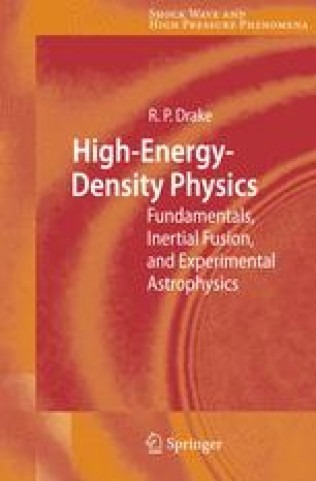
High-Energy-Density Physics : Fundamentals, Inertial Fusion, and Experimental Astrophysics
The raw numbers of high-energy-density physics are amazing: shock waves at hundreds of km/s (approaching a million km per hour), temperatures of millions of degrees, and pressures that exceed 100 million atmospheres. This book introduces the reader to the fundamental tools and discoveries of high-energy-density physics. It surveys the production of high-energy-density conditions, the fundamental plasma and hydrodynamic models that can describe them and the problem of scaling from the laboratory to the cosmos. Connections to astrophysics are discussed throughout. The book is intended to support coursework in high-energy-density physics, to meet the needs of new researchers in this field, and also to serve as a useful reference on the fundamentals. Specifically the book has been designed to enable academics in physics, astrophysics, applied physics and engineering departments to provide in a single-course introduction to fluid mechanics and radiative transfer, with dramatic applications in the field of high-energy-density systems.

Discontinuous Finite Elements in Fluid Dynamics and Heat Transfer
Discontinuous Finite Elements in Fluid Dynamics and Heat Transfer offers its readers a systematic and practical introduction to the discontinuous finite element method. It moves from a brief review of the fundamental laws and equations governing thermal and fluid systems, through a discussion of different approaches to the formulation of discontinuous finite element solutions for boundary and initial value problems, to their applicaton in a variety of thermal-system and fluid-related problems, including: heat conduction problems / convection-dominant problems / computational compressible flows / external radiation problems / internal radiation and radiative transfer / free- and moving-boundary problems / micro- and nanoscale heat transfer and fluid flow / thermal fluid flow under the influence of applied magnetic fields.

Light Scattering Reviews 3 : Light Scattering and Reflection
Ddevoted to modern knowledge and milestones in both experimental and theoretical techniques related to light scattering and radiative transport problems. It will consist of 3 parts comprising 11 contributions written by world leading experts in their respective fields. The general focus of the book will be on remote sensing of geophysical media. The first part will be devoted exclusively to studies of single light scattering by particles of different shapes and chemical compositions. The first chapter will review in situ measurements of cloud optical characteristics like cloud extinction and phase function, with the emphasis on ice clouds. Chapter 2 will cover opitcally soft particles common in marine environments and bio-suspensions while Chapter 3 will describe numerical techniques applicable not only to isotropic but also to chiral and anisotropic mdia. The final chapter in this part will deal with spatial symmetries in light scattering problems.

Light Scattering Reviews 2
Part of the ""Light Scattering Reviews"" series that is devoted to modern knowledge and milestones in both experimental and theoretical techniques related to light scattering and radiative transport problems. This work gives a picture of developments in the area of remote sensing and radiative transfer.

3D Radiative Transfer in Cloudy Atmospheres
Assessing developments in three-dimensional cloud radiation, this volume treats two main application areas: the impact of clouds on the Earth's radiation budget, and remote observation of clouds. It is suitable for graduate students, researchers, and also for those interested in cloud-radiation processes in the solar and infrared spectral regions.
