



الصفحة 1
الصفحة 1

Multivariate Public Key Cryptosystems
Multivariate public key cryptosystems (MPKC) is a fast-developing new area in cryptography. In the past 10 years, MPKC schemes have increasingly been seen as a possible alternative to number theoretic-based cryptosystems such as RSA, as they are generally more efficient in terms of computational effort. As quantum computers are developed, MPKC will become a necessary alternative. Multivariate Public Key Cryptosystems systematically presents the subject matter for a broad audience. Information security experts in industry can use the book as a guide for understanding what is needed to implement these cryptosystems for practical applications, and researchers in both computer science and mathematics will find this book a good starting point for exploring this new field. It is also suitable as a textbook for advanced-level students.

International Symposium on Mathematics, Quantum Theory, and Cryptography ; Proceedings of MQC 2019
This book presents selected papers from International Symposium on Mathematics, Quantum Theory, and Cryptography (MQC), which was held on September 25-27, 2019 in Fukuoka, Japan.

Experimental Aspects of Quantum Computing
Practical quantum computing still seems more than a decade away, and researchers have not even identified what the best physical implementation of a quantum bit will be. There is a real need in the scientific literature for a dialog on the topic of lessons learned and looming roadblocks. These papers, which appeared in the journal of "Quantum Information Processing" are dedicated to the experimental aspects of quantum computing These papers highlight the lessons learned over the last ten years, outline the challenges over the next ten years, and discuss the most promising physical implementations of quantum computing.

Machine Learning for Cyber Agents : Attack and Defence
The cyber world has been both enhanced and endangered by AI. On the one hand, the performance of many existing security services has been improved, and new tools created. On the other, it entails new cyber threats both through evolved attacking capacities and through its own imperfections and vulnerabilities. Moreover, quantum computers are further pushing the boundaries of what is possible, by making machine learning cyber agents faster and smarter.
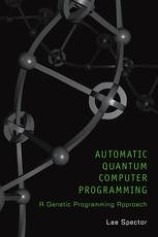
Automatic Quantum Computer Programming : A Genetic Programming Approach
Computer science will be radically transformed if ongoing efforts to build large-scale quantum computers eventually succeed and if the properties of these computers meet optimistic expectations. Nevertheless, computer scientists still lack a thorough understanding of the power of quantum computing, and it is not always clear how best to utilize the power that it is understood. This dilemma exists because quantum algorithms are difficult to grasp and even more difficult to write. Despite large-scale international efforts, only a few important quantum algorithms are documented, leaving many essential questions about the potential of quantum algorithms unanswered.

Advanced Visual Quantum Mechanics
Investigate and to teach quantum mechanics with the aid of computer-generated animations. It is a self-contained textbook that combines selected topics from atomic physics (spherical symmetry, the hydrogen atom, and particles with spin) with an introduction to quantum information theory (qubits, EPR paradox, teleportation, quantum computers). It explores relativistic quantum mechanics and the strange behavior of Dirac equation solutions. A series of appendices covers important topics from perturbation and scattering theory. The book places an emphasis on ideas and concepts, with a fair to moderate amount of mathematical rigor. Though this book stands alone, it can also be paired with Thaller Visual Quantum Mechanics to form a comprehensive course in quantum mechanics. The software for the first book earned the European Academic Software Award 2000 for outstanding innovation in its field.
