



الصفحة 1
الصفحة 1

Numeri e Crittografia
Number Theory is one of the most classic fields of Mathematics. The numbers he deals with are those that are called natural 0, 1, 2, ... and that we use since childhood to count. Seemingly simple and harmless, they nevertheless hide some of the most difficult and exciting mysteries of the whole of mathematics. Cryptography, on the other hand, is concerned with hiding the content of confidential communications from prying eyes and corresponds to widespread needs in our society. The Theory of Numbers can help Cryptography in these needs, thanks to the mysteries that still surround it. The text gives an account of this link. It first introduces Modern Cryptography, its goals and priorities. He then goes on to expose arguments of Number Theory, with particular reference to the two problems of recognizing prime numbers, and of decomposing a natural into its prime factors; for each of the two issues it provides a vast panorama of the algorithms that deal with it and try to solve it as effectively as possible. In particular, it presents the very recent AKS procedure for recognizing prime numbers. The book then returns to Cryptography and shows how ideas and methods of Number Theory apply to the construction of reliable procedures for the secure transmission of confidential information.

Number Theory : An Introduction via the Distribution of Primes
This book provides an introduction and overview of number theory based on the distribution and properties of primes. This unique approach provides both a firm background in the standard material as well as an overview of the whole discipline. All the essential topics are covered: fundamental theorem of arithmetic, theory of congruences, quadratic reciprocity, arithmetic functions, and the distribution of primes.

Number Theory : An Introduction to Mathematics ; Part B
This book attempts to provide such an understanding of the nature and extent of mathematics. It is a modern introduction to the theory of numbers, emphasizing its connections with other branches of mathematics. This part B is more advanced than the first and should give the reader some idea of the scope of mathematics today. The connecting theme is the theory of numbers. By exploring its many connections with other branches, we may obtain a broad picture.

Mathematics Is Not a Spectator Sport
Mathematics Is Not a Spectator Sport challenges the reader to become an active mathematician. Beginning at a gentle pace, the author encourages the reader to get involved, with discussions of an exciting variety of topics, each placed in its historical context, The chapters are largely self-contained and each topic can be understood independently. However, the author draws many connections between the various topics to demonstrate their interplay and role within the context of mathematics as a whole. Lots of carefully chosen problems are included at the end of each section to stimulate the reader's development as a mathematician.

Foundation Mathematics for Computer Science : A Visual Approach
In this second edition of Foundation Mathematics for Computer Science, John Vince has reviewed and edited the original book and written new chapters on combinatorics, probability, modular arithmetic and complex numbers. These subjects complement the existing chapters on number systems, algebra, logic, trigonometry, coordinate systems, determinants, vectors, matrices, geometric matrix transforms, differential and integral calculus. During this journey, the author touches upon more esoteric topics such as quaternions, octonions, Grassmann algebra, Barrycentric coordinates, transfinite sets and prime numbers.

Equidistribution in Number Theory, An Introduction
This volume presents details of the lecture series that were given at the school. Across the broad panorama of topics that constitute modern number t- ory one nds shifts of attention and focus as more is understood and better questions are formulated. Over the last decade or so we have noticed incre- ing interest being paid to distribution problems, whether of rational points, of zeros of zeta functions, of eigenvalues, etc. Although these problems have been motivated from very di?erent perspectives, one nds that there is much in common, and presumably it is healthy to try to view such questions as part of a bigger subject.

Cryptanalytic Attacks on RSA
RSA is a public-key cryptographic system, and is the most famous and widely-used cryptographic system in today's digital world. Cryptanalytic Attacks on RSA, a professional book, covers almost all major known cryptanalytic attacks and defenses of the RSA cryptographic system and its variants.
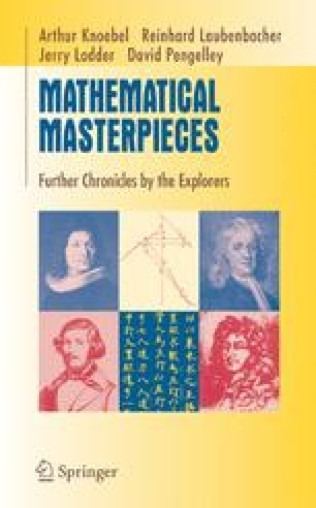
Mathematical Masterpieces : Further Chronicles by the Explorers
Experience the discovery of mathematics by reading the original work of some of the greatest minds throughout history. Here are the stories of four mathematical adventures, including the Bernoulli numbers as the passage between discrete and continuous phenomena, the search for numerical solutions to equations throughout time, the discovery of curvature and geometric space, and the quest for patterns in prime numbers. Each story is told through the words of the pioneers of mathematical thought. Particular advantages of the historical approach include providing context to mathematical inquiry, perspective to proposed conceptual solutions, and a glimpse into the direction research has taken.

Analytic Number Theory : Lectures given at the C.I.M.E. Summer School held in Cetraro, Italy, July 11-18, 2002
The four contributions collected in this volume deal with several advanced results in analytic number theory. Friedlander’s paper contains some recent achievements of sieve theory leading to asymptotic formulae for the number of primes represented by suitable polynomials. Heath-Brown's lecture notes mainly deal with counting integer solutions to Diophantine equations, using among other tools several results from algebraic geometry and from the geometry of numbers. Iwaniec’s paper gives a broad picture of the theory of Siegel’s zeros and of exceptional characters of L-functions, and gives a new proof of Linnik’s theorem on the least prime in an arithmetic progression. Kaczorowski’s article presents an up-to-date survey of the axiomatic theory of L-functions introduced by Selberg, with a detailed exposition of several recent results.
An Introduction to Number Theory
An Introduction to Number Theory provides an introduction to the main streams of number theory. Starting with the unique factorization property of the integers, the theme of factorization is revisited several times throughout the book to illustrate how the ideas handed down from Euclid continue to reverberate through the subject. In particular, the book shows how the Fundamental Theorem of Arithmetic, handed down from antiquity, informs much of the teaching of modern number theory. The result is that number theory will be understood, not as a collection of tricks and isolated results, but as a coherent and interconnected theory. A number of different approaches to number theory are presented, and the different streams in the book are brought together in a chapter that describes the class number formula for quadratic fields and the famous conjectures of Birch and Swinnerton-Dyer. The final chapter introduces some of the main ideas behind modern computational number theory and its applications in cryptography.
