



الصفحة 1
الصفحة 1

Monograph of the Spathidiida (Ciliophora, Haptoria) ; Vol. I : Protospathidiidae, Arcuospathidiidae, Apertospathulidae
The present monograph carefully revises the taxonomy, nomenclature, and ecology of all nominal species and shows that spathidiid diversity has been greatly underestimated. Based on the reinvestigation of described species with modern methods (silver impregnation, scanning electron microscopy) and the first description of over 50 new species, the family Spathidiidae is split into four families and 20 genera. Each species is described and figured in detail, making it unnecessary to go back to the original literature often difficult to obtain. Two identification keys are provided, viz., one for taxonomists and another, simple key for users not specifically trained in ciliate taxonomy.

Integrated Management and Biocontrol of Vegetable and Grain Crops Nematodes
The second volume of the IMPD series describes aspects related to most important phytoparasitic nematodes, considering the integration of biological control methods with other management practices and technologies, including the use of predatory nematodes and microbial rhizosphere antagonists. Chapters cover topics like the mode of action and interactions of nematophagous fungi, the efficacy of controll and management of plant parasitic nematode communities through a soil conservation approach, and exploitation of nematodes-bacteria antagonistic relationships.

Insects as natural enemies : A practical perspective
This book it is an account of major aspects of the biology of predators and parasitoids, punctuated with information and advice on which experiments or observations to conduct, and how to carry them out. Guidance is provided, where necessary, on the literature that may need to be consulted on particular topics.

Geological Approaches to Coral Reef Ecology
By reconstructing the ecological history of coral reefs, the authors are able to evaluate whether or not recent, dramatic changes to reef ecosystems are novel events or part of a long-term trend or cycle. The contributions examine the interacting causes of change, which include hurricane damage, regional outbreaks of coral-consuming predators, disease epidemics, sea-level rise, nutrient loading, global warming and acidification of the oceans. Crucial predictions about the future of coral reefs lead to practical strategies for the successful restoration and management of reef ecosystems.

From Biological Control to Invasion : the Ladybird Harmonia axyridis as a Model Species
Harmonia axyridis has been described as the "most invasive ladybird on Earth". It has a long history of use as a classical biological control agent in the USA and more recently in Europe. This beetle has been effective at controlling pest insects in a variety of crop systems but it poses unacceptable risks by impacting on non-target species as both an intraguild predator and competitor.Written by renowned scientists, this book is a synthesis of recent research on H. axyridis and provides informative insights into current perspectives and future directions. Biological control is an essential component of sustainable agriculture but the distinction between a successful biological control agent and an invasive species can be narrow. We hope that lessons can be learnt from H. axyridis.

Fractional-in-time semilinear parabolic equations and applications
This book provides a unified analysis and scheme for the existence and uniqueness of strong and mild solutions to certain fractional kinetic equations. This class of equations is characterized by the presence of a nonlinear time-dependent source, generally of arbitrary growth in the unknown function, a time derivative in the sense of Caputo and the presence of a large class of diffusion operators. The global regularity problem is then treated separately and the analysis is extended to some systems of fractional kinetic equations, including prey-predator models of Volterra–Lotka type and chemical reactions models, all of them possibly containing some fractional kinetics.
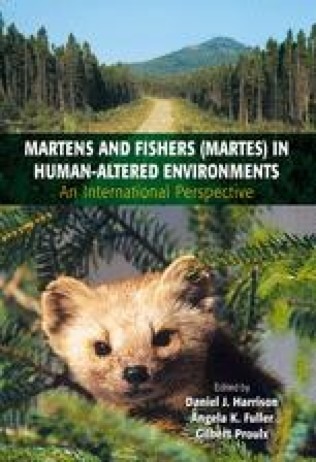
Martens and Fishers (Martes) in human-altered environments : An international perspective
Examines the conditions where humans and martens are compatible and incompatible, and promotes land use practices that allow Martes to be representatively distributed and viable. All Martes have been documented to use forested habitats and 6 species (excluding the stone marten) are generally considered to require complex mid- to late-successional forests throughout much of their geographic ranges. All species in the genus require complex horizontal and vertical structure to provide escape cover protection from predators, habitat for their prey, access to food resources, and protection from the elements. Martens and the fisher have high metabolic rates, have large spatial requirements, have high surface area to volume ratios for animals that often inhabit high latitudes, and often require among the largest home range areas per unit body weight of any group of mammals. Resulting from these unique life history characteristics, this genus is particularly sensitive to human influences on their habitats, including habitat loss, stand-scale simplification of forest structure via some forms of logging, and landscape-scale effects of habitat fragmentation. Given their strong associations with structural complexity in forests, martens and the fisher are often considered as useful barometers of forest health and have been used as ecological indicators, flagship, and umbrella species in different parts of the world. Thus, efforts to successfully conserve and manage martens and fishers are associated with the ecological fates of other forest dependent species and can greatly influence ecosystem integrity within forests that are increasingly shared among wildlife and humans.We have made great strides in our fundamental understanding of how animals with these unique life history traits perceive and utilize habitats, respond to habitat change, and how their populations function and perform under different forms of human management and mismanagement.
Chemical Signals in Vertebrates 10
This book also represents the tenth in a series of books on chemical communication, chemical ecology, olfactory and vomeronasal research in vertebrate species. The species covered in the chapters herein range from fish to mammals including humans. By taxonomic breakdown the mammals are the most represented in number of species and chapter contributions. However, the hosts of the meeting endeavored to have some representative contributions covering all of the major vertebrate taxa.
