



الصفحة 1
الصفحة 1

Nuclear fusion research : Understanding plasma-Surface interactions
It became clear in the early days of fusion research that the effects of the containment vessel (erosion of "impurities") degrade the overall fusion plasma performance. Progress in controlled nuclear fusion research over the last decade has led to magnetically confined plasmas that, in turn, are sufficiently powerful to damage the vessel structures over its lifetime. This book reviews current understanding and concepts to deal with this remaining critical design issue for fusion reactors. It reviews both progress and open questions, largely in terms of available and sought-after plasma-surface interaction data and atomic/molecular data related to these "plasma edge" issues.

Nonequilibrium Phenomena in Plasmas
This book presents studies of complexity in the context of nonequilibrium phenomena using theory, modeling, simulations, and experiments, both in the laboratory and in nature.

Molecular Processes in Plasmas : Collisions of Charged Particles with Molecules
Molecular Processes in Plasmas describes elementary collision processes in plasmas, particularly those involving molecules or molecular ions. Those collision processes (called molecular processes) maintain plasmas, produce reactive species and emissions, and play a key role in energy balance in plasmas or more specifically in determining the energy distribution of plasma particles.

Interactions Between Charged Particles in a Magnetic Field : A Theoretical Approach to Ion Stopping in Magnetized Plasmas
This monograph focusses on the influence of a strong magnetic field on the interactions between charged particles in a many-body system. Two complementary approaches, the binary collision model and the dielectric theory are investigated in both analytical and numerical frameworks.
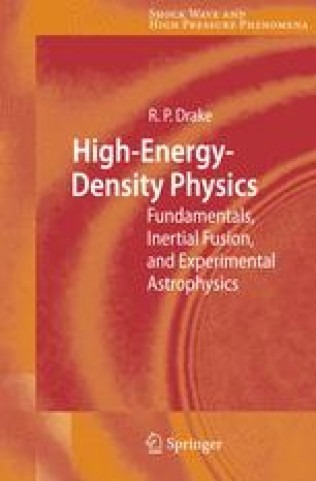
High-Energy-Density Physics : Fundamentals, Inertial Fusion, and Experimental Astrophysics
The raw numbers of high-energy-density physics are amazing: shock waves at hundreds of km/s (approaching a million km per hour), temperatures of millions of degrees, and pressures that exceed 100 million atmospheres. This book introduces the reader to the fundamental tools and discoveries of high-energy-density physics. It surveys the production of high-energy-density conditions, the fundamental plasma and hydrodynamic models that can describe them and the problem of scaling from the laboratory to the cosmos. Connections to astrophysics are discussed throughout. The book is intended to support coursework in high-energy-density physics, to meet the needs of new researchers in this field, and also to serve as a useful reference on the fundamentals. Specifically the book has been designed to enable academics in physics, astrophysics, applied physics and engineering departments to provide in a single-course introduction to fluid mechanics and radiative transfer, with dramatic applications in the field of high-energy-density systems.

High energy density laboratory astrophysics
During the past several years, research teams around the world have developed astrophysics-relevant utilizing high energy-density facilities such as intense lasers and z-pinches. Research is underway in many areas, such as compressible hydrodynamic mixing, strong shock phenomena, radiation flow, radiative shocks and jets, complex opacities, equations o fstat, and relativistic plasmas. Beyond this current research and the papers it is producing, plans are being made for the application, to astrophysics-relevant research, of the 2 MJ National Ignition Facility (NIF) laser at Lawrence Livermore National Laboratory; the 600 kj Ligne d'Intergration Laser (LIL) and the 2 MJ Laser Megajoule (LMJ) in Bordeaux, France; petawatt-range lasers now under construction around the world; and current and future Z pinches.

Handbook of Solar-Terrestrial Environment
Recognized international leaders in their field contribute basic topics of solar physics, space plasmas and the Earth's magnetosphere. The book further covers applied topics like the aurora, magnetospheric storms, space weather, space climatology and planetary science.

Foundations of plasma physics for physicists and mathematicians
Foundations of Plasma Physics for Physicists and Mathematicians covers the basic physics underlying plasmas and describes the methodology and techniques used in both plasma research and other disciplines such as optics and fluid mechanics.

Elementary physics of complex plasmas
Complex plasmas are dusty plasmas in which the density and electric charges of the dust grains are sufficiently high to induce long-range grain-grain interactions, as well as strong absorption of charged-plasma components. Together with the sources replenishing the plasma such systems form a highly dissipative thermodynamically open system that exhibits many features of collective behaviour generally found in complex systems. Most notably among them are self-organized patterns such as plasma crystals, plasma clusters, dust stars and further spectacular new structures. Beyond their intrinsic scientific interest, the study of complex plasmas grows in importance in a great variety of fields, ranging from space-plasma sciences to applied fields such as plasma processing, thin-film deposition and even the production of computer chips by plasma etching, in which strongly interacting clouds of complex plasmas can cause major contamination of the final product.

Cosmic Ray Interactions, Propagation, and Acceleration in Space Plasmas
"The book consists of four Chapters. Chapter 1 shortly describes main properties of space plasmas and primary CR, different types of CR interactions with space plasmas components Chapter 2 considers the problem of CR propagation in space plasmas described by the kinetic equation and different types of diffusion approximations ,Chapter 3 is devoted to CR non-linear effects in space plasmas caused by CR pressure and CR kinetic stream instabilities with the generation of Alfvèn turbulence In Chapter 4 different processes of CR acceleration in space plasmas are considered: the development of the Fermi statistical mechanism, acceleration in the turbulent plasma, Alfven mechanism of magnetic pumping, induction mechanisms, acceleration during magnetic collapse and compression, cumulative acceleration mechanism near the zero lines of a magnetic field, acceleration in shear flows, shock-wave diffusion (regular) acceleration. The book ends with a list providing more than 1,300 full references, a discussion on future developments and unsolved problems, as well as Object and Author indexes. "

Construction of Mappings for Hamiltonian Systems and Their Applications
Based on the method of canonical transformation of variables and the classical perturbation theory, this innovative book treats the systematic theory of symplectic mappings for Hamiltonian systems and its application to the study of the dynamics and chaos of various physical problems described by Hamiltonian systems. It develops a new, mathematically-rigorous method to construct symplectic mappings which replaces the dynamics of continuous Hamiltonian systems by the discrete ones. Applications of the mapping methods encompass the chaos theory in non-twist and non-smooth dynamical systems, the structure and chaotic transport in the stochastic layer, the magnetic field lines in magnetically confinement devices of plasmas, ray dynamics in waveguides, etc. The book is intended for postgraduate students and researches, physicists and astronomers working in the areas of plasma physics, hydrodynamics, celestial mechanics, dynamical astronomy, and accelerator physics. It should also be useful for applied mathematicians involved in analytical and numerical studies of dynamical systems.

Magnetohydrodynamics : Historical Evolution and Trends
Magnetohydrodynamics (MHD) studies the interaction between the flow of an electrically conducting fluid and magnetic fields. It involves such diverse topics as the evolution and dynamics of astrophysical objects, thermonuclear fusion, metallurgy and semiconductor crystal growth, etc. Although the first ideas in magnetohydrodynamics appeared at the beginning of the last century, the "explosion" in theoretical and experimental studies occurred in the 1950s-60s. This state-of-the-art book aims at revising the evolution of ideas in various branches of magnetohydrodynamics (astrophysics, earth and solar dynamos, plasmas, MHD turbulence and liquid metals) and reviews current trends and challenges.

Magnetic Control of Tokamak Plasmas
The main topic of Magnetic Control of Tokamak Plasmas is the design of feedback control systems guaranteeing the stability of plasma equilibrium inside a tokamak and the regulation of the plasma position and shape during plasma pulses. Modelling and control details are presented, allowing the non-expert to understand the control problem. Starting from equations of magneto-hydro-dynamics, all the steps needed for the derivation of plasma state-space models are enumerated. The basics of electromagnetics are frequently recalled. The control problem is then described beginning with control of current and position – vertical and radial – and progressing to the more challenging shape control. The solutions proposed vary from simple PIDs to more sophisticated MIMO controllers.

Laser Ablation and its Applications
Laser Ablation and its Applications emphasizes the wide range of these topics rather than focusing on one specialty or discipline. It is intended for a graduate course in laser interactions with plasmas and materials, but it should be accessible to anyone with a graduate degree in physics or engineering.

Cathodic Arcs : From Fractal Spots to Energetic Condensation
Cathodic Arcs: From Fractal Spots to Energetic Condensation is the first book in over a decade dedicated to the physics and technology of cathodic arcs. It includes a detailed account of arc history, a textbook-like introduction to cathode phenomena, and some basic physics of expanding plasmas; it deals with the infamous macroparticle issue and describes a host of practical plasma filter solutions. In contrast to previous books on cathodic arcs, the focus is on the relation of arc plasmas and their properties to surface modification and thin film deposition. The book contains sections on basic plasma physics and thin film materials science. It also deals with practical issues of coatings such as stress control and the often-underrated issue of the coating’s color. By stressing the fractal nature of cathode spots, the theme of fluctuations can be found throughout the book: fluctuations affect all plasma properties and thereby have consequences for plasma-based surface modifications and film growth.

Bilinear integrable systems : From classical to quantum, continuous to discrete ; Proceedings of the NATO Advanced Research Workshop on Bilinear Integrable Systems: From Classical to Quantum, Continuous to Discrete St. Petersburg, Russia, 15-19 September 2002
Trained as a physicistin his home university Kyushu University, Professor Hirota earned his PhD in’61 at Northwestern University with Professor Siegert in the field of “QuantumStatistical mechanics”. He wrote a widely appreciated Doctoral dissertation on“Functional Integral representation of the grand partition function”. As a youngresearcher, he entered the RCA Company in Tokyo to do research on semi-conductor plasmas. Professor Hirota was led to model the Toda lattice as a non-linear networkof ladder-type LC circuits. The self-dual case led to equations very reminiscentof the Sine-Gordon equation, with much the same features (existence of onesoliton, soliton-soliton interaction, etc)
