



الصفحة 1
الصفحة 1

Information and knowledge : A constructive type-theoretical approach
This book develops a philosophical and logical interpretation of the concept of information within the formal structure of Constructive Type Theory (CTT), in a manner concurrent with a diverse range of contemporary perspectives on the philosophy of information. On the basis of this conceptual framework, the problem of analyticity for logical derivations is faced and a solution is proposed.The text begins with a presentation of the formal structure of CTT, paying particular attention to some topics that have been neglected by current researchers in Type Theory. Information and Knowledge presents a new interesting perspective on the constructive interpretation of knowledge processes, suggesting the reliability of such an approach for the logical modeling of epistemic problems and proposing a unifying frame from one of the more important contemporary philosophical perspectives.

Genetic Democracy : Philosophical Perspectives
GENETIC DEMOCRACY involves an in-depth analysis of the ethical, social and philosophical issues related to modern genetic research and gene technology. The aim of the book is to introduce systematic research on the social and ethical impacts of the use and development of genetically modified organisms (GMOs) as well as the acquisition, use and storage of human genetic information (HGI). The book contributes into enhancing public discussion and reaching fair and democratic decision-making practices in GMO and HGI use and development both on local and global level.

Extensionalism : The Revolution in Logic
This vivid and thought-provoking book by the Israeli logician Nimrod Bar-Am impels one to rethink the place of logic in Western thought. It shows that the history of logic from Aristotle to Tarski is the history of the gradual undoing of the classic conflation of logic and empirical science. It sets tomorrow’s agenda for philosophers and historians of logic and scientific method by taking as its starting point the mere fact that, curiously, ancient logic is not as formal as current literature presents it. Rather, as Bar-Am explains, modern formal logic became possible only after a series of bold criticisms of the magnificent Aristotelian system. These criticisms begin with David Hume’s declaration that logic does not sanction induction, follow on with Kant’s view of logic as an extremely limited system, and culminating with Booles’ introduction of logic as an extensional system, and Russell’s solution to his own paradox.

Ethics of Belief : Essays in Tribute to D.Z. Phillips
This volume is presented as a tribute to D.Z. Phillips and the introduction by Eugene Long includes a brief discussion of Phillips' life and work. The first six articles were originally written at the invitation of Phillips for a conference on the ethics of belief held at Claremont Graduate University. Essays by Allen Wood, Richard Amesbury and Van Harvey discuss the question of the ethics of belief in the context of the evidentialist principle most frequently associated with W. K. Clifford. Essays by Ronney Mourad, Jennifer Faust and Robert Audi are concerned with the voluntariness of belief, the persuasive power of arguments and differing conceptions of faith, belief and acceptance. The final two essays by John Whittaker and Anselm Min focus on Phillips' understanding of the logic and rationality of religious belief.

Deduction, Computation, Experiment : Exploring the Effectiveness of Proof
What is a proof for? What is the characteristic use of a proof as a computation, as opposed to its use as an experiment? What is the relationship between mathematical procedures and natural processes? The essays collected in this volume address such questions from different points of view and will interest students and scholars in several branches of scientific knowledge. Some essays deal with the logical skeleton of deduction, others examine the interplay between natural systems and models of computation, yet others use significant results from the natural sciences to illustrate the character of procedures in applied mathematics. Focusing on relevant conceptual and logical issues underlying the overall quest for proving, the volume seeks to cast light on what the effectiveness of proof rests on.
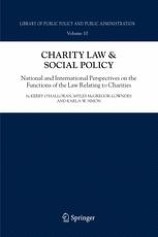
Charity Law & Social Policy : National and International Perspectives on the Functions of the Law Relating to Charities
Charity Law & Social Policy explores contemporary law, policy and practice in a range of modern common law nations. It does so in four parts and from the perspective of how this has evolved in the UK.As progenitor of a system bequeathed to its colonies and after centuries of leadership in developing the core principles, policies and precedents that subsequently shaped its development, the contribution of England & Wales, the originating jurisdiction, is first described and analysed in detail.
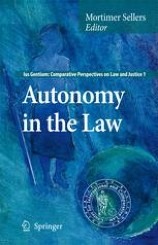
Autonomy : In the Law
Autonomy in the Law considers one of the most important benefits of the rule of law. Juxtaposing European and American conceptions of autonomy in the law of families, capital punishment and, criminal trials reveals the common values that justify all legal systems. Law protects the autonomy of individuals and associations by defending the boundaries of their own self-rule. This book illuminates the fundamental purpose of law by examining how European and American lawyers, judges and citizens do and should apply legal autonomy to the practical circumstances of litigation, legislation and the law.
