



الصفحة 1
الصفحة 1
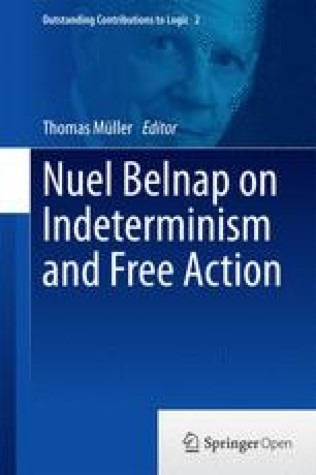
Nuel Belnap on Indeterminism and Free Action
Seeks to further the use of formal methods in clarifying one of the central problems of philosophy: that of our free human agency and its place in our indeterministic world. It celebrates the important contributions made in this area by Nuel Belnap, American logician and philosopher. Philosophically, indeterminism and free action can seem far apart, but in Belnap’s work, they are intimately linked. This book explores their philosophical interconnectedness through a selection of original research papers that build forth on Belnap’s logical and philosophical work. Some contributions take the form of critical discussions of Belnap's published work, some develop points made in his publications in new directions, and others provide additional insights on the topics of indeterminism and free action.

Investigations Into the Phenomenology and the Ontology of the Work of Art : What are Artworks and How Do We Experience Them?
This book investigates the nature of aesthetic experience and aesthetic objects. Written by leading philosophers, psychologists, literary scholars and semioticians, the book addresses two intertwined issues. The first is related to the phenomenology of aesthetic experience: The understanding of how human beings respond to artworks, how we process linguistic or visual information, and what properties in artworks trigger aesthetic experiences. The examination of the properties of aesthetic experience reveals essential aspects of our perceptual, cognitive, and semiotic capacities. The second issue studied in this volume is related to the ontology of the work of art: Written or visual artworks are a specific type of objects, containing particular kinds of representation which elicit a particular kind of experience.

Il senso e la narrazione = The sense and the narration
Humans are creatures of narration: infinitely they narrate and narrate themselves, intertwine dialogues, light up stories to illuminate the dark caves of the heart and the world, recover and transmute memories. We live between a firm and rough, unknowable reality, an enormous furnace of perturbations and calls and colors, and an elusive, delicate and ephemeral interiority: and between the two, between the world and us, we weave with thought and with words a fragile ponte, a bridge called sense. Swing this bridge at the unequal breath of a cosmic wind, dropping phosphoric fragments: sudden hourglasses, anonymous centaurs, sleepless geometers, distant syllogisms, vanished lineages, black basalts, crazy anchorites, silent plesiosaurs, flutes and bagpipes ... and they recompose figures, and we ask ourselves questions about those figures and tell stories. Only the vertigo of asking and narrating can give meaning to a life that some say is interwoven with pure chance. Forever detached from the flourishing matrix of the world, tormented by thought, prisoners of words, slaves of interpretation, lost in a long corridor of facing mirrors: we are at the center of a great, incomprehensible rumble.
A Philosophical Examination of Social Justice and Child Poverty
Investigates child poverty from a philosophical perspective. It identifies the injustices of child poverty, relates them to the well-being of children, and discusses who has a moral responsibility to secure social justice for children.
