



الصفحة 1
الصفحة 1
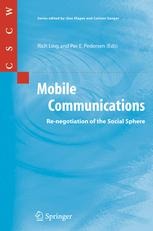
Mobile Communications : Re-negotiation of the Social Sphere
Mobile Communications: Renegotiation of the Social Sphere surveys some of the broader issues associated with the adoption and use of mobile communication, and explores developing areas of inquiry. Mobile communications are looked at in the context of other types of mediated interaction (e-mail, instant messaging, Wi-Fi, landline telephone etc.), thus demonstrating the uniqueness of this form of communication and how it is influencing the renegotiation of the social sphere. A truly international set of contributors consider how mobile communication has impacted on society and reflect on how it is used (and sometimes resented) in various public and private spaces. They provide an in-depth analysis of specific areas which complement our understanding of the phenomena including: • The psychological dimensions of mobile communication (addiction, proclivity to be disturbed by others use of the mobile phone), • The linguistics of mobile communication, and • The understanding of mobile communication’s commercialisation. This book will be a valuable addition to any researcher’s or professional’s reading material in the area of interaction of technology and society, providing the reader with a broad insight and specific knowledge of how mobile communication is reformulating the social sphere.

Human-computer interaction – INTERACT 2005 ; IFIP TC 13 International Conference, Rome, Italy, September 12-16, 2005, Proceedings
We will be, sooner or later, not only handling personal computers but also mul- purpose cellular phones, complex personal digital assistants, devices that will be context-aware, and even wearable computers stitched to our clothes…we would like these personal systems to become transparent to the tasks they will be performing. In fact the best interface is an invisible one, one giving the user natural and fast access to the application he (or she) intends to be executed. The working group that organized this conference (the last of a long row!) tried to combine a powerful scientific program (with drastic refereeing) with an entertaining cultural program, so as to make your stay in Rome the most pleasant one all round: I do hope that this expectation becomes true. July 2005 Stefano Levialdi, IEEE Life Fellow INTERACT 2005 General Chairman [1] Peter J. Denning, ACM Communications, April 2005, vol. 48, N° 4, pp. 27-31. Editors’ Preface INTERACT is one of the most important conferences in the area of Human-Computer Interaction at the world-wide level. We believe that this edition, which for the first time takes place in a Southern European country, will strengthen this role, and that Rome, with its history and beautiful setting provides a very congenial atmosphere for this conference. The theme of INTERACT 2005 is Communicating Naturally with Computers.

Handhelds in medicine : A practical guide for clinicians
Handheld computers are emerging as the stethoscopes of the twenty-first century, and no clinician should be without! These small, easy-to-use devices are now powerful enough to help clinicians manage information and make medical decisions at the point of care. Here, Drs. Stayer, Reynolds and Ebell, practicing physicians and nationally recognized handheld computing experts, show you how to make the most of a handheld computer in your medical practice. This comprehensive how-to guide targets all levels of handheld computer users from novices to experts. It is designed with easy-to-understand hands-on exercises that walk readers through each new skill presented. For beginners, the first section is devoted to "getting to know your handheld," choosing or upgrading a handheld computer, and the basics of handheld operation. There's also a comprehensive chapter on downloading and installing software. Futher sections delve into different types of medical and nonmedical software, Internet and evidence-based resources for medical handheld computing, and, finally, advanced topics such as designing custom software and going wireless. Even the most advanced user will find a lot to learn in this book.

Embedded and Ubiquitous Computing - EUC 2005 ; International Conference EUC 2005, Nagasaki, Japan, December 6-9, 2005, Proceedings
Welcome to the proceedings of the 2005 IFIP International Conference on - bedded and Ubiquitous Computing (EUC 2005), which was held in Nagasaki, Japan, December 6–9, 2005. Embedded and ubiquitous computing is emerging rapidly as an exciting new paradigm to provide computing and communication services all the time, - erywhere. Its systems are now pervading every aspect of life to the point that they are hidden inside various appliances or can be worn unobtrusively as part of clothing and jewelry. This emergence is a natural outcome of research and technological advances in embedded systems, pervasive computing and c- munications, wireless networks, mobile computing, distributed computing and agent technologies, etc. Its tremendous impact on academics, industry, gove- ment, and daily life can be compared to that of electric motors over the past century, in fact it but promises to revolutionize life much more profoundly than elevators, electric motors or even personal computers. The EUC 2005 conference provided a forum for engineers and scientists in academia, industry, and government to address profound issues including te- nical challenges, safety, and social, legal, political, and economic issues, and to present and discuss their ideas, results, work in progress, and experience on all aspects of embedded and ubiquitous computing.
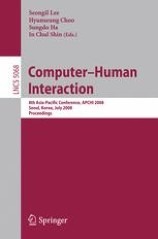
Computer-Human Interaction ; 8th Asia-Pacific Conference, APCHI 2008 Seoul, Korea, July 6-9, 2008 Proceedings
This book constitutes the refereed proceedings of the 8th Asia Pacific Conference on Computer Human Interaction, APCHI 2008, held in Seoul, Korea, in July 2008.

Codes : An Introduction to Information Communication and Cryptography
Information is an important feature of the modern world. Mathematical techniques underlie the devices that we use to handle it, for example, mobile phones, digital cameras, and personal computers. This book is an integrated introduction to the mathematics of coding, that is, replacing information expressed in symbols, such as a natural language or a sequence of bits, by another message using (possibly) different symbols. There are three main reasons for doing this: economy, reliability, and security, and each is covered in detail. Only a modest mathematical background is assumed, the mathematical theory being introduced at a level that enables the basic problems to be stated carefully, but without unnecessary abstraction.
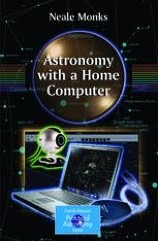
Astronomy with a home computer
Here is a one-volume guide to just about everything computer-related for amateur astronomers!Today’s amateur astronomy is inextricably linked to personal computers. Computer-controlled "go-to" telescopes are inexpensive. CCD and webcam imaging make intensive use of the technology for capturing and processing images. Planetarium software provides information and an easy interface for telescopes. The Internet offers links to other astronomers, information, and software. The list goes on and on.
