



الصفحة 1
الصفحة 1
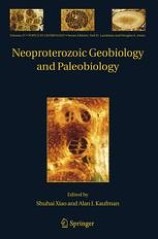
Neoproterozoic Geobiology and Paleobiology
The Neoproterozoic Era (1000-542 million years ago) is a geological period of dramatic climatic change and important evolutionary innovations. Repeated glaciations of unusual magnitude occurred throughout this tumultuous interval, and various eukaryotic clades independently achieved multicellularity, becoming more complex, abundant, and diverse at its termination. Animals made their first debut in the Neoproterozoic too. The intricate interaction among these geological and biological events is a centrepiece of Earth system history, and has been the focus of geobiological investigations in recent decades. The purpose of this volume is to present a sample of views and visions among some of the growing numbers of Neoproterozoic workers. The contributions represent a cross section of recent insights into the field of Neoproterozoic geobiology.

Neanderthals Revisited : New Approaches and Perspectives
This volume presents cutting-edge research by leading scientists re-examining the major debates in Neanderthal research with the use of innovative state-of-the art methods and exciting new theoretical approaches.Topics addressed include the re-evaluation of Neanderthal anatomy, inferred adaptations and habitual activities, developmental patterns, phylogenetic relationships, and the Neanderthal extinction; new methods include computer tomography, 3D geometric morphometrics, ancient DNA and bioenergetics. The diverse contributions offer fresh insights and advances in Neanderthal and modern human origins research.

Geological Approaches to Coral Reef Ecology
By reconstructing the ecological history of coral reefs, the authors are able to evaluate whether or not recent, dramatic changes to reef ecosystems are novel events or part of a long-term trend or cycle. The contributions examine the interacting causes of change, which include hurricane damage, regional outbreaks of coral-consuming predators, disease epidemics, sea-level rise, nutrient loading, global warming and acidification of the oceans. Crucial predictions about the future of coral reefs lead to practical strategies for the successful restoration and management of reef ecosystems.

Evolutionary Stasis and Change in the Dominican Republic Neogene
In practice, however, science is no less susceptible to fads, culture shifts, and pendulum swings than any other realm of human endeavor. This is an especially important feature of science to keep in mind in the present climate of shrinking government funding (at least in prop- tion to the demand) and the resulting susceptibility of individual scientists and entire disciplines to being influenced by the changing priorities of funding agencies (even if, as such agencies maintain, those priorities come ultimately “from the c- munity”). The present volume is in several important respects a testimonial to both the threats and opportunities that such scientific culture swings pose, both for the individual researcher and a wider field. When scientific research in the Dominican Republic Neogene began more than a century ago, paleontology was an essentially descriptive discipline, focused mainly on finding, describing, and documenting the taxa represented in the fossil record, and (especially in invertebrate paleontology) on using these taxa for bi- tratigraphic correlation.
