



الصفحة 1
الصفحة 1

Nonlinear Optical Crystals : A Complete Survey
Nonlinear optical crystals are widely used in modern optical science and technology for frequency conversion of laser light, i.e. to generate laser radiation at any specific wavelength in visible, UV or IR spectral regions. This unrivalled reference book contains the most complete and up-to-date information on properties of nonlinear optical crystals. It includes: * Database of 63 common and novel nonlinear optical crystals * Periodically-poled and self-frequency-doubling materials * Full description of linear and nonlinear optical properties * Significant amount of crystallophysical, thermophysical, spectroscopic, electro-optic and magneto-optic information * 7 mini-reviews on novel applications, such as deep-UV light generation, terahertz-wave generation, ultrashort laser pulse compression, photonic band-gap crystals, x3 nonlinearity, etc. * More than 1500 different references with full titles It is a vital source of information for scientists and engineers dealing with modern applications of nonlinear optical crystals in quantum electronics, photonics, optoelectronics and laser physics.
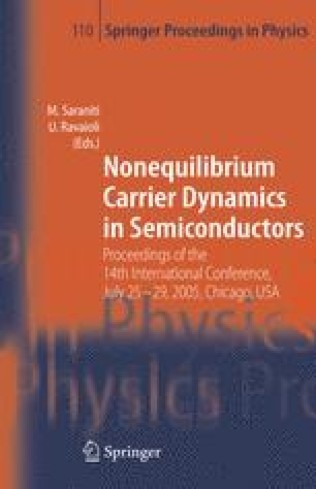
Nonequilibrium Carrier Dynamics in Semiconductors ; Proceedings of the 14th International Conference, July 25-29, 2005, Chicago, USA
International experts gather every two years at this established conference to discuss recent developments in theory and experiment in non-equilibrium transport phenomena. These developments have been the driving force behind the spectacular advances in semiconductor physics and devices over the last few decades. Originally known as "Hot Carriers in Semiconductors," the 14th conference in the series covered a wide spectrum of traditional topics dealing with non-equilibrium phenomena, ranging from quantum transport to optical phenomena in mesoscopic and nano-scale structures. Particular attention was given this time to emerging areas of this rapidly evolving field, with many sessions covering terahertz devices, high field transport in nitride semiconductors, spintronics, molecular electronics, and bioelectronics applications.

Nanostructured and advanced materials for applications in sensor, optoelectronic and photovoltaic technology ; Proceedings of the NATO Advanced Study Institute on nanostructured and advanced materials for applications in sensors, optoelectronic and photovoltaic technology ; Sozopol, Bulgaria, 6-17 September 2004
Nanotechnology is an emerging scientific field receiving significant worldwide attention. On a nanometer scale, materials or structures may possess new and unique physical properties. Some of these are now known to the scientific community, but there may well be many properties not yet known to us, rendering it as a fascinating area of research and a suitable subject for a NATO ASI. Yet another aspect of the field is the possibility for creating meta-stable phases with unconventional properties and the ultra-miniaturization of current devices, sensors, and machines. Such nanotechnological and related advanced materials have an extremely wide range of potential applications, viz. nanoscale electronics, sensors, optoelectronics, photonics, nano-biological systems, na- medicine, energy storage systems, etc. This is a wide-ranging subject area and therefore requires the formation of multi-disciplinary teams of physicists, chemists, materials scientists, engineers, molecular biologists, pharmacologists, and others to work together on the synthesis and processing of materials and structures, the understanding of their physical properties, the design and fabrication of devices.

Mid-infrared Semiconductor Optoelectronics
Mid-infrared Semiconductor Optoelectronics is an overview of the current status and technological development in this rapidly emerging area. It is composed of four parts. First, the basic physics and some of the main problems facing the design engineer (together with a comparison of possible solutions) are laid out. Next, there is a consideration of the multifarious lasers used as sources for mid-infrared technology, including an inspection of current approaches to the lack of such a source in the 3–4 µm region. Part III reviews recent work in light-emitting diodes and detectors and also deals with negative luminescence. The final part of the book is concerned with applications and highlights, once more, the diversity and technological importance of the mid-infrared spectral region.

Micro- and opto-electronic materials and Structures : Physics, mechanics, design, reliability, packaging ; Vol. I : Materials physics - materials mechanics ; Vol. II : Physical design - reliability and packaging
Micro- and Opto-Electronic Materials and Structures: Physics, Mechanics, Design, Reliability, Packaging is the first comprehensive reference to collect and present the most, up-to-date, in-depth, practical and easy-to-use information on the physics, mechanics, reliability and packaging of micro- and opto-electronic materials, assemblies, structures and systems. The chapters in these two volumes contain summaries of the state-of-the-art and present new information on recently developed important methods or devices. Furthermore, practical recommendations are offered on how to successfully apply current knowledge and recently developed technology to design, manufacture and operate viable, reliable and cost-effective electronic components or photonic devices. The emphasis is on the science and engineering of electronic and photonic packaging, on physical design problems, challenges and solutions.

Highly Sensitive Optical Receivers
Highly Sensitive Optical Receivers primarily treats the circuit design of optical receivers with external photodiodes. Continuous-mode and burst-mode receivers are compared. The monograph first summarizes the basics of III/V photodetectors, transistor and noise models, bit-error rate, sensitivity and analog circuit design, thus enabling readers to understand the circuits described in the main part of the book. In order to cover the topic comprehensively, detailed descriptions of receivers for optical data communication in general and, in particular, optical burst-mode receivers in deep-sub-µm CMOS are presented. Numerous detailed and elaborate illustrations facilitate better understanding.

Frontiers in Planar Lightwave Circuit Technology : Design, Simulation, and Fabrication
This book is the result of the NATO Advanced Research Workshop on Frontiers in Planar Lightwave Circuit Technology, which took place in Ottawa, Canada from September 21-25, 2004. In this volume the reader will find detailed overviews of experimental and theoretical work in high index contrast waveguide systems, micro-optical resonators, nonlinear optics, and advanced optical simulation methods, as well as articles describing emerging applications of integrated optics for medical and biological applications.

Electronic Devices and Circuit Design : Challenges and Applications in the Internet of Things
Offers a broad view of the challenges of electronic devices and circuits for IoT applications. The book presents the basic concepts and fundamentals behind new low power, high-speed efficient devices, circuits, and systems in addition to CMOS. It provides an understanding of new materials to improve device performance with smaller dimensions and lower costs. It also looks at the new methodologies to enhance system performance and provides key parameters for exploring the devices and circuit performance based on smart applications.

Electromagnetic Theory for Microwaves and Optoelectronics
This book is a first year graduate text on electromagnetic fields and waves. At the same time it serves as a useful reference for researchers and engineers in the areas of microwaves and optoelectronics. Following the presentation of the physical and mathematical foundations of electromagnetic theory, the book discusses the field analysis of electromagnetic waves confined in material boundaries, or so-called guided waves, electromagnetic waves in the dispersive media and anisotropic media, Gaussian beams and scalar diffraction theory. The theories and methods presented in the book are foundations of wireless engineering, microwave and millimeter wave techniques, optoelectronics and optical fiber communication.

Dilute III-V Nitride Semiconductors and Material Systems : Physics and Technology
A major current challenge for semiconductor devices is to develop materials for the next generation of optical communication systems and solar power conversion applications. Recently, extensive research has revealed that an introduction of only a few percentages of nitrogen into III-V semiconductor lattice leads to a dramatic reduction of the band gap. This discovery has opened the possibility of using these material systems for applications ranging from lasers to solar cells. Physics and Technology of Dilute III-V Nitride Semiconductors & Novel Dilute Nitride Material Systems reviews the current status of research and development in dilute III-V nitrides, with 24 chapters from prominent research groups covering recent progress in growth techniques, experimental characterization of band structure, defects carrier transport, transport properties, dynamic behavior of N atoms, device applications, modeling of device design, novel optoelectronic integrated circuits, and novel nitrogen containing III-V materials.

Carbon Nanotubes : Advanced Topics in the Synthesis, Structure, Properties and Applications
The carbon nanotubes field has evolved substantially since the publication of the bestseller "Carbon Nanotubes: Synthesis, Structure, Properties and Applications". The present volume builds on the generic aspects of the aforementioned book, which emphasizes the fundamentals, with the new volume emphasizing areas that have grown rapidly since the first volume, guiding future directions where research is needed and highlighting applications. The volume also includes an emphasis on areas like graphene, other carbon-like and other tube-like materials because these fields are likely to affect and influence developments in nanotubes in the next 5 years.

Broadband Opto-Electrical Receivers in Standard CMOS
Broadband Opto-Electrical Receivers in Standard CMOS starts from the basic fundamentals, necessary for the design of opto-electronic interface circuits. The book continues with an in-depth analysis of the photodiode, transimpedance amplifier (TIA) and limiting amplifier (LA). To thoroughly understand the light detection mechanisms in silicon, first a one-dimensional and second a two-dimensional model is developed. Analytical design equations are derived to guide the design of the amplifying circuits. For the TIA, the focus lies on the sensitivity-speed trade-off. For the LA, a high gain-bandwidth is pursued. Several practical design examples reveal the subtleties and challenges encountered during the design of high-performance analog circuits.
Applied Physics of Carbon Nanotubes : Fundamentals of Theory, Optics and Transport Devices
The book describes the state-of-the-art in fundamental, applied and device physics of nanotubes, including fabrication, manipulation and characterization for device applications; optics of nanotubes; transport and electromechanical devices and fundamentals of theory for applications. This information is critical to the field of nanoscience since nanotubes have the potential to become a very significant electronic material for decades to come. The book will benefit all all readers interested in the application of nanotubes, either in their theoretical foundations or in newly developed characterization tools that may enable practical device fabrication.

Advances in solid state physics ; Vol. 46
Many topical talks given at the numerous symposia are included. Most of these were organized collaboratively by several of the divisions of the Arbeitskreis. The topis range from zero-dimensional physics in quantum dots, molecules and nanoparticles over one-dimensional physics in nanowires and 1d systems to more applied subjects like optoelectronics and materials science in thin films.

Advances in optical fiber communications
Given the increasing importance of a globally interconnected world, driven by modern digital services and the need for fast and reliable access to digital resources, communication networks are one of the key infrastructures in today’s society. In this scenario, fiber optics and optical devices play a leading role, as they allow for unprecedented growth in our capacity to cope with the ever-increasing traffic demand. Optical transmission solutions range from high-speed networks based on coherent detection and advanced modulation formats for long-haul-level communications, to networks still relying on traditional intensity modulation and direct detection receivers for short-reach communications, down to intra-data center scenarios.
