



الصفحة 1
الصفحة 1

Online Storage Systems and Transportation Problems with Applications : Optimization Models and Mathematical Solutions
This books covers the analysis and development of online algorithms involving exact optimization and heuristic techniques, and their application to solve two real life problems. The first problem is concerned with a complex technical system: a special carousel based high-speed storage system - Rotastore. It is shown that this logistic problem leads to an NP-hard Batch PreSorting problem which is not easy to solve optimally in offline situations. The second problem originates in the health sector and leads to a vehicle routing problem. Reasonable solutions for the offline case covering a whole day with a few hundred orders are constructed with a heuristic approach, as well as by simulated annealing. Optimal solutions for typical online instances are computed by an efficient column enumeration approach leading to a set partitioning problem and a set of routing-scheduling subproblems. The latter are solved exactly with a branch-and-bound method which prunes nodes if they are value-dominated by previous found solutions or if they are infeasible with respect to the capacity or temporal constraints.

Object-Oriented Technology. ECOOP 2007 Workshop Reader ; ECOOP 2007 Workshops, Berlin, Germany, July 30-31, 2007, Final Reports
Contains the reports from the workshopsheld at the 21st European Conference on Object-Oriented Programming - ECOOP 2007 - at Technische Universit] at Berlin. Nineteen workshops were heldin the courseofthis conference on July 30 and July 31, 2007, covering a large spectrum of hot research topics. As in previous editions of ECOOP, numerous scientists from academia and industry took the chance to present innovative and topical ideas in an environment ofering optimal conditions for exciting discussions and fruitful interactions. The Workshop Reader which contains the reports from the workshops has been a substantial part of the ECOOP conference for more than10 years

Nutrition and diet in health: Principles and applications
Food provides us with essential nutrients involved in many physiological activities and biological processes in the body including growth and development, metabolism, immune function, and overall well-being. Nutrition and Diet in Health: Principles and Applications reviews and discusses the issues related to the roles of nutrition and diets in human health and diseases. The book contains two sections - one section features principles, the other, covers applications. Part One provides information on sustainable use of nutrition and diets in health and diseases; advanced biotechnological approaches to improve nutritional content of food; trace elements in nutrition; drug and nutrient interactions; functional foods and nutraceuticals in health maintenance; and Bio markers of functional foods and nutraceuticals in health maintenance. Part Two discusses the significance of nutrition in selected human diseases, including cardiovascular diseases, cancer, infection, neurodegenerative diseases, and metabolic co-morbidities. It also discusses optimal nutrition for wellness, fitness, pregnancy, mental health, aging, and longevity.

Numerical computation, data analysis and software in mathematics and engineering
Include the aspects of the meshless method, numerical simulation, mathematical models, deep learning and data analysis. Meshless methods, such as the improved element-free Galerkin method, the dimension-splitting, interpolating, moving, least-squares method, the dimension-splitting, generalized, interpolating, element-free Galerkin method and the improved interpolating, complex variable, element-free Galerkin method, are presented. Some complicated problems, such as tge cold roll-forming process, ceramsite compound insulation block, crack propagation and heavy-haul railway tunnel with defects, are numerically analyzed.
Nonlinear Optimization with Engineering Applications
This textbook examines a broad range of problems in science and engineering, describing key numerical methods applied to real life. The case studies presented are in such areas as data fitting, vehicle route planning and optimal control, scheduling and resource allocation, sensitivity calculations and worst-case analysis.
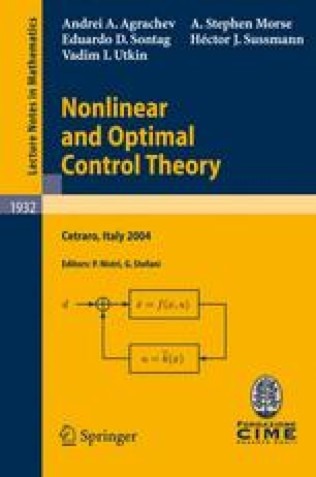
Nonlinear and Optimal Control Theory : Lectures given at the C.I.M.E. Summer School held in Cetraro, Italy June 19–29, 2004
The lectures gathered in this volume present some of the different aspects of Mathematical Control Theory. Adopting the point of view of Geometric Control Theory and of Nonlinear Control Theory, the lectures focus on some aspects of the Optimization and Control of nonlinear, not necessarily smooth, dynamical systems. Specifically, three of the five lectures discuss respectively: logic-based switching control, sliding mode control and the input to the state stability paradigm for the control and stability of nonlinear systems. The remaining two lectures are devoted to Optimal Control: one investigates the connections between Optimal Control Theory, Dynamical Systems and Differential Geometry, while the second presents a very general version, in a non-smooth context, of the Pontryagin Maximum Principle.

New Trends in Optimal Filtering and Control for Polynomial and Time-Delay Systems
0. 1 Introduction Although the general optimal solution of the ?ltering problem for nonlinear state and observation equations confused with white Gaussian noises is given by the Kushner equation for the conditional density of an unobserved state with respect to obser- tions (see [48] or [41], Theorem 6. 5, formula (6. 79) or [70], Subsection 5. 10. 5, formula (5. 10. 23)), there are a very few known examples of nonlinear systems where the Ku- ner equation can be reduced to a ?nite-dimensional closed system of ?ltering eq- tions for a certain number of lower conditional moments.

Neurosurgery : Principles and Practice
This book provides coverage of a broad range of topics in the ?eld of neurosurgery, 5 for residents and registrars in training and for recent graduates of training programs. 6 As neurosurgical training incorporates expertise from centers worldwide, there is a 7 need to have input from specialists in neurosurgery from various countries. This text 8 is a compilation by expert authors in the USA and the UK to provide information on 9 the basic knowledge and clinical management required for optimal care of neuro- 2011 surgical patients. 1 The text is an up-to-date synopsis of the ?eld of neurosurgery from American and 2 British perspectives, which covers the most common clinical conditions encountered 3 by neurosurgeons. The chapters are organized under broad topics, including inves- 4 tigative studies, perioperative care, the role of newer techniques and the management 5 of tumors, vascular and traumatic lesions. Additional topics are then covered, includ- 6 ing pediatrics, spine and peripheral nerve lesions, as well as functional neurosurgery 7 and infections. We anticipate that trainees will ?nd this information useful for certi?- 8 cation examinations and recent graduates of neurosurgical training programs can 9 utilize this text as an update of the most important neurosurgical topics.

Neuroscribe = نيوروسكرايب
Neuroscribe is a cutting-edge deep learning framework designed to address the complexities and inefficiencies encountered in existing frameworks like PyTorch and TensorFlow. Aimed at streamlining model development and enhancing performance across diverse hardware environments, NeuroScribe offers a lightweight and flexible solution. The framework features a robust tensor library, an auto-differentiation engine, a comprehensive neural network module, and advanced optimization algorithms. With built-in visualization tools and a user-friendly interface, NeuroScribe simplifies both beginner and advanced workflows. Its cross-platform compatibility, supported by CUDA and Metal Performance Shaders (MPS), ensures optimal performance, and in some scenarios, NeuroScribe demonstrates superior speed compared to leading frameworks. Additionally, NeuroScribe introduces unique libraries and features not found in other frameworks, further enhancing its versatility and appeal. The modular architecture and automatic system detection further enhance its adaptability, making NeuroScribe a versatile and powerful tool for deep learning practitioners.

Networked Control Systems: Theory and Applications
Networked Control Systems presents the most recent results in stability and robustness analysis as well as new developments related to networked fuzzy and optimal control. Many of the chapters contain details of case-studies, experimental, simulation and/or other application-related work showing how the theories put forward can be implemented in real systems.

Network Classification For Traffic Management : Anomaly detection, feature selection, clustering and classification
Investigates network traffic classification solutions by proposing transport-layer methods to achieve better run and operated enterprise-scale networks. With the massive increase of data and traffic on the Internet within the 5G, IoT and smart cities frameworks, current network classification and analysis techniques are falling short. Novel approaches using machine learning algorithms are needed to cope with and manage real-world network traffic, including supervised, semi-supervised, and unsupervised classification techniques. Accurate and effective classification of network traffic will lead to better quality of service and more secure and manageable networks. Investigates network traffic classification solutions by proposing transport-layer methods to achieve better run and operated enterprise-scale networks. The authors explore novel methods for enhancing network statistics at the transport layer, helping to identify optimal feature selection through a global optimization approach and providing automatic labelling for raw traffic through a SemTra framework to maintain provable privacy on information disclosure properties.

Multiscale Optimization Methods and Applications
One general strategy for dealing with a large or difficult problem is to partition it into smaller ones, which are hopefully much easier to solve, and then work backwards towards the solution of original problem, using a solution from a previous level as a starting guess at the next level.The topics of the chapters selected for this volume are focused on the development of new solution methodologies, including general multilevel solution techniques, for tackling difficult, large-scale optimization problems that arise in science and industry. Applications presented in the book include but are not limited to the circuit placement problem in VLSI design, a wireless sensor location problem, optimal dosages in the treatment of cancer by radiation therapy, and facility location.

Multiple Classifier Systems ; 2nd International Workshop, MCS 2001 Cambridge, UK, July 2-4, 2001 Proceedings
Driven by the requirements of a large number of practical and commercially - portant applications, the last decade has witnessed considerable advances in p- tern recognition. Better understanding of the design issues and new paradigms, such as the Support Vector Machine, have contributed to the development of - proved methods of pattern classi cation. However, while any performance gains are welcome, and often extremely signi cant from the practical point of view, it is increasingly more challenging to reach the point of perfection as de ned by the theoretical optimality of decision making in a given decision framework. The asymptoticity of gains that can be made for a single classi er is a re?- tion of the fact that any particular design, regardless of how good it is, simply provides just one estimate of the optimal decision rule.

Multiobjective Optimization : Interactive and Evolutionary Approaches
Multiobjective optimization deals with solving problems having not only one, but multiple, often conflicting, criteria. Such problems can arise in practically every field of science, engineering and business, and the need for efficient and reliable solution methods is increasing. The task is challenging due to the fact that, instead of a single optimal solution, multiobjective optimization results in a number of solutions with different trade-offs among criteria, also known as Pareto optimal or efficient solutions. Hence, a decision maker is needed to provide additional preference information and to identify the most satisfactory solution. Depending on the paradigm used, such information may be introduced before, during, or after the optimization process. Clearly, research and application in multiobjective optimization involve expertise in optimization as well as in decision support.

Multiobjective Evolutionary Algorithms and Applications
Multiobjective Evolutionary Algorithms and Applications provides comprehensive treatment on the design of multiobjective evolutionary algorithms and their applications in domains covering areas such as control and scheduling. Emphasizing both the theoretical developments and the practical implementation of multiobjective evolutionary algorithms, a profound mathematical knowledge is not required. Written for a wide readership, engineers, researchers, senior undergraduates and graduate students interested in the field of evolutionary algorithms and multiobjective optimization with some basic knowledge of evolutionary computation will find this book a useful addition to their book case.

Multicriteria Scheduling : Theory, Models and Algorithms
Scheduling and multicriteria optimisation theory have been subject, separately, to numerous studies. Since the last twenty years, multicriteria scheduling problems have been subject to a growing interest. However, a gap between multicriteria scheduling approaches and multicriteria optimisation field exits. This book is an attempt to collect the elementary of multicriteria optimisation theory and the basic models and algorithms of multicriteria scheduling. It is composed of numerous illustrations, algorithms and examples which may help the reader in understanding the presented concepts. This book covers general concepts such as Pareto optimality, complexity theory, and general method for multicriteria optimisation, as well as dedicated scheduling problems and algorithms: just-in-time scheduling, flexibility and robustness, single machine problems, parallel machine problems, shop problems, etc.

Multicriteria Optimization
Decision makers in many areas, from industry to engineering and the social sector, face an increasing need to consider multiple, conflicting objectives in their decision processes. In many cases these real world decision problems can be formulated as multicriteria mathematical optimization models. The solution of such models requires appropriate techniques to compute so called efficient, or Pareto optimal, or compromise solutions that - unlike traditional mathematical programming methods - take the contradictory nature of the criteria into account. This book provides the necessary mathematical foundation of multicriteria optimization to solve nonlinear, linear and combinatorial problems with multiple criteria. Motivational examples illustrate the use of multicriteria optimization in practice. Numerous illustrations and exercises as well as an extensive bibliography are provided.

MRI of the Temporomandibular Joint : Correlation Between Imaging and Pathology
This book is the outcome of a fruitful, long-standing cooperation between expert radiologists and clinicians, and explains the most relevant features and technical requirements that are needed to optimally conduct and assess MR examinations for temporomandibular joint (TMJ) pathologies.

MR Cholangiopancreatography : Atlas with Cross-Sectional Imaging Correlation
Magnetic resonance cholangiopancreatography (MRCP) is a novel non-invasive technique for diagnosis of pancreatic-biliary disease. The purpose of this book is to highlight the advantages, limitations and indications of MRCP. Specific examples have been selected to showcase the utility of this technique in a large variety of clinical conditions. Each example is purposefully used to stress important technical features, to give practical advice, or to discuss the role of MRCP in specific clinical situations. Important features of the book are the high quality of the illustrations, the reduction of the text to relevant and practically useful issues, and the simple and logic organisation of the case material. The book should show: the optimal technique in MRCP, the pitfalls and limitations.
Molecular Diagnostic PCR Handbook
PREFACE The Joint FAO/IAEA Division of Nuclear Techniques in Food and Agriculture is involved in agricultural research and development and assists Member States of FAO and IAEA in improving strategies to ensure food security through the use of nuclear techniques and related biotechnologies, where such techniques have a valuable and often unique role. In particular, molecular diagnostic methods have rapidly evolved in the past twenty years, since the advent of the Polymerase Chain Reaction (PCR). They are used in a wide range of agricultural areas such as, improving soil and water management; producing better crop varieties; diagnosing plant and animal diseases; controlling insect pests and improving food quality and safety. The uses of nucleic acid-directed methods have increased significantly in the past five years and have made important contributions to disease control country programmes for improving national and international trade. These developments include the more routine use of PCR as a diagnostic tool in veterinary diagnostic laboratories. However, there are many problems associated with the transfer and particularly, the application of this technology. These include lack of consideration of: the establishment of quality-assured procedures, the required set-up of the laboratory and the proper training of staff. This can lead to a situation where results are not assured. This book gives a comprehensive account of the practical aspects of PCR and strong consideration is given to ensure its optimal use in a laboratory environment. This includes the setting-up of a PCR laboratory; Good Laboratory Practice and standardised of PCR protocols.
