



الصفحة 1
الصفحة 1
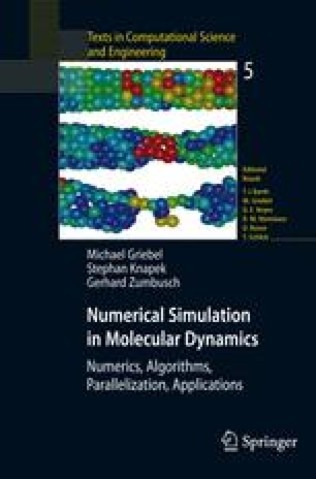
Numerical Simulation in Molecular Dynamics : Numerics, Algorithms, Parallelization, Applications
Particle models play an important role in many applications in physics, chemistry and biology. They can be studied on the computer with the help of molecular dynamics simulations. This book presents in detail both the necessary numerical methods and techniques (linked-cell method, SPME-method, tree codes, multipole technique) and the theoretical background and foundations. It illustrates the aspects modelling, discretization, algorithms and their parallel implementation with MPI on computer systems with distributed memory. Furthermore, detailed explanations are given to the different steps of numerical simulation, and code examples are provided.

Numerical Methods and Applications ; 6th International Conference, NMA 2006, Borovets, Bulgaria, August 20-24, 2006, Revised Papers
This book constitutes the thoroughly refereed post-proceedings of the 6th International Conference on Numerical Methods and Applications, NMA 2006. The papers are organized in topical sections on numerical methods for hyperbolic problems, robust preconditioning solution methods, Monte Carlo and quasi-Monte Carlo for diverse applications, metaheuristics for optimization problems, uncertain/control systems and reliable numerics, interpolation and quadrature processes, large-scale computations in environmental modelling, and contributed talks.

New Results in Numerical and Experimental Fluid Mechanics VI ; Contributions to the 15th STAB/DGLR Symposium Darmstadt, Germany, 2006
The volume gives a broad overview over the ongoing work in this field in Germany, with the topics being high-aspect ratio wings, low aspect-ratio wings, bluff bodies, laminar flow control and transition, active flow control, hypersonic flows, aeroelasticity, aeroacoustics, mathematical fundamentals/ numerical simulation, physical fundamentals, and facilities.

Hyperbolic Problems : Theory, Numerics, Applications ; Proceedings of the Eleventh International Conference on Hyperbolic Problems held in Ecole Normale Supérieure, Lyon, July 17-21, 2006
This volume contains papers that were presented at HYP2006, the eleventh international Conference on Hyperbolic Problems: Theory, Numerics and Applications held at the Ecole Normale Supérieure de Lyon, France, July 17-21, 2006. This biennial series of conferences has become one of the most important international events in Applied Mathematics. As computers became more and more powerful, the interplay between theory, modelling, and numerical algorithms gained considerable impact, and the scope of HYP conferences expanded accordingly. The field is currently in interaction with a variety of scientific domains, including fluid dynamics, physics, electromagnetism, chemistry, biology, road and network traffic, and engineering. Many of these papers present new effective numerical methods and their application in various contexts.

Hemodynamical Flows : Modeling, Analysis and Simulation
This book surveys research results on the physical and mathematical modeling, as well as the numerical simulation of complex fluid and structural mechanical processes occurring in the human blood circulation system. Topics treated include continuum mechanical description; choice of suitable liquid and wall models; mathematical analysis of coupled models; numerical methods for flow simulation; parameter identification and model calibration; fluid-solid interaction; mathematical analysis of piping systems; particle transport in channels and pipes; artificial boundary conditions, and many more.

Handbook of Continued Fractions for Special Functions
Special functions are pervasive in all fields of science and industry. The most well-known application areas are in physics, engineering, chemistry, computer science and statistics. Because of their importance, several books and websites (see for instance http: functions.wolfram.com) and a large collection of papers have been devoted to these functions. Of the standard work on the subject, namely the Handbook of Mathematical Functions with formulas, graphs and mathematical tables edited by Milton Abramowitz and Irene Stegun, the American National Institute of Standards claims to have sold over 700 000 copies!

Domain Decomposition Methods in Science and Engineering XVII
This volume contains a selection of papers presented at the 17th International Conference on Domain Decomposition Methods in Science and Engineering held at St. Wolfgang / Strobl, Austria, July 3 - 7, 2006. Domain decomposition is an active, interdisciplinary research area concerned with the development, analysis, and implementation of coupling and decoupling strategies in mathematical and computational models. Domain decomposition techniques provide efficient tools for treating problems in all Computational Sciences. The reader will become familiar with the newest domain decomposition technologies and their use for modeling and simulating of complex problems from different fields of applications.

Computational Science and High Performance Computing ; Russian-German Advanced Research Workshop, Novosibirsk, Russia, September 30 to October 2, 2003
This volume contains contributions to the Russian-German Advanced Research Workshop on Computational Science and High Performance Computing as presented in September 2003 at Novosibirsk (Academgorodok), Russia. The workshop was organized jointly by the German High Performance Computing Center Stuttgart (HLRS) and the Russian Institute for Computational Technologies (ICT SB RAS). The contributions range from computer science, mathematics and high performance computing to applications in mechanical and aerospace engineering. They bring together a wealth of theoretical work and simulation experie.

Computational Multiscale Modeling of Fluids and Solids : Theory and Applications
The book includes the micro-scale, the meso-scale and the macro-scale. The chapters follow this classification. The book will explain in detail many tricks of the trade of some of the most important methods and techniques that are used to simulate materials on the perspective levels of spatial and temporal resolution. Case studies are occasionally included to further illustrate some methods or theoretical considerations. Example applications for all techniques are provided, some of which are from the author’s own contributions to some of the research areas. Methods are explained, if possible, on the basis of the original publications but also references to standard text books established in the various fields are mentioned.
Analysis and Numerics for Conservation Laws
The physical and chemical mechanisms as well as the sizes of these processes are quite different. So are the motivations for studying them scientifically.The super- 8 nova is a thermo-nuclear explosion on a scale of 10 cm. Astrophysicists try to understand them in order to get insight into fundamental properties of the universe. In hows around airfoils of commercial airliners at the scale of 3 10 cm shock waves occur that influence the stability of the wings as well as fuel consumption in ight. This requires appropriate design of the shape and structure of airfoils by engineers. Knocking occurs in combustion, a chemical 1 process, and must be avoided since it damages motors. The scale is 10 cm and these processes must be optimized for efficiency and environmental conside- tions. The common thread is that the underlying ?uid ?ows may at a certain scale of observation be described by basically the same type of hyperbolic s- tems of partial differential equations in divergence form, called conservation laws. Astrophysicists, engineers and mathematicians share a common interest in scientific progress on theory for these equations and the development of computational methods for solutions of the equations. Due to their wide applicability in modeling of continua. A substantial portion of mathematical research is related to the analysis and numerical approximation of solutions to such equations. Hyperbolic conservation laws in two or more space dimensions still poseone of the main challenges to modern mathematics.
AdvancED ActionScript Components : Mastering the Flash Component Architecture
Macromedia's architecture is like a chest filled with precious jewels, and this book is quite simply the key to open it! One of the most important tools provided with Flash is the Macromedia Component Architecture: a framework of components written in ActionScript 2, based on established design patterns, that provides a wealth of functionality you can just bolt on to your Flash applications when desired. This can save you an enormous amount of time during application development and help you improve the quality of your code. What's more, the source code is included, so if you can't find the component you need within the component architecture, you can just modify existing components to create your own!
Ada 2005 Reference Manual. Language and Standard Libraries : International Standard ISO/IEC 8652/1995(E) with Technical Corrigendum 1 and Amendment 1
The Ada 2005 Reference Manual incorporates these changes in the overall standard text and thus will replace the former versions as an indispensable working companion for anybody using Ada professionally or learning and studying the language systematically. In naming this version, we have chosen the vernacular term Ada 2005 used by the Ada community to refer to the interesting extensions made to the language Ada by the Amendment 1.
