



الصفحة 1
الصفحة 1

Numerical Techniques for Chemical and Biological Engineers Using MATLAB® : A Simple Bifurcation Approach
This book addresses the bifurcation characteristics of chemical and biological processes as the general case and treats systems with a unique steady state as special cases. It uses a system approach which is the most efficient for knowledge organization and transfer. The book develops mathematical models for many commercial processes utilizing the mass-, momentum-, and heat-balance equations coupled to the rates of the processes that take place within the boundaries of the system. The models are solved numerically through MATLAB codes with emphasis on the design and optimization of the chemical and biological industrial equipment and plants.

Numerical Methods in Finance
The use of mathematical models and numerical techniques in finance is a growing practice, and an increasing number of applied mathematicians are working on applications in finance and business. This book presents some exciting developments arising from the combination of mathematics, numerical analysis, and finance. It covers a wide range of topics, from portfolio management and asset pricing, to performance, risk, debt and real option evaluation. It also presents applications of a variety of cutting edge approaches and techniques, including robust control, min-max optimisation, Bessel processes, stochastic viability, variational inequalities, and Monte-Carlo test techniques. The book also presents surveys of models and approaches in specific areas in finance, such as corporate debt valuation and portfolio selection
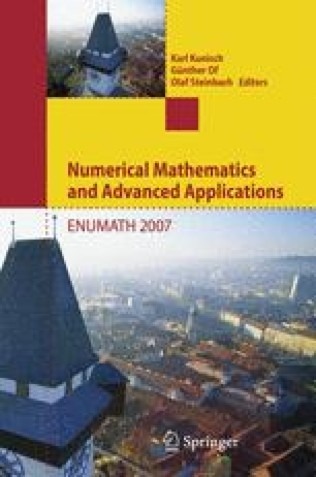
Numerical Mathematics and Advanced Applications ; Proceedings of ENUMATH 2007, the 7th European Conference on Numerical Mathematics and Advanced Applications, Graz, Austria, September 2007
The European Conference on Numerical Mathematics and Advanced Applications (ENUMATH) is a series of meetings held every two years to provide a forum for discussion on recent aspects of numerical mathematics and their applications. These proceedings contain a selection of invited plenary lectures, papers presented in minisymposia and contributed papers. Topics include theoretical aspects of new numerical techniques and algorithms as well as of applications in engineering and science. The book will be useful for a wide range of readers, giving them an excellent overview of the most modern methods, techniques, algorithms and results in numerical mathematics, scientific computing and their applications.

Nonlinear Optimization with Financial Applications
The book introduces the key ideas behind practical nonlinear optimization. Computational finance—an increasingly popular area of mathematics degree programmes—is combined here with the study of an important class of numerical techniques. The essentials of most currently popular algorithms are described and their performance is demonstrated on a range of optimization problems arising in financial mathematics. Theoretical convergence properties of methods are stated and formal proofs are provided in enough cases to be instructive rather than overwhelming. Practical behaviour of methods is illustrated by computational examples and discussions of efficiency, accuracy and computational costs. Supporting software for the examples and exercises is available

Multiscale Modeling in Epitaxial Growth
Epitaxy is a very active area of theoretical research since several years. It is experimentally well-explored and technologically relevant for thin film growth. Recently powerful numerical techniques in combination with a deep understanding of the physical and chemical phenomena during the growth process offer the possibility to link atomistic effects at the surface to the macroscopic morphology of the film. The goal of this book is to summarize recent developments in this field, with emphasis on multiscale approaches and numerical methods. It covers atomistic, step-flow, and continuum models and provides a compact overview of these approaches. It also serves as an introduction into this highly active interdisciplinary field of research for applied mathematicians, theoretical physicists and computational materials scientists.

Max-Plus Methods for Nonlinear Control and Estimation
The central focus of this book is the control of continuous-time/continuous-space nonlinear systems. Using new techniques that employ the max-plus algebra, the author addresses several classes of nonlinear control problems, including nonlinear optimal control problems and nonlinear robust/H-infinity control and estimation problems. Several numerical techniques are employed, including a max-plus eigenvector approach and an approach that avoids the curse-of-dimensionality.. The max-plus-based methods examined in this monograph belong to an entirely new class of numerical methods for the solution of nonlinear control problems.The potential advantages of the max-plus-based approaches lie in the fact that solution operators for nonlinear HJB problems are linear over the max-plus algebra, and this linearity is exploited in the construction of algorithms.

Integral Methods in Science and Engineering : Theoretical and Practical Aspects
The quantitative and qualitative study of the physical world makes use of many mathematical models governed by a great diversity of ordinary, partial differential, integral, and integro-differential equations. An essential step in such investigations is the solution of these types of equations, which sometimes can be performed analytically, while at other times only numerically. This edited, self-contained volume presents a series of state-of-the-art analytic and numerical methods of solution constructed for important problems arising in science and engineering, all based on the powerful operation of (exact or approximate) integration.It covers a wide variety of topics, from the theoretical development of boundary integral methods to the application of integration-based analytic and numerical techniques that include integral equations, finite and boundary elements, conservation laws, hybrid approaches, and other procedures.

Fractional order systems and applications in engineering
Covers the fundamentals of fractional calculus together with some analytical and numerical techniques, and provides MATLAB® codes for the simulation of fractional-order control (FOC) systems. The use of fractional calculus can improve and generalize well-established control methods and strategies. Many different FOC schemes are presented for control and dynamic systems problems. These extend to the challenging control engineering design problems of robust and nonlinear control. Practical material relating to a wide variety of applications including, among others, mechatronics, civil engineering, irrigation and water management, and biological systems is also provided.

Discrete Element Analysis Methods of Generic Differential Quadratures
This book presents numerical differential quadrature (DQ) - based methods recently developed by the author. Their ability for solving generic scientific and engineering problems is demonstrated. These methods are the generic differential quadrature, the extended differential quadrature and the related discrete element analysis methods. These novel numerical techniques are both efficient and reliable. They are suitable for developing solution algorithms for various computational mechanics problems with arbitrarily complex geometry. This is shown for several comprehensive examples such as bars and beams, trusses, frames, general field problems, elasticity problems or bending of plates.

Computing the Electrical Activity in the Heart
This book describes mathematical models and numerical techniques for simulating the electrical activity in the heart. The book gives an introduction to the most important models of the field, followed by a detailed description of numerical techniques for the models. Particular focus is on efficient numerical methods for large scale simulations on both scalar and parallel computers.

Computational Quantum Mechanics for Materials Engineers : The EMTO Method and Applications
Computational Quantum Mechanics for Materials Engineers describes new approaches to the modelling of disordered alloys that combine the most efficient quantum-level theories of random alloys with the most sophisticated numerical techniques to establish a theoretical insight into the electronic structure of complex materials such as stainless steels, Hume-Rothery alloys and silicates. The practical success of these approaches to applications in all of these areas are covered in detail. The new EMTO-CPA method is detailed, including its application in alloys to model structural stability and elastic properties of random alloys of arbitrary composition and the effect of alloying elements on elastic stiffnesses stacking fault energies and structural parameters. The EMTO-CPA method makes new approaches to computational alloy design feasible. Computational Quantum Mechanics for Materials Engineers shows how the technique will soon allow materials engineers to become "quantum blacksmiths
Light Scattering Reviews 3 : Light Scattering and Reflection
Ddevoted to modern knowledge and milestones in both experimental and theoretical techniques related to light scattering and radiative transport problems. It will consist of 3 parts comprising 11 contributions written by world leading experts in their respective fields. The general focus of the book will be on remote sensing of geophysical media. The first part will be devoted exclusively to studies of single light scattering by particles of different shapes and chemical compositions. The first chapter will review in situ measurements of cloud optical characteristics like cloud extinction and phase function, with the emphasis on ice clouds. Chapter 2 will cover opitcally soft particles common in marine environments and bio-suspensions while Chapter 3 will describe numerical techniques applicable not only to isotropic but also to chiral and anisotropic mdia. The final chapter in this part will deal with spatial symmetries in light scattering problems.
Light Scattering Reviews 2
Part of the ""Light Scattering Reviews"" series that is devoted to modern knowledge and milestones in both experimental and theoretical techniques related to light scattering and radiative transport problems. This work gives a picture of developments in the area of remote sensing and radiative transfer.
Chaos : A Program Collection for the PC
This new edition strives yet again to provide readers with a working knowledge of chaos theory and dynamical systems through parallel introductory explanations in the book and interaction with carefully-selected programs supplied on the accompanying diskette. The programs enable readers, especially advanced-undergraduate students in physics, engineering, and math, to tackle relevant physical systems quickly on their PCs, without distraction from algorithmic details. For the third edition of Chaos: A Program Collection for the PC, each of the previous twelve programs is polished and rewritten in C++ (both Windows and Linux versions are included). A new program treats kicked systems, an important class of two-dimensional problems, which is introduced in Chapter 13. Each chapter follows the structure: theoretical background; numerical techniques; interaction with the program; computer experiments; real experiments and empirical evidence; reference.
