



الصفحة 1
الصفحة 1

Nonlinear Dynamics in Geosciences
Nonlinear Dynamics in Geosciences is comprised of the proceedings of "20 Years of Nonlinear Dynamics in Geosciences", held June 11-16, 2006 in Rhodes, Greece as part of the Aegean Conferences. The volume brings together the most up-to-date research from the atmospheric sciences, hydrology, geology, and other areas of geosciences, and discusses the advances made in the last two decades and the future directions of nonlinear dynamics. Topics covered include predictability, ensemble prediction, nonlinear prediction, nonlinear time series analysis, low-dimensional chaos, nonlinear modeling, fractals and multifractals, bifurcation, complex networks, self-organized criticality, extreme events, and other aspects of nonlinear science.
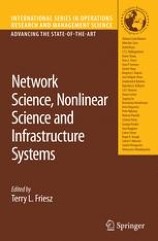
Network Science, Nonlinear Science and Dynamic Game Theory Applied to the Study of Infrastructure Systems
Network Science, Nonlinear Science and Infrastructure Systems has been written by leading scholars in these areas. Its express purpose is to develop common theoretical underpinnings to better solve modern infrastructural problems. It is felt by many who work in these fields that many modern communication problems, ranging from transportation networks to telecommunications, Internet, supply chains, etc., are fundamentally infrastructure problems. Moreover, these infrastructure problems would benefit greatly from a confluence of theoretical and methodological work done with the areas of Network Science, Dynamical Systems and Nonlinear Science. This book is dedicated to the formulation of infrastructural tools that will better solve these types of infrastructural problems.

Emergent Nonlinear Phenomena in Bose-Einstein Condensates : Theory and Experiment
This book, written by experts in the fields of atomic physics and nonlinear science, consists of reviews of the current state of the art at the interface of these fields, as is exemplified by the modern theme of Bose-Einstein condensates. Topics covered include bright, dark, gap and multidimensional solitons; vortices; vortex lattices; optical lattices; multicomponent condensates; manipulation of condensates; mathematical methods/rigorous results; and aspects beyond the mean field approach. A distinguishing feature of the contents is the detailed incorporation of both the experimental and theoretical viewpoints through subsections of the relevant chapters.
