



الصفحة 1
الصفحة 1

Numerical Mathematics and Advanced Applications ; Proceedings of ENUMATH 2005 the 6th European Conference on Numerical Mathematics and Advanced Applications, Santiago de Compostela, Spain, July 2005
This book include applications such as atmosphere and ocean, water pollution, electromagnetism, interface problems, waves, finance, heat transfer, unbounded domains, numerical linear algebra, convection-diffusion, fluid-structure, plates, solids, hyperbolic equations, multiphase flow, Navier-Stokes, singular perturbation problems, non linear PDE, control, parabolic equations, as well as methodologies such as a posteriori error estimates, discontinuous Galerkin methods, multiscale methods, optimization, adaptive methods, domain decomposition techniques, exponential integrators, hp-finite elements, level set methods, fractional step methods, penalty procedures, and finite volumes. The book gives an extensive overview of the most recent research in scientific computing, providing to the reader the latest developments concerning the mathematical issues and the applications of this active field of science.

Nonlinear finite element analysis of composite and reinforced concrete beams
Nonlinear Finite Element Analysis of Composite and Reinforced Concrete Beams presents advanced methods and techniques for the analysis of composite and FRP reinforced concrete beams. The title introduces detailed numerical modeling methods and the modeling of the structural behavior of composite beams, including critical interfacial bond-slip behavior. It covers a new family of composite beam elements developed by the authors. Other sections cover nonlinear finite element analysis procedures and the numerical modeling techniques used in commercial finite element software that will be of particular interest to engineers and researchers executing numerical simulations.
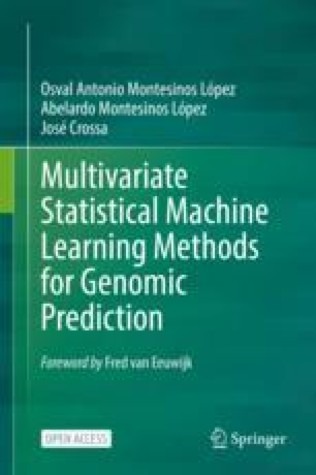
Multivariate Statistical Machine Learning Methods for Genomic Prediction
This book brings together the latest genome base prediction models currently being used by statisticians, breeders and data scientists. It provides an accessible way to understand the theory behind each statistical learning tool, the required pre-processing, the basics of model building, how to train statistical learning methods, the basic R scripts needed to implement each statistical learning tool, and the output of each tool. To do so, for each tool the book provides background theory, some elements of the R statistical software for its implementation, the conceptual underpinnings, and at least two illustrative examples with data from real-world genomic selection experiments.
