



الصفحة 1
الصفحة 1

Spectral Methods : Evolution to Complex Geometries and Applications to Fluid Dynamics
Spectral methods, particularly in their multidomain version, have become firmly established as a mainstream tool for scientific and engineering computation. While retaining the tight integration between the theoretical and practical aspects of spectral methods that was the hallmark of their 1988 book, Canuto et al. now incorporate the many improvements in the algorithms and the theory of spectral methods that have been made since then.The recent companion book Fundamentals in Single Domains discusses the fundamentals of the approximation of solutions to ordinary and partial differential equations on single domains by expansions in smooth, global basis functions.

SPDE in Hydrodynamic : Recent Progress and Prospects : Lectures given at the C.I.M.E. Summer School held in Cetraro, Italy August 29–September 3, 2005
Of the three lecture courses making up the CIME summer school on Fluid Dynamics at Cetraro in 2005 reflected in this volume, the first, due to Sergio Albeverio describes deterministic and stochastic models of hydrodynamics. In the second course, Franco Flandoli starts from 3D Navier-Stokes equations and ends with turbulence. Finally,Yakov Sinai, in the 3rd course, describes some rigorous mathematical results for multidimensional Navier-Stokes systems and some recent results on the one-dimensional Burgers equation with random forcing.

Robust Numerical Methods for Singularly Perturbed Differential Equations : Convection-Diffusion-Reaction and Flow Problems
This considerably extended and completely revised second edition incorporates many new developments in the thriving field of numerical methods for singularly perturbed differential equations. It provides a thorough foundation for the numerical analysis and solution of these problems, which model many physical phenomena whose solutions exhibit layers. The book focuses on linear convection-diffusion equations and on nonlinear flow problems that appear in computational fluid dynamics. It offers a comprehensive overview of suitable numerical methods while emphasizing those with realistic error estimates. The book should be useful for scientists requiring effective numerical methods for singularly perturbed differential equations.

Nonlinear Parabolic-Hyperbolic Coupled Systems and Their Attractors
This book presents recent results concerning the global existence in time, the large-time behaviour, decays of solutions and the existence of global attractors for some nonlinear parabolic-hyperbolic coupled systems of evolutionary partial differential equations arising from physics, mechanics and material science, such as the compressible Navier-Stokes equations, thermo(visco)elastic systems and elastic systems. To keep the book as self-contained as possible, the first chapter introduces to the needed results and tools from functional analysis, Sobolev spaces, differential and integral inequa.

Nonlinear Elliptic and Parabolic Problems : A Special Tribute to the Work of Herbert Amann
The present volume is dedicated to celebrate the work of the renowned mathematician Herbert Amann, who had a significant and decisive influence in shaping Nonlinear Analysis. Most articles published in this book, which consists of 32 articles in total, written by highly distinguished researchers, are in one way or another related to the scientific works of Herbert Amann. The contributions cover a wide range of nonlinear elliptic and parabolic equations with applications to natural sciences and engineering. Special topics are fluid dynamics, reaction-diffusion systems, bifurcation theory, maximal regularity, evolution equations, and the theory of function spaces.

Meshfree Methods for Partial Differential Equations II
A Particle Strategy for Solving the Fokker-Planck Equation Modelling the Fiber Orientation Distribution in Steady Recirculating Flows Involving Short Fiber Suspensions.- Extended Meshfree Method for Elastic and Inelastic Media.- Meshfree Petrov-Galerkin Methods for the Incompressible Navier-Stokes Equations.- The ?-shape Based Natural Element Method in Solid and Fluid Mechanics.- A Particle-Partition of Unity Method Part VI: A p-robust Multilevel Solver.- Enriched Reproducing Kernel Approximation: Reproducing Functions with Discontinuous Derivatives.- Reproducing Kernel Element Interpolation: Globally Conforming I m/C n/P k Hierarchies.- Multi-scale Analysis Using Two Influence Radii in EFGM.- Solution of a Dynamic Main Crack Interaction with a System of Micro-Cracks by the Element Free Galerkin Method.- Finite Cover Method for Physically and Geometrically Nonlinear Problems.- A Numerical Scheme for Solving Incompressible and Low Mach Number Flows by the Finite Pointset Method.- SPH Renormalized Hybrid Methods for Conservation Laws: Applications to Free Surface Flows.- Discontinuous Radial Basis Function Approximations for Meshfree Methods.- Treating Moving Interfaces in Thermal Models with the C-NEM.- Bridging Scale Particle and Finite Element Methods.

Mathematics of Large Eddy Simulation of Turbulent Flows
Large eddy simulation (LES) is a method of scientific computation seeking to predict the dynamics of organized structures in turbulent flows by approximating local, spatial averages of the flow. This book focuses on the mathematical foundations of LES and its models and provides a connection between the powerful tools of applied mathematics, partial differential equations and LES. Thus, it is concerned with fundamental aspects not treated so deeply in the other books in the field, aspects such as well-posedness of the models, their energy balance and the connection to the Leray theory of weak solutions of the Navier-Stokes equations.

Instability in Models Connected with Fluid Flows II
Instability in Models Connected with Fluid Flows II presents chapters from world renowned specialists. The stability of mathematical models simulating physical processes is discussed in topics on control theory, first order linear and nonlinear equations, water waves, free boundary problems, large time asymptotics of solutions, stochastic equations, Euler equations, Navier-Stokes equations, and other PDEs of fluid mechanics. Fields covered include: the free surface Euler (or water-wave) equations, the Cauchy problem for transport equations, irreducible Chapman--Enskog projections and Navier-Stokes approximations, randomly forced PDEs, stability of equilibrium figures of uniformly rotating viscous incompressible liquid, Navier-Stokes equations in cylindrical domains, Navier-Stokes-Poisson flows in a vacuum.

Instability in Models Connected with Fluid Flows I
Instability in Models Connected with Fluid Flows I presents chapters from world renowned specialists. The stability of mathematical models simulating physical processes is discussed in topics on control theory, first order linear and nonlinear equations, water waves, free boundary problems, large time asymptotics of solutions, stochastic equations, Euler equations, Navier-Stokes equations, and other PDEs of fluid mechanics. Fields covered include: controllability and accessibility properties of the Navier- Stokes and Euler systems, nonlinear dynamics of particle-like wavepackets, attractors of nonautonomous Navier-Stokes systems, large amplitude monophase nonlinear geometric optics, existence results for 3D Navier-Stokes equations and smoothness results for 2D Boussinesq equations, instability of incompressible Euler equations, increased stability in the Cauchy problem for elliptic equations.

From Hyperbolic Systems to Kinetic Theory : A Personalized Quest
Equations of state are not always effective in continuum mechanics. Maxwell and Boltzmann created a kinetic theory of gases, using classical mechanics. How could they derive the irreversible Boltzmann equation from a reversible Hamiltonian framework? By using probabilities, which destroy physical reality! Forces at distance are non-physical as we know from Poincaré's theory of relativity. Yet Maxwell and Boltzmann only used trajectories like hyperbolas, reasonable for rarefied gases, but wrong without bound trajectories if the "mean free path between collisions" tends to 0. Tartar relies on his H-measures, a tool created for homogenization, to explain some of the weaknesses, e.g. from quantum mechanics: there are no "particles", so the Boltzmann equation and the second principle, can not apply. He examines modes used by energy, proves which equation governs each mode, and conjectures that the result will not look like the Boltzmann equation, and there will be more modes than those indexed by velocity!

Fluid Mechanics : An Introduction to the Theory of Fluid Flows
Advancements of fluid flow measuring techniques and of computational methods have led to new ways to treat laminar and turbulent flows. These methods are extensively used these days in research and engineering practise. This also requires new ways to teach the subject to students at higher educational institutions in an introductory manner. The book provides the knowledge to students in engineering and natural science needed to enter fluid mechanics applications in various fields. Analytical treatments are provided, based on the Navier-Stokes equations. Introductions are also given into numerical and experimental methods applied to flows. The main benefit the reader will derive from the book is a sound introduction into all aspects of fluid mechanics covering all relevant subfields.

Fluid and thermodynamics ; Vol.1 : Basic fluid mechanics
Simple, yet precise solutions to special flows are also constructed, namely Blasius boundary layer flows, matched asymptotics of the Navier-Stokes equations, global laws of steady and unsteady boundary layer flows and laminar and turbulent pipe flows

Engineering Fluid Mechanics
The intended purpose of this book is to provide the fundamental and physical aspects of fluid mechanics and to develop engineering practice for fluid machineries. The subject of fluid engineering is most often approached at the senior undergraduate or postgraduate level of study.

Control of Coupled Partial Differential Equations
Contains selected contributions originating from the ‘Conference on Optimal Control of Coupled Systems of Partial Differential Equations’, held at the ‘Mathematisches Forschungsinstitut Oberwolfach’ in April 2005.

Computational Turbulent Incompressible Flow: Applied Mathematics : Body and Soul 4
This is Volume 4 of the book series of the Body & Soul mathematics education reform program, and presents a unified new approach to computational simulation of turbulent.

Computational Fluid Dynamics for Wind Engineering
Covers topics such as: Fluid mechanics, turbulence in fluid mechanics, turbulence modelling, and mathematical modelling of wind engineering problems The finite difference method for CFD, solutions to the incompressible Navier-Stokes equations, visualization, and animation in CFD, and the application of CFD to building and bridge aerodynamics How to compare CFD analysis with wind tunnel measurements, field measurements, and the ASCE-7 pressure coefficients Wind effects and strain on large structures

Computational Fluid Dynamics for Engineers
This book introduces a wide range of Computational Fluid Dynamics (CFD) methods used in the aerospace industry to solve engineering problems. Its format is arranged so that students and practicing engineers can understand the fundamental principles used in CFD, with sample computer programs for the solution of model problems. The emphasis is on two-dimensional equations in order to present the material in a modest sized book. Source codes for selected problems are given so that the reader can understand how those methods are implemented in FORTRAN and C languages, while exercises provide more hands-on experience.

Mathematical Foundation of Turbulent Viscous Flows : Lectures given at the C.I.M.E. Summer School held in Martina Franca, Italy, September 1-5, 2003
Five leading specialists reflect on different and complementary approaches to fundamental questions in the study of the Fluid Mechanics and Gas Dynamics equations. Constantin presents the Euler equations of ideal incompressible fluids and discusses the blow-up problem for the Navier-Stokes equations of viscous fluids, describing some of the major mathematical questions of turbulence theory.
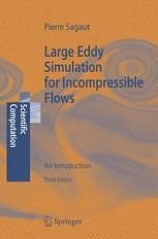
Large Eddy Simulation for Incompressible Flows : An Introduction
First concise textbook on Large-Eddy Simulation, a very important method in scientific computing and engineeringFrom the foreword to the third edition written by Charles Meneveau: ".

IUTAM Symposium on Laminar-Turbulent Transition and Finite Amplitude Solutions
This volume contains refereed papers presented symposium on "Non-Uniqueness of Solutions to the Navier-Stokes equations and their Connection with Laminar-Turbulent Transition" The central objective of the symposium was to discuss the increasing amount of experimental and numerical evidence for finite amplitude solutions to the Navier-Stokes equations and to set the work into a modern theoretical context.
