



الصفحة 1
الصفحة 1

Multi-Source National Forest Inventory : Methods and Applications
The book describes in detail the full MS-NFI process, and the input data used – including field data, satellite images, and digital map data, as well as coarse-scale variation of forest variables. It also presents comprehensive information on the types of outputs which can be derived, including maps and statistics, describing, for example, stock volumes and development, dominant tree species, age-class distribution, and large and small-scale variation. The book will provide an invaluable resource for those involved in forest inventory, including government departments and bodies involved in forest policy, management and monitoring, forest managers, and researchers and graduate students interested in forest inventory, modelling and analysis. It will find an additional market among those interested in Earth observation, ecology and broader areas of environmental and natural resource management.

Interlocal Adaptations to Climate Change in East and Southeast Asia : Sharing Lessons of Agriculture, Disaster Risk Reduction, and Resource Management
This Obook’s main focus is agriculture and natural resource management, disaster risk reduction, and human resource development in the countries of East and Southeast Asia and Japan.

Green economy in the transport sector : A case study of Limpopo Province, South Africa
This book provides policy framework on “towards a Green Economy in the Transport Sector” draws inspiration from the UNEP report on Green Economy Modeling (2014), which focused on South Africa with respect to Transport, Natural Resource Management, Agriculture, and Energy sectors. This is because in the last 10 years natural resources, environmental risks and ecological issues have come to the attention of the international community because the subject is fundamentally important for overarching sustainable growth. It is important to note that environmental problems such as greenhouse gas emissions and climate change in different regions of the world including South Africa result in significant problems.

Fragmentation in Semi-Arid and Arid Landscapes : Consequences for Human and Natural Systems
Exploring the concept of fragmentation, the ecological processes interrupted by fragmentation, and the social consequences of fragmented landscapes, this book presents a timely synthesis on the effects of fragmentation on arid and semi-arid pastoral systems throughout the world. the authors examine how fragmentation occurs, the patterns that result, and the consequences of fragmentation for ecosystems and the people who depend on them. The book will provide a valuable reference for students and researchers in rangeland ecology, park and natural resource management, environmental and ecological anthropology, economics and agriculture.

Forest Policies and Social Change in England
The book stresses how values and perceptions shape policies, and conversely how policies can modify perceptions, and also how policies can fail if they do not take perceptions into account. She concludes that many of the issues facing English forestry in the 21st century – from leisure, health and amenity provision, through education and rural as well as urban regeneration, to biodiversity conservation – go well beyond both national borders and the scope of forestry. This novel synthesis provides a valuable resource for advanced students and researchers from all areas of natural resource studies, including those interested in social history, socio-economics, cultural geography and environmental psychology, as well as those studying landscape ecology, environmental history, policy analysis and natural resource management.

Forest Landscape Ecology : Transferring Knowledge to Practice
Forest Landscape Ecology: Transferring Knowledge to Practice is the first book to introduce landscape ecologists to the discipline of knowledge transfer. The book considers knowledge transfer in general, critically examines aspects of transfer that are unique to forest landscape ecology, and reviews several case studies of successful applications for policy developers and forest managers in North America. Readers are encouraged to recognize the value of sharing their knowledge, and to understand their role in active knowledge transfer. The intent is to connect, as seamlessly and effectively as possible, ecological principles to policy and practice.

Ecosystem Services for Well-Being in Deltas : Integrated Assessment for Policy Analysis
Answers key questions about environment, people and their shared future in deltas. It develops a systematic and holistic approach for policy-orientated analysis for the future of these regions. It does so by focusing on ecosystem services in the world’s largest, most populous and most iconic delta region, that of the Ganges-Brahmaputra delta in Bangladesh. The book covers the conceptual basis, research approaches and challenges, while also providing a methodology for integration across multiple disciplines, offering a potential prototype for assessments of deltas worldwide.
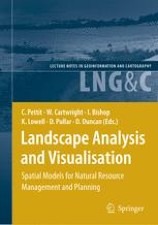
Landscape Analysis and Visualisation : Spatial Models for Natural Resource Management and Planning
This book presents a collection and synthesis of many of these perspectives — perhaps it could only be produced in a land urb- ised in the tiniest of pockets, and yet so daunting with respect to the way non-populated landscapes dwarf its cities. Many travel to Australia to its cities and never see the landscapes — but it is these that give the country its power and imagery. It is the landscapes that so impress on us the need to consider how our intervention, through activities ranging from resource exploitation and settled agriculture to climate change, poses one of the greatest crises facing the modern world. In this sense, Australia and its landscape provide a mirror through which we can glimpse the extent to which our intervention in the world threatens its very existence.
