



الصفحة 1
الصفحة 1

Nature, Value, Duty : Life on Earth with Holmes Rolston, III
"Nature Value and Duty: Life on Earth with Holmes Rolston, III" is a collection of contemporary writings on the work of Holmes Rolston, III. The authors contributing to this volume are a mixture of senior scholars in environmental ethics and new voices in philosophy and in literature. Together they provide an in depth evaluation of many of the topics discussed by Rolston. They probe the strengths and weaknesses of his work and suggest valuable correctives. Rolston himself, in a detailed reply to each of his critics at the end of the volume, reveals where some of these criticisms sting him the most and in the process provides one of the most detailed and articulate defenses of his position ever offered."

Mechanics and natural philosophy before the scientific revolution
This volume deals with a variety of moments in the history of mechanics when conflicts arose within one textual tradition, between different traditions, or between textual traditions and the wider world of practice. Its purpose is to show how the accommodations sometimes made in the course of these conflicts ultimately contributed to the emergence of modern mechanics.

Experiment and Natural Philosophy in Seventeenth-Century Tuscany : The History of the Accademia del Cimento
This work is to counter historiographies that search for the origins of modern science within the experimental practices of Europe’s first scientific institutions, such as the Cimento. It proposes that we should look beyond the experimental rhetoric found in published works, to find that the Cimento academicians were participants in a culture of natural philosophical theorising that existed throughout Europe.
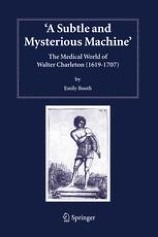
A Subtle and Mysterious Machine : The Medical World of Walter Charleton (1619-1707)
Walter Charleton (1619-1707) has been widely depicted as a natural philosopher whose intellectual career mirrored the intellectual ferment of the ‘scientific revolution’. Instead of viewing him as a barometer of intellectual change, I examine the previously unexplored question of his identity as a physician. Examining three of his vernacular medical texts, this volume considers Charleton’s thoughts on anatomy, physiology and the methods by which he sought to understand the invisible processes of the body.
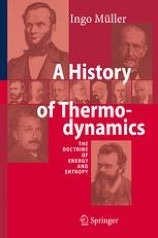
A History of Thermodynamics : The Doctrine of Energy and Entropy
The development of thermodynamics in the second half of the 19th century has had a strong impact on both technology and natural philosophy. It is true that the steam engine for the conversion of heat into work existed before thermodynamics was developed as a branch of physics. However, the systematic theory improved the conversion process, and it succeeded in developing other processes essential to modern life, notably refrigeration and rectification. So, altogether thermodynamics has provided humanity with cheap energy, and cheap fuel, -- consequently with cheap, and abundant, and unspoiled food. Thus thermodynamics has made populations grow, and life expectancy increase beyond anything people could possibly have imagined 200 years ago.
