



الصفحة 1
الصفحة 1

Microflows and Nanoflows : Fundamentals and Simulation
This book provides a comprehensive summary of these changes describing fluid flow in micro and nano configurations. Where as in their previous book entitled Microflows: Fundamentals and Simulation. In this new book they discuss length scales from angstroms to microns (and beyond). While still maintaining the emphasis on fundamental concepts with a mix of semianalytical, experimental, and numerical results, this book outlines their relevance to modeling and analyzing functional devices.

Encyclopedia of Microfluidics and Nanofluidics
Covering all aspects of transport phenomena on the nano- and micro-scale, Springer’s Encyclopedia of Microfluidics and Nanofluidics includes over 750 entries in three alphabetically-arranged volumes including the most up-to-date research, insights, and applied techniques across all areas. Specifically, subjects covered in this comprehensive Springer Reference include electrical double-layers, optofluidics, DNC lab-on-a-chip, nanosensors, and more.

CMOS Biotechnology
"CMOS Biotechnology reviews the recent research and developments joining CMOS technology with biology. Written by leading researchers these chapters delve into four areas including: Microfluidics for electrical engineers / CMOS Actuators CMOS Electrical Sensors CMOS Optical Sensors Bioanalytical instruments have been miniaturized on ICs to study various biophenomena or to actuate biosystems. These bio-lab-on-IC systems utilize the IC to facilitate faster, repeatable, and standardized biological experiments at low cost with a small volume of biological sample. CMOS Biotechnology will interest electrical engineers, bioengineers, biophysicists as well as researchers in MEMS, bioMEMS, microelectronics, microfluidics, and circuits and systems."
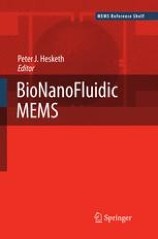
BioNanoFluidic MEMS
BioNanoFluidic MEMS explains nanofabrication and nanomaterials synthesis suitable for the development of biosensors. The fundamentals initiate an awareness for engineers and scientists who would like to develop and implement novel biosensors for various applications. In addition, the material covered includes: BioNanoFluidic MEMS connection between the interdisciplinary nature of BioNanoFluidics and MEMS BioNanoFluidics and sensor technology including Micro-Mechanical Sensors and Chemical Sensor Technologies ands-on steps for implementation of biosensor fabrication including a discussion of the clean room lithography process and etching, microsensor systems lamination, PDMS moulding, parylene deposition, and others Interconnection between the interdisciplinary nature of BioNanoFluidics and MEMS BioNanoFluidics and sensor technology including Micro-Mechanical Sensors and Chemical Sensor Technologies
