



الصفحة 1
الصفحة 1

Mountains : Sources of Water, Sources of Knowledge
This book addresses the major challenges in assuring globally sustainable water use. Paradoxically, water resources have been identified both as too plentiful, producing major disasters, and increasingly vulnerable to shortages. Addressing both of these aspects requires attention to physical hydrological processes as well as human activities that affect water supply and demand.

International conference on terrain and geohazard challenges facing onshore oil and gas pipelines : Evaluation, routing, resign, construction, operation ; Proceedings of a three day international conference on terrain and geohazard challenges facing onshore oil and gas pipelines, organised by the Institution of Civil Engineers in association with BP Exploration and held at the Institution of Civil Engineers, London, UK, on 2 – 4 June 2004
To access global oil and gas deposits, major pipelines must traverse remote regions with extreme terrains. There are a significant number of pipeline projects, active or planned, in tropical jungles, mountains and deserts, in permafrost and in areas of wetland. Each of these natural environments is associated with a range of geohazards, which may include landslides, soil erosion, karst, river migration, and seismic or volcanic activity. At the same time, society demands increasing availability and reliability of supply, together with improved environmental standards, all making for substantial challenges.

Hypoxia and Exercise
The 14th volume in the series will focus on cutting edge research at the interface of hypoxia and exercise. The work will cover the range from molecular mechanisms of muscle fatigue and muscle wasting to whole body exercise on the world’s highest mountains. State of the art papers on training at high altitude for low altitude athletic performance will also be featured.

High mountain conservation in a changing world
This book aims to provide case studies and a general view of the main processes involved in the ecosystem shifts occurring in the high mountains, and to analyse the implications for nature conservation. Although case studies from the Pyrenees are preponderant, conclusions are aimed at any mountain range surrounded by highly populated lowland areas. The chapters give emphasis to approaches from environmental geography, functional ecology, biogeography, and paleoenvironmental reconstructions. The introductory and closing chapters summarize the main challenges that nature conservation may face in mountain areas under the environmental shifting conditions.

Environmental Geotechnics
A guide to aid engineers in applying geotechnical principles, processes and techniques in a way that will not only reduce their environmental impact but should benefit the environment. The major construction-environment interface is geotechnical in nature. For engineers to be able to foresee environmental problems and modify construction projects, or derive novel approaches, to prevent negative impacts from their works, they need a thorough knowledge of their subject and a constant awareness of the pollution-output' of any construction operation.

Embedded computer systems : Architectures, modeling, and simulation ; Vol. 3553 ; 5th International Workshop, SAMOS 2005, Samos, Greece, July 18-20, Proceedings
The SAMOS workshop is an international gathering of highly quali?ed researchers from academia and industry, sharing in a 3-day lively discussion on the quiet and - spiring northern mountainside of the Mediterranean island of Samos. As a tradition, the workshop features workshop presentations in the morning, while after lunch all kinds of informal discussions and nut-cracking gatherings take place. The workshop is unique in the sense that not only solved research problems are presented and discussed but also (partly) unsolved problems and in-depth topical reviews can be unleashed in the sci- ti?c arena. Consequently, the workshop provides the participants with an environment where collaboration rather than competition is fostered. The earlier workshops, SAMOS I–IV (2001–2004), were composed only of invited presentations. Due to increasing expressions of interest in the workshop, the Program Committee of SAMOS V decided to open the workshop for all submissions. As a result the SAMOS workshop gained an immediate popularity; a total of 114 submitted papers were received for evaluation. The papers came from 24 countries and regions: Austria (1), Belgium (2), Brazil (5), Canada (4), China (12), Cyprus (2), Czech Republic (1), Finland (15), France (6), Germany (8), Greece (5), Hong Kong (2), India (2), Iran (1), Korea (24), The Netherlands (7), Pakistan (1), Poland (2), Spain (2), Sweden (2), T- wan (1), Turkey (2), UK (2), and USA (5). We are grateful to all of the authors who submitted papers to the workshop.
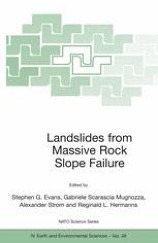
Landslides from Massive Rock Slope Failure
Amongst the thematic topics discussed are global frequency, impacts on society, analysis of initial rock slope failure, monitoring of rock slope movement, analysis and modeling of post-failure behaviour, volcanic landslides, and influences of massive rock slope failure on the geomorphological evolution of mountain regions. Regional contributions include reports on rockslides and rock avalanches in Norway, western Canada, the Andes of Argentina, the Karakoram Himalaya, the European Alps, the Appennines, and the mountains of Central Asia.

Atlas of seeds and fruits of Central and East-European Flora : The carpathian mountains region
The Carpathian flora occurs not only in the Carpathian Mountains, but also in large lowlands extending towards the south, north and east and involves introduced and invading flora of more than 7,500 species. Since the morphological characteristics of the seeds are usually constant they are very important for determination of systematic units. The present atlas of seeds with nearly 4,800 seed illustrations is supplemented with detailed seed descriptions, brief plant descriptions, locality and the native source of plants. This publication is unique, both in its extent – with so many plant seeds from such a wide-ranging region - and in the form of its presentation – with such detailed descriptions.

An Introduction to Global Spectral Modeling
Numerical weather prediction is receiving increased attention as weather forecasters aim to improve the numerical models used to forecast the weather. This is a textbook on global spectral modeling, which is an important component for global weather forecasts at numerous operational centers. This book covers all areas of model development including numerical analysis, treatment of clouds, mountains, radiation, precipitation processes, and the surface layers over land and the ocean. The objectives of this book are to provide a systematic and sequential background for students, researchers, and operational weather forecasters in order to develop comprehensive weather forecast models. This is designed for a one semester introductory graduate level course on weather prediction methodologies. As a prerequisite it requires a basic background in meteorology, applied mathematics, and numerical analysis.
