



الصفحة 1
الصفحة 1

Introduction to Structural Analysis
Covers the principles of structural analysis without any requirement of prior knowledge of structures or equations. Beginning with basic principles of equilibrium of forces and moments, all other subsequent theories of structural analysis have been discussed logically. Divided into two major parts, this book discusses the basics of mechanics and principles of degrees of freedom upon which the entire paradigm rests, followed by analysis of determinate and indeterminate structures. The energy method of structural analysis is also included.

High performance concrete optimal composition design
Presents experimental and theoretical results allowing production of special high-strength rapid hardening concrete and fiber reinforced concrete. It describes a method for effective proportioning of high-strength fast-setting concrete and fiber reinforced concrete with high dynamic strength as well as selecting proper technological parameters, methodology for design of reinforced concrete structures using such concrete. Particular attention is paid to ensuring the early strengthening of concrete within 24 hours after casting and to constructing structures with limited energy resources at the site.
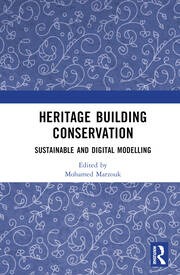
Heritage building conservation : Sustainable and digital modelling
Covers: The technology used to digitally document heritage buildings, including LIDAR, photogrammetry, Heritage Building Information Modelling (HBIM), and Virtual Reality (VR) technologies Introducing a Maintainability Index of Heritage Buildings (MIHB) to support the decision-making and prioritization process for the maintenance of heritage buildings The adaptive reuse of heritage buildings Modelling embodied and operational energy performance Using Chatbot and Blockchain technology to support the management and preservation of heritage buildings Ultimately, this book presents a useful tool for use in heritage management and highlights how the reusability of heritage buildings is critical to the creation and survival of sustainable communities.

Handbook on Tunnels and Underground Works ; Vol.1 : Concept – Basic Principles of Design
Provides a new, global, updated, thorough, clear and practical risk-based approach to tunnelling design and construction methods, and discusses detailed examples of solutions applied to relevant case histories. It provides the following features and benefits: updated vision on tunnelling design, tools, materials and construction balanced mix of theory, technology and applied experience different and harmonized points of view from academics, professionals and contractors easy consultation in the form of a handbook risk-oriented approach to tunnelling problems.

Fundamentals of Sustainability in Civil Engineering
Provides a foundation to understand the development of sustainability in civil engineering, and tools to address the three pillars of sustainability: economics, environment, and society. It includes case studies in the five major areas of civil engineering: environmental, structural, geotechnical, transportation, and construction management.

Fundamentals of durable reinforced concrete
The book presents a framework for specification through internationally adopted codes and standards and summarises the background to probabilistic approaches to durability design, providing a state-of-the-art review of mathematical modelling of deterioration mechanisms along with current directions in test methods for performance-based specifications.

Examples in Structural Analysis
This code-independent and comprehensive collection of fully worked and graded examples shows undergraduates how to analyse different types of structure, with the main analysis techniques, with some detailed mathematics. Now with pin-jointed frames and arches and cables, with more on the direct stiffness method and influence lines for beams.

Evolution, Monitoring and Predicting Models of Rockburst : Precursor Information for Rock Failure
Focuses on investigating predicting precursor information and key points of rockburst in mining engineering through laboratory experiment, theoretical analysis, numerical simulation and case studies. Understanding the evolution patterns for the microstructure instability of rock is a prerequisite for rockburst prediction. The book provides a guide for readers seeking to understand the evolution patterns for the microstrucure of rock failure, the predicting key point of rock failure and the rockburst predicting model. It will be an essential reference to understand mechanism of rockburst and sheds new light on dynamic disasters prediction. Chapters are carefully developed to cover (1) The evolution patterns for the microstructure instability of rock; (2) Rockburst hazard monitoring and predicting criterion and predicting models. The book addresses the issue with a holistic and systematic approach that investigates the occurrence mechanism of rockburst based on the evolution patterns for the microstructure of rock failure and establishes the predicting model of rockburst.

Engineering Geology for Underground Rocks
This book clearly and systematically explains underground engineering geology principles, methods, theories and case studies, depicts engineering problems in underground rock engineering and how to study and solve them. It specially emphasizes mechanical and hydraulic couplings in rock engineering for wellbore stability, mining near aquifers and other underground structures where inflow is a problem. Using the methods and models given in this book, the reader is able to analyse underground geological engineering problems and also for the design of underground structures.

Eco-design of buildings and infrastructure : developments in the period 2016–2020
Reviews the second five-year sequence of the Chair, first presenting methodological advances in eco-design: life cycle assessment and quantification of uncertainties; local environmental impacts of transport and biodiversity. The interdisciplinary partnership, also associating the human sciences, shows its interest in taking into account the human factor in the modelling of urban systems. This modelling is based on several numerical simulation tools, presented in the third part.

Design of industrial structures : Reinforced cement concrete and steel
Bridges the gap between academic and professional field pertaining to design of industrial reinforced cement concrete and steel structures. It covers pertinent topics on contracts, specifications, soil survey and design criteria to clarify objectives of the design work. Further, it gives out guiding procedures on how to proceed with the construction in phases at site, negotiating changes in equipment and design development. Safety, quality and economic requirements of design are explained with reference to global codes. Latest methods of analysis, design and use of advanced construction materials have been illustrated along with a brief on analysis software and drafting tool.

Design and Performance of Underground Excavations : ISRM Symposium — Cambridge, U.K., 3–6 September 1984
These proceedings contain the papers presented at the ISRM-sponsored Symposium "The Design and Performance of Underground Excavations" held at Cambridge in England on 3-6 September, 1984. The major themes of the Symposium "Design, Construction and Performance" are addressed by plenary and specialist sessions papers concerning both civil and mining engineering.With contributions from twenty countries, this volume is a rich source of theory and experience for the researcher and practical engineering alike.

Corrosion of Steel in Concrete : Understanding, Investigation and Repair
A guide for designing, constructing and maintaining reinforced concrete structures, such as buildings and bridges which are subject to reinforcement corrosion. It presents the basics of theory and practice in steel corrosion in concrete and reviews the latest research and developments, such as progress on measuring the corrosion threshold for chloride-induced corrosion.

Construction and Building Automation : From Concepts to Implementation
Intended to be used as a textbook in undergraduate civil engineering and construction courses to introduce cutting edge mechanical, electrical and computer science topics that are needed for civil and construction engineers to collaborate in inter-disciplinary automation projects. Introduces hardware and software needed for automating engineering tasks ; Presents examples of applications in the control of building systems ; Illustrates of the use of automation for improving construction processes ; Provides a lucid introduction to advanced computing concepts, machine learning, artificial intelligence, and control algorithms to construction and engineering students.
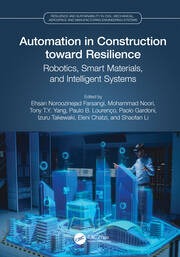
Automation in construction toward resilience : Robotics, smart materials and intelligent systems
Presents all aspects of automation in construction pertaining to the use of information technologies in design, engineering, construction technologies, and maintenance and management of constructed facilities. The broad scope encompasses all stages of the construction life cycle from initial planning and design, through the construction of the facility, its operation, and maintenance, to the eventual dismantling and recycling of buildings and engineering structures
