



الصفحة 1
الصفحة 1

Official Statistics 4.0 : Verified Facts for People in the 21st Century
Explores official statistics and their social function in modern societies. Digitisation and globalisation are creating completely new opportunities and risks, a context in which facts (can) play an enormously important part if they are produced with a quality that makes them credible and purpose-specific. In order for this to actually happen, official statistics must continue to actively pursue the modernisation of their working methods.

Non-Equilibrium Social Science and Policy : Introduction and Essays on New and Changing Paradigms in Socio-Economic Thinking
The overall aim of this book, an outcome of the European FP7 FET Open NESS project, is to contribute to the ongoing effort to put the quantitative social sciences on a proper footing for the 21st century. A key focus is economics, and its implications on policy making, where the still dominant traditional approach increasingly struggles to capture the economic realities we observe in the world today - with vested interests getting too often in the way of real advances.Insights into behavioral economics and modern computing techniques have made possible both the integration of larger information sets and the exploration of disequilibrium behavior

Inclusion and Psychological Intervention in Schools : A Critical Autoethnography
This book consists of a number of case studies about interventions in schools to promote the inclusion of pupils referred to a local authority Educational Psychology Service (EPS) in the north of England. The aim is to provide accounts which do not shirk from describing ‘failures’ as well as ‘successes’ and which reflect the general ‘messiness’ of this kind of work. They are written as ‘stories’ from the point of view of an educational psychologist who regards himself as a critical reflective practitioner whose professional practice is grounded in a democratic, inclusive philosophy.

Handbook of transdisciplinary research
Transdisciplinary research (TR) is an emerging field of research in the knowledge society.This handbook provides, for the first time, a structured overview of the manifold experiences gained in these fields. Twenty-one projects from all over the world present their research approaches, structured along the three phases of a TR project.

Doing Cross-Cultural Research : Ethical and Methodological Perspectives
Conducting cross-cultural research is rife with methodological, ethical and moral challenges. Researchers are challenged with many issues in carrying out their research with people in cross-cultural arenas. In this book, I attempt to bring together salient issues for the conduct of culturally appropriate research. The task of undertaking cross-cultural research can present researchers with unique opportunities, and yet dilemmas. The book will provide some thought-provoking points so that our research may proceed relatively well and yet ethical in our approach. The subject of the book is on the ethical, methodological, political understanding and practical procedures in undertaking cross-cultural research.

Differential Undercounts in the U.S. Census : Who is Missed?
This book describes the differences in US census coverage, also referred to as “differential undercount”, by showing which groups have the highest net undercounts and which groups have the greatest undercount differentials, and discusses why such undercounts occur. In addition to focusing on measuring census coverage for several demographic characteristics, including age, gender, race, Hispanic origin status, and tenure, it also considers several of the main hard-to-count populations, such as immigrants, the homeless, the LBGT community, children in foster care, and the disabled. However, given the dearth of accurate undercount data for these groups, they are covered less comprehensively than those demographic groups for which there is reliable undercount data from the Census Bureau. This book is of interest to demographers, statisticians, survey methodologists, and all those interested in census coverage.

Design of Observational Studies
This book introduction to statistical inference in observational studies and a detailed discussion of the principles that guide the design of observational studies. An observational study is an empiric investigation of effects caused by treatments when randomized experimentation is unethical or infeasible. Observational studies are common in most fields that study the effects of treatments on people, including medicine, economics, epidemiology, education, psychology, political science and sociology. The quality and strength of evidence provided by an observational study is determined largely by its design. Design of Observational Studies is organized into five parts. Chapters 2, 3, and 5 of Part I cover concisely many of the ideas discussed in Rosenbaum’s Observational Studies. Part II discusses the practical aspects of using propensity scores and other tools to create a matched comparison that balances many covariates, and includes an updated chapter on matching in R. In Part III, the concept of design sensitivity is used to appraise the relative ability of competing designs to distinguish treatment effects from biases due to unmeasured covariates. Part IV discusses evidence factors and the computerized construction of more than one comparison group. Part V discusses planning the analysis of an observational study, with particular reference to Sir Ronald Fisher’s striking advice for observational studies: "make your theories elaborate."
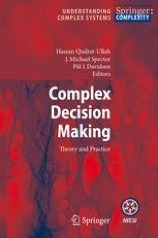
Complex decision making : Theory and practice
The increasingly complex environment of today's world, characterized by technological innovation and global communication, generates myriads of possible and actual interactions while limited physical and intellectual resources severely impinge on decision makers, be it in the public or private domains. At the core of the decision-making process is the need for quality information that allows the decision maker to better assess the impact of decisions in terms of outcomes, nonlinear feedback processes and time delays on the performance of the complex system invoked.

Analisi di Rasch e questionari di misura : Applicazioni in medicina e scienze sociali = Rasch analysis and measurement questionnaires: Applications in medicine and social sciences
Evaluation questionnaires are the most used tools nowadays in the field of medicine and the human sciences to evaluate variables such as disability, altruism or pain. However, clinicians are often unfamiliar with these tools. What do they really measure? How are the results to be interpreted? This book tries to answer these questions.
